Annual Research Expenditures
Nationally in Atmospheric Science & Meteorology Funding
NSF HERD Survey
Nationally in NIH Funding
Blue Ridge Institute for Medical Research
Universities Granted Utility Patents
National Academy of Inventors
OVPRP’s impact-focused research strategy is anchored in four key areas

Oklahoma faces some of the most persistent health challenges in the country, and no single discipline is going to solve them. Our health research strategy draws on the full breadth of team science, working alongside our clinical partners, to drive life-saving research across cancer, diabetes, neuroscience, maternal and pediatric health, and more.

Oklahoma sits at the center of some of the most complex and severe weather patterns on the planet. Our weather research strategy draws on the full strength of the National Weather Center and our atmospheric science expertise to lead innovation in forecasting, risk reduction, and community resilience.
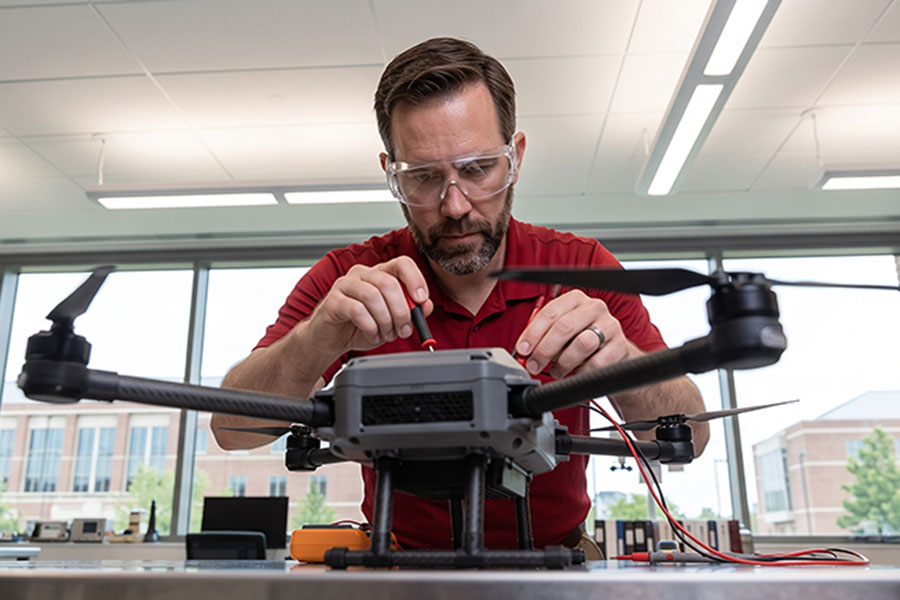
Oklahoma is home to a long-standing, deeply embedded aerospace and defense ecosystem, and few places can move research from concept to application as quickly. Home to major federal installations, world-class sustainment and logistics capabilities, and a growing network of industry partners, OU is advancing innovation, workforce development, and operational readiness for the nation’s warfighters.

Oklahoma has a deep legacy in domestic energy, and few states are better equipped to shape what comes next. Our energy research strategy draws on that legacy to lead advances in subsurface energy systems, critical minerals, carbon management, grid resilience, and next-generation energy technologies.
A newly funded study at the University of Oklahoma aims to increase prostate-specific antigen (PSA) screening among Black men in Oklahoma, who die from prostate cancer at rates two to four times higher than other racial groups.
Young adults who want to quit vaping may turn to social media for support, but keeping them engaged with digital cessation programs over time can be challenging. A University of Oklahoma researcher is testing whether adding support from trained peers can help keep young adults engaged as they try to quit vaping.
The University of Oklahoma, partnering with the state of Oklahoma and academic and industry partners, has received funding from the U.S. National Science Foundation to build the nation’s first integrated platform for recovering critical minerals from existing oil and gas wells.