NEWS

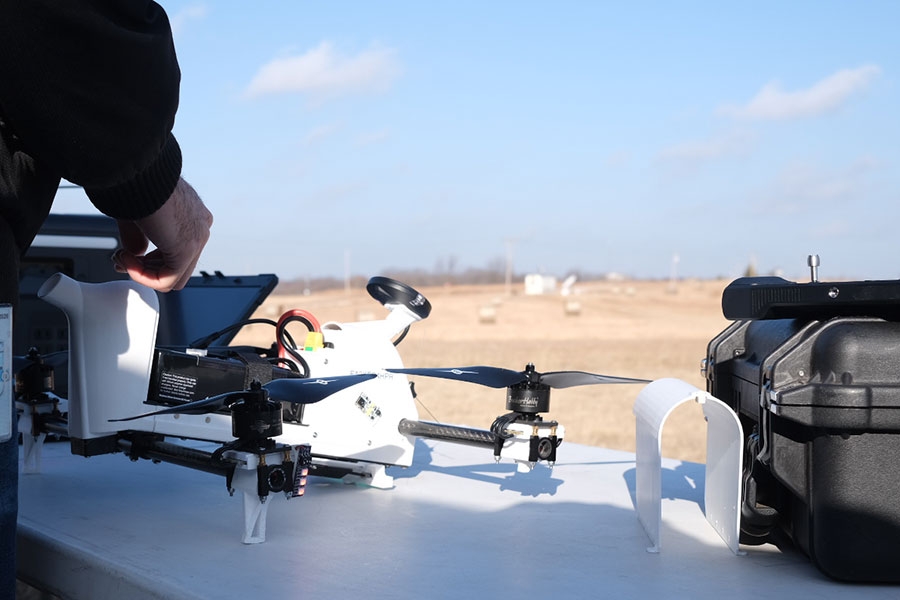
NORMAN, Okla. – This past December, a group of National Weather Center researchers arrived on a McClain County farm. Sending a sleek drone thousands of feet into the air, the team gathered data on the atmospheric boundary layer it traveled through before returning back down to its orange launch pad on the rolling hills.
As the first of several flights that day, the drone launch kicked off a groundbreaking project to improve short-term weather forecasting. The 3D Mesonet system is testing technology to gather spatiotemporal atmospheric data more frequently than ever before in the United States. This approach will allow scientists to better predict short-term, high-impact weather, like thunderstorms, severe winds and winter precipitation.
The National Oceanic and Atmospheric Administration (NOAA)’s National Mesonet Program recently awarded the Oklahoma Climatological Survey (OCS), a University of Oklahoma research unit, with a contract to develop the 3D Mesonet system. OCS director Chris Fiebrich said that his group is utilizing the Oklahoma Mesonet’s statewide network of monitoring stations to launch a fleet of uncrewed aerial systems (UAS) – or drones.
“Over the last 10 years, we've worked with scientists at the National Weather Center to make over a thousand flights at our Mesonet stations,” said Fiebrich, who is also a professor in OU’s School of Meteorology. “We're very proud of that rich history because a lot of other state Mesonets want to get into this UAS arena.”
Those flights have used technology developed by the Cooperative Institute for Severe and High-Impact Weather Research and Operations (CIWRO), which is headquartered at OU and promotes collaboration between the university and NOAA. The latest design, known as the CopterSonde-SWX, is being used in weekly flights at the Kessler Atmospheric and Ecological Field Station (KAEFS) in McClain County.
While the Oklahoma Mesonet’s 10-meter towers collect typical weather station data such as wind speed and relative humidity, drones near these towers can reach further into the atmospheric boundary layer. Using their sensors to gather and send real-time data to researchers, the drones can explore what Fiebrich said are historically unmeasured parts of the atmosphere.
They can also be launched more often than weather balloons, which are only deployed twice a day.
“Perhaps we're on the morning of a day when we know there's tornado potential in the afternoon,” Fiebrich said. “Being able to take these UAS flights, perhaps every hour, might help us have a better idea of when those convective storms will initiate and exactly what part of the state they will initiate in.”
He added that the drones could also help predict hazardous winter weather better than existing forecasting models by providing frequent boundary layer readings.
“Living in Oklahoma, we don’t always know whether precipitation is going to be freezing rain, sleet or snow,” Fiebrich said. “We see a lot of potential for these UAS profiles to help us understand how temperatures are evolving at different levels. Small changes in the temperature profile can make the difference between a snow event and a freezing rain event.”
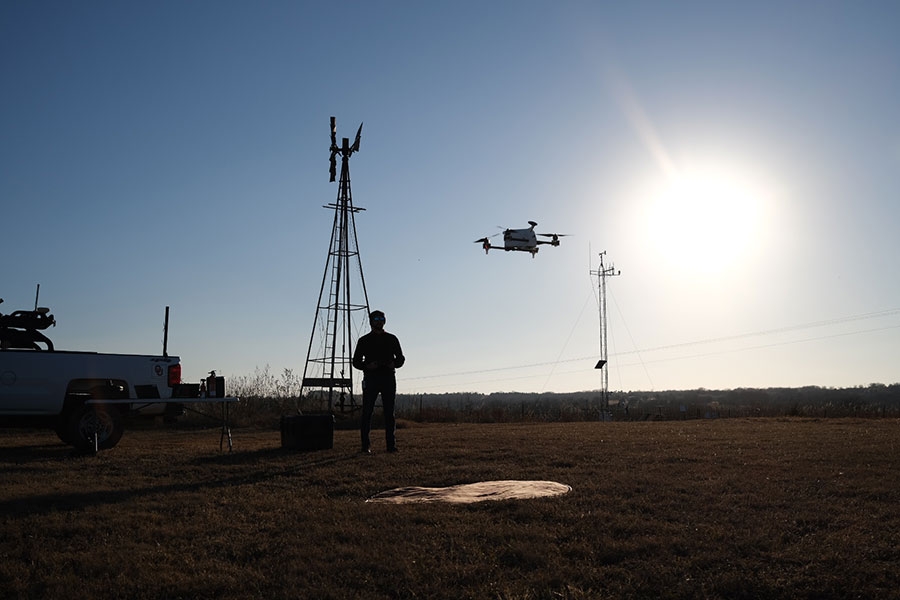
The 3D Mesonet team, which is led by Cindy Luttrell of the Oklahoma Mesonet, Tyler Bell of the School of Meteorology and Tony Segales of CIWRO, is sending the KAEFS test flight data to NOAA’s National Weather Service. Fiebrich said that makes Oklahoma the first state to deliver these types of atmospheric profiles through the National Mesonet Program.
As drone launches continue through early April, the researchers aim to increase flight frequency to hourly deployments. Fiebrich calls the project “quasi-operational,” meaning it’s not quite as automated as the Mesonet’s 10-meter towers, which record data every five minutes. He said the end goal within the next few years is to send the drones up across multiple Oklahoma Mesonet sites without needing a pilot and observer on site.
While the project will need a new contract to continue after April, Fiebrich said the work his team is doing is already having an impact.
“There's a lot of excitement for this project to lay the groundwork for other states across the U.S. to begin these types of activities.”
About the University of Oklahoma
Founded in 1890, the University of Oklahoma is a public research university located in Norman, Oklahoma. As the state’s flagship university, OU serves the educational, cultural, economic and health care needs of the state, region and nation. For more information about the university, visit www.ou.edu.
From strengthening severe-weather preparedness to advancing national security, MITRE and the University of Oklahoma (OU) are joining forces to tackle some of the nation’s most critical challenges.
Desiree Hill was an executive producer at News 9 when the Oklahoma City bombing put local journalists in the middle of a story they would carry with them long after the coverage ended. Years later, she returned to the bombing as a researcher, interviewing journalists about its effects on their lives and work.
Jensen Moore, Ph.D., an associate professor of public relations at the University of Oklahoma’s Gaylord College of Journalism and Mass Communication, has been elected to a three-year term on the Association for Education in Journalism and Mass Communication’s Standing Committee on Professional Freedom and Responsibility.