NEWS


NORMAN, Okla. – Newly published research in Science Advances, led by Jessica Cerezo-Román, at the University of Oklahoma, documents the oldest known cremation in Africa and provides some of the earliest evidence for intentional cremation using a pyre in the world. The study sheds new light on the mortuary practices of a 9,500-year-old hunter-gatherer community in central Africa, revealing them to be far more sophisticated and complex than previously thought.
About 9,500 years ago, a community of hunter-gatherers in central Africa cremated a small woman on an open pyre at the base of Mount Hora, a prominent natural landmark in northern Malawi. It is the first time this behavior has been documented in the African hunter-gatherer record and represents the world's oldest known in situ cremation pyre – an intentionally built structure for burning a body – containing an adult.
"This study brings together a robust dataset with a strong theoretical framework to reconstruct this very important event," said Cerezo-Román, Associate Professor of Anthropology and leading expert on the study of burned and fragmented human remains in the US. "We can get at the humanity of these people by reconstructing this spectacular ritual that followed this woman's death."
The research, coauthored by an international team based in the United States, Africa and Europe, demonstrates that the mortuary and other social behaviors of ancient African foragers were considerably more complex than previously understood.
"Cremation is very rare among ancient and modern hunter-gatherers, at least partially because pyres require a huge amount of labor, time, and fuel to transform a body into fragmented and calcined bone and ash," Cerezo-Román explained.
The oldest evidence for an in situ pyre dates to about 11,500 years ago from the Xaasaa Na’ (Upward Sun River) archaeological site in Alaska and contains the remains of a child about three years old. Prior to the discovery of the pyre at Mount Hora, the first definitive cremations in Africa appear around 3,500 years ago in eastern Africa and were associated with Pastoral Neolithic herders. “In the African archaeological record, cremation is associated with food producing societies,” says coauthor and bioarchaeologist Dr. Elizabeth Sawchuk of the Cleveland Museum of Natural History. “Not only was it surprising to find a nearly 10,000-year-old cremation pyre built by hunter-gatherers, the sheer scale of the cremation event was also a shock.”

Using archaeological, geospatial, forensic and bioarchaeological methods, including microscopic examination of the pyre sediments and detailed analysis of the human bone fragments, the research team reconstructed the extraordinary sequence of events surrounding the cremation in unprecedented detail.
The research team analyzed 170 highly fragmented and thermally altered human bone fragments—mostly from arms and legs—using cutting-edge methods. Combining spatial analysis of the site, examination of the pyre matrix and its contents, and evidence from the bones themselves allowed the team to reconstruct the specifics of the unique event.
The findings revealed that the individual was a small adult female between 18 and 60 years old and just under five feet tall. Her bones and the patterns of thermal alteration showed her body was cremated prior to decomposition, probably within a few days of her death.
Her bones exhibited cutmarks from stone tools consistent with both disarticulation—the separation of bones at the joint—and defleshing, indicating that her body was prepared for cremation. Some parts of her body appear to have been removed – the team found no evidence of her skull.
"These hands-on manipulations, cutting flesh from the bones and removing the skull, sound very gruesome, but there are many reasons people may have done this associated with remembrance, social memory, and ancestral veneration," said Cerezo-Román. "There is growing evidence among ancient hunter-gatherers in Malawi for mortuary rituals that include posthumous removal, curation, and secondary reburial of body parts, perhaps as tokens."
Based on the ash mound roughly the size of a queen bed, the pyre required major effort and fuel to construct. Mourners would have had to gather at least 30 kilograms or over 60 pounds of deadwood and grass, pointing toward significant communal effort, the researchers said.
Participants actively disturbed the fire and continually added fuel to sustain high temperatures, according to the microscopic analysis of ash sediments and bone fragments. Differences in the degree of burning observed on the bones demonstrates manipulation of the body during the cremation process, indicating active attendance at the pyre. Evidence suggests the blaze reached temperatures greater than 500°C.
Discovery of stone tools within the pyre suggest they were either added to or embedded within the burning remains, perhaps as funerary objects.
The cremation site, Hora 1, is under an overhang at the base of a granite inselberg (a large rocky hill or mountain) that rises several hundred feet from the surrounding plain. Archaeological research in the 1950s revealed that the site was used as a hunter-gatherer burial ground, but how long ago remained unknown.
Work by senior author Jessica Thompson, an Assistant Professor of Anthropology at Yale University who leads a long-term research project at the site in collaboration with the Malawi Department of Museums and Monuments, showed that people first inhabited the site about 21,000 years ago. The site was used for burials between about 16,000 and 8,000 years ago, but all other people were buried in a complete, unburned state. By contrast, the cremation pyre from approximately 9,500 years ago contained a single highly fragmented individual. There is no evidence of anyone else being cremated at the site before or after.
The team also found evidence that about 700 years before the pyre event, people had already begun building large fires at that location. This continued for 500 years after the cremation event with multiple additional large fires lit atop the pyre ash. Although no one else was cremated, this suggests that people remembered the pyre's location and recognized its ongoing significance. The findings revealed that the community returned repeatedly to the same site, indicating a strong cultural connection to the landscape.
The history of large fires in this location, the effort associated with the cremation, and the subsequent burning events all point towards a deep-rooted tradition at the site linked to ritual behavior and memory-making tied to an important local landmark.
While the cremation process is now clear, the motivation behind the event remains mysterious.
"Why was this one woman cremated when the other burials at the site were not treated that way?" Thompson said. "There must have been something specific about her that warranted special treatment."
Cerezo-Román said that while this event remains highly unusual, the case adds to growing evidence for greater social complexity in ancient African hunter-gatherer communities than previously thought. This study challenges other researchers to re-examine the African archaeological record, and consider why small-scale societies may have engaged in this kind of labor-intensive behavior.
"From the ashes and bone fragments, we're recovering the stories of people long forgotten," said Cerezo-Román.
About the University of Oklahoma
Founded in 1890, the University of Oklahoma is a public research university located in Norman, Oklahoma. As the state’s flagship university, OU serves the educational, cultural, economic and health care needs of the state, region and nation. For more information about the university, visit www.ou.edu.
The University of Oklahoma has received a transformative gift from Jon and Shannon McCartney, which will name the McCartney Family Tunnel of Champions, the McCartney Family Gate of the Gaylord Family - Oklahoma Memorial Stadium and the McCartney Family Grand Lecture Hall in the Michael F. Price College of Business. The gift will also support the Inspiring Champions and the Athletic Director’s Discretionary Fund, in addition to establishing the McCartney DFW Career Trek program at Price College.
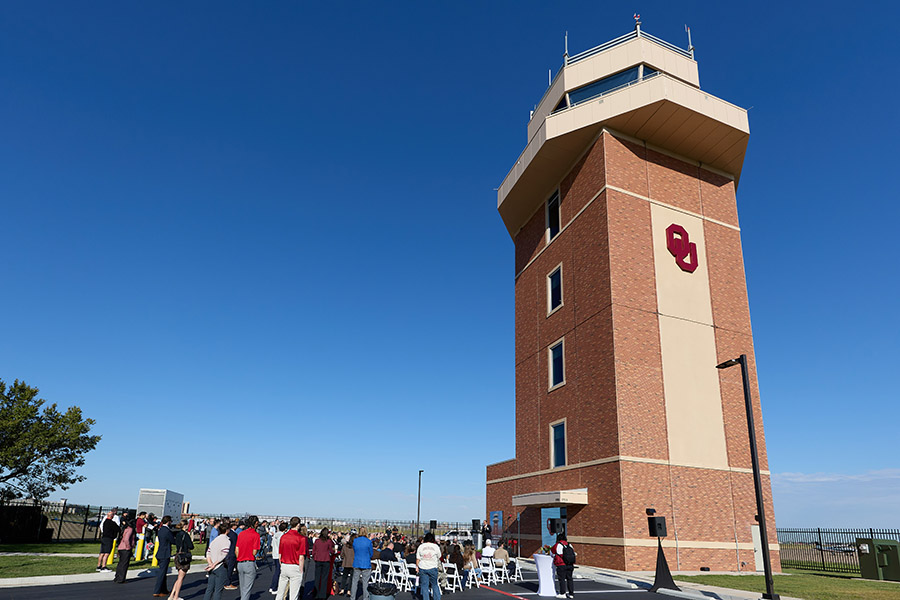
The University of Oklahoma today celebrated the opening of a new air traffic control tower at the OU Max Westheimer Airport. Standing 106 feet tall, more than double the current 52-foot facility, the new tower will modernize air traffic control operations and improve safety for pilots and students operating in the airspace.
Do I buy groceries or pay the electric bill? Should I pawn some of my belongings to afford my prescription? My child is sick, so I will have to miss work to take care of him. Those are just a few of the difficult choices that OU-Tulsa health professional students confronted during the Community Access to Resources Experience. The role-playing activity challenged students to navigate the financial, family and other pressures that can affect a person’s health and ability to follow medical advice. Held annually during the SCM Institute orientation week, the experience is designed to generate understanding and build empathy.