NEWS


NORMAN, Okla. – Scott Salesky, a researcher with the University of Oklahoma, has been awarded funding from the U.S. Department of Defense (DoD) to study how clouds above the sea surface are created and changed by factors such as airborne particles and atmospheric instability. His team is using advanced computer simulations to determine how these factors influence processes like solar radiation and rainfall. Through this research, they aim to improve civilian and military weather forecasting models.
Clouds in the marine atmospheric boundary layer (MABL), particularly those in its lowest level, are influenced by a variety of processes taking place between the ocean’s surface and the atmosphere. These turbulent interactions involve heat, water vapor and aerosols that influence cloud morphology, which in turns impacts cloud coverage and the climate. However, there is great uncertainty on how exactly these turbulent processes contribute to cloud formation.
Salesky’s research team will address these unknowns by using simulations to replicate turbulence and test how different environmental conditions shape the MABL and its clouds. Salesky, who is an associate professor in the College of Atmospheric and Geographic Sciences’ School of Meteorology, said that MABL fluctuations have significant impacts on weather conditions: stratocumulus clouds in the layer cover around 20% of Earth’s surface, making them the dominant cloud type.
“Clouds are really crucial for understanding and predicting precipitation and severe weather, Salesky said. “If you slightly change the amount of cloud cover or cloud thickness, that changes radiative feedbacks and has major implications for Earth's climate system.”
The researchers are specifically looking at how buoyancy, wind speeds and aerosol properties affect the MABL and its associated cloud structures. To accomplish this, they’re using models that simulate both turbulent eddies – which are swirling air motions that range from around 10 meters to a kilometer in size – and the small-scale interactions within turbulence. Those complex simulations also track individual particles and droplets, allowing the team to see how they are influenced by varying conditions.
“If you have a very polluted environment, you have a high aerosol number concentration,” Salesky said. “You end up with many cloud droplets, but they tend to be a lot smaller. This causes what we call higher albedo in the cloud, meaning that it reflects more sunlight back to space. And because cloud droplets are so small, this tends to inhibit rain formation. So, you can get very cloudy conditions, but it won't necessarily precipitate.”
However, in a clean environment, “you have fewer aerosols,” he said, “which result in fewer, but larger cloud droplets whose properties are more strongly influenced by turbulence.”
Salesky’s project team is among more than two dozen groups – four of which are led by OU researchers – to earn funding through the DoD’s Defense Established Program to Stimulate Competitive Research (DEPSCoR) 2024 Research Collaboration competition. DEPSCoR aims to strengthen higher education research infrastructure in underutilized U.S. states and territories. Through the competition, projects are awarded in areas associated with DoD initiatives.
The study’s findings will not only shed light on how interactions between turbulence, microphysics and aerosols impact the MABL but will also improve knowledge of how shallow marine clouds affect radiation. Salesky said that there is limited research that systematically explores how instability, aerosol properties and other factors impact different cloud regimes, or cloud types. His team’s simulations will advance understanding of precipitation, severe weather and the climate.
Salesky added that the project has military applications. “The Navy have their own weather forecasting models, and they do a lot of work to improve their parameterizations,” he said. “Things like visibility through clouds and fog are a very big deal for them.”
In addition to his DEPSCoR-funded research, Salesky is also working on other research into cloud turbulence through a grant from the National Science Foundation. He hopes to apply his work in that project – determining how to best represent small-scale interactions in simulations – to his newer study.
“There's a quote, perhaps apocryphal, from physicist and Nobel laureate Richard Feynman who called turbulence ‘the most important unsolved problems of classical physics,’” Salesky said. “It’s just a very rich area of physics, and there’s a lot we can learn. It’s always exciting to do these sort of idealized studies that help us understand the physics better, but also have real-world implications."
About the research
“Cloud Morphology in the Marine Boundary Layer: Exploring Interactions between Turbulence, Aerosols, and Microphysics” is funded by a $469,746 grant from the Department of Defense, Award No. FA95502510374. It began in Sept. 2025 and is expected to end in Sept. 2028.
About the University of Oklahoma
Founded in 1890, the University of Oklahoma is a public research university located in Norman, Oklahoma. As the state’s flagship university, OU serves the educational, cultural, economic and health care needs of the state, region and nation. For more information about the university, visit www.ou.edu.
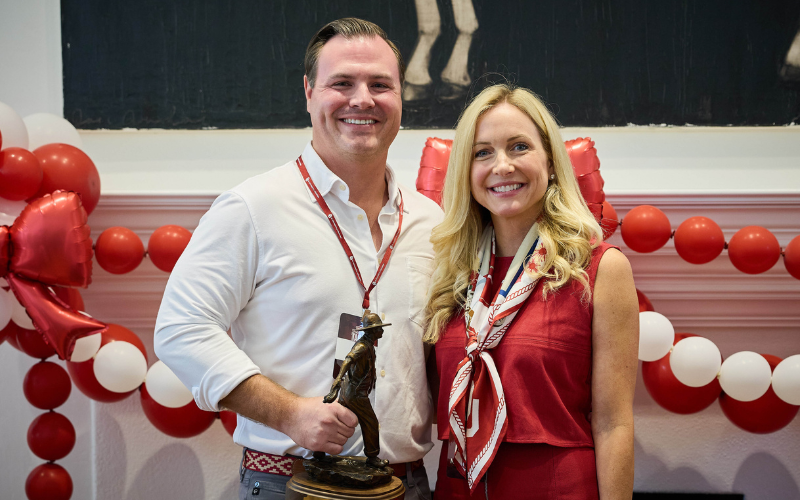
The University of Oklahoma has received a transformative gift from Jon and Shannon McCartney, which will name the McCartney Family Tunnel of Champions, the McCartney Family Gate of the Gaylord Family - Oklahoma Memorial Stadium and the McCartney Family Grand Lecture Hall in the Michael F. Price College of Business. The gift will also support the Inspiring Champions and the Athletic Director’s Discretionary Fund, in addition to establishing the McCartney DFW Career Trek program at Price College.
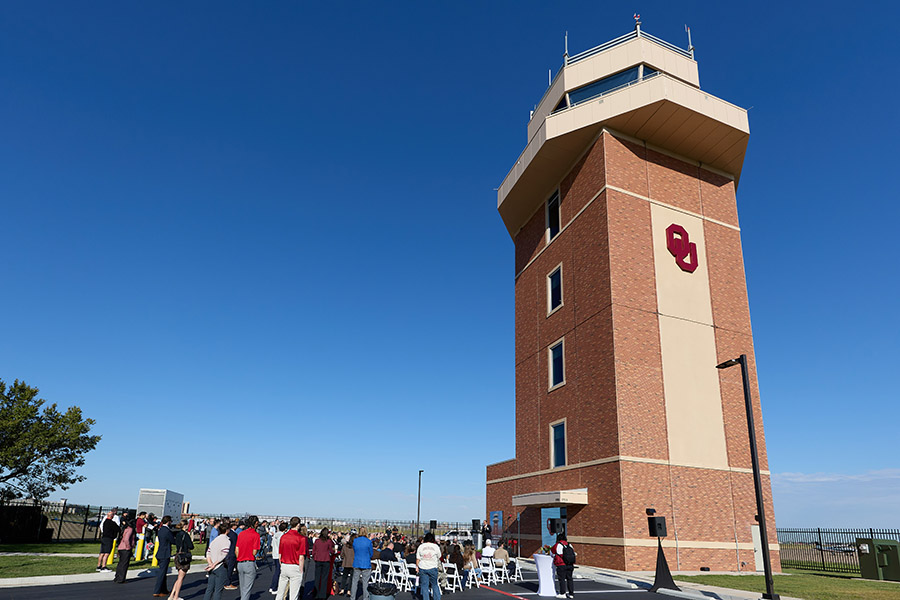
The University of Oklahoma today celebrated the opening of a new air traffic control tower at the OU Max Westheimer Airport. Standing 106 feet tall, more than double the current 52-foot facility, the new tower will modernize air traffic control operations and improve safety for pilots and students operating in the airspace.
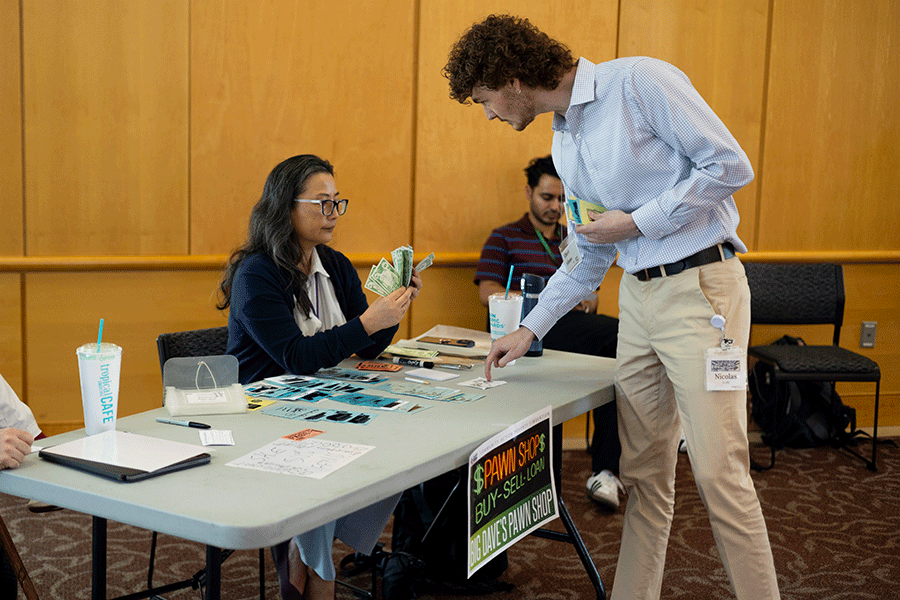
Do I buy groceries or pay the electric bill? Should I pawn some of my belongings to afford my prescription? My child is sick, so I will have to miss work to take care of him. Those are just a few of the difficult choices that OU-Tulsa health professional students confronted during the Community Access to Resources Experience. The role-playing activity challenged students to navigate the financial, family and other pressures that can affect a person’s health and ability to follow medical advice. Held annually during the SCM Institute orientation week, the experience is designed to generate understanding and build empathy.