NEWS

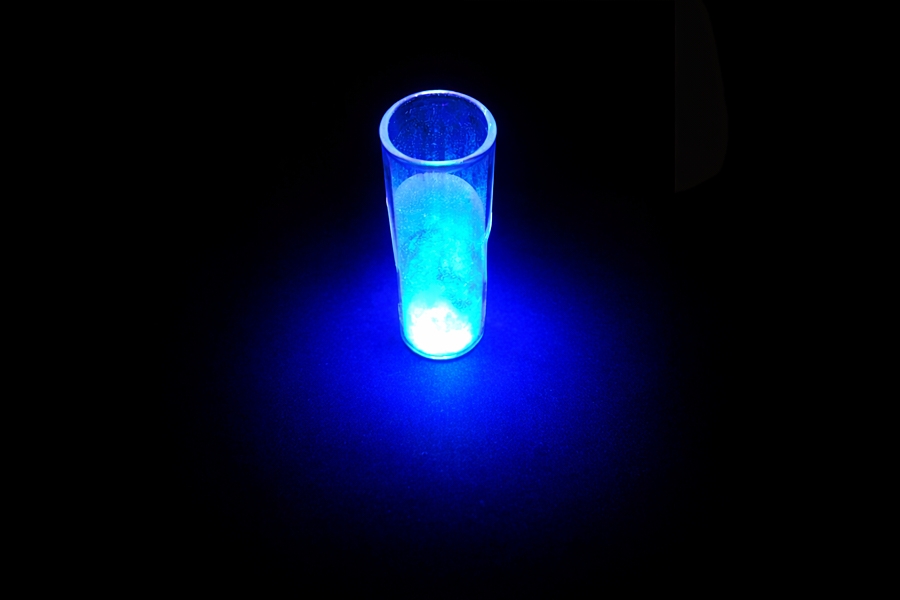
NORMAN, Okla. – Researchers at the University of Oklahoma have developed new hybrid materials that challenge conventional thinking about how light-emitting compounds work and could advance the field of fast radiation detection. The research, published in the Journal of the American Chemical Society, presents a novel approach to designing layered perovskite materials that combine the best of both organic and inorganic components.
Perovskites are crystalline materials with a specific atomic arrangement that has made them increasingly important in materials science. While perovskites have been known to researchers for some time, previous studies have largely focused on the inorganic structural part of the materials, because this is typically where the useful properties lie.
The OU team led by M S Muhammad, a graduate student in the Department of Chemistry and Biochemistry, developed new materials based on a novel design approach that takes advantage of the organic component of the hybrid. These materials emit light due to the organic molecules embedded in them. Their light emission is among the record high when exposed to radiation, a critical factor in detecting high-energy radiation.
“By combining the inorganic and organic components into one hybrid material, we can take advantage of the strengths of each structural part,” Muhammad said. “Fast radiation detectors need fast scintillation properties, which means we want the light emission to be fast. The organic structural part of these materials can provide that.”
By incorporating molecules called stilbenes into custom-designed layered perovskite structures, the team achieved a five-fold increase in light emission efficiency compared to the organic molecules alone.
Muhammad’s findings came from a simple question: Do the interesting properties of perovskites only come from the inorganic portion of the structure?
“A person not familiar with the field may ask why it even matters if the light emission is coming from the organic or inorganic structural part. But it turns out that the light emission properties of inorganic and organic structural parts are quite different,” said Bayram Saparov, Ph.D., a professor in the department and the senior author on the paper.
Organic light emissions are faster than inorganic light emissions, and in certain applications, the emission lifetime or rate of emission is important.
“We want to have fast neutron detectors, fast X-ray detectors, fast gamma ray detectors, and for those applications, organic materials can be used,” Saparov said. “This strategy that Muhammad used led to an increase in light emission efficiency of the organic component up to five times.”
Stability is another significant advantage of these hybrid materials. Many radiation detection materials require protective encapsulation to prevent environmental degradation. These new materials have remained stable for over a year, unprotected in the open air.
“The performance of Muhammad’s materials is on par with the state-of-the-art fast radiation detectors,” Saparov said. “What it tells us is that the strategy we demonstrated in this work is effective. With further fine-tuning, we can increase the luminescence efficiency of these hybrid materials, and they can even beat the state-of-the-art.”
About the Research
“Optimized Photoemission from Organic Molecules in 2D Layered Halide Perovskites” is published in Journal of the American Chemical Society at doi/10.1021/jacs.5c20638.
About the University of Oklahoma
Founded in 1890, the University of Oklahoma is a public research university located in Norman, Oklahoma. As the state’s flagship university, OU serves the educational, cultural, economic and health care needs of the state, region and nation. For more information about the university, visit www.ou.edu.
The University of Oklahoma has received a transformative gift from Jon and Shannon McCartney, which will name the McCartney Family Tunnel of Champions, the McCartney Family Gate of the Gaylord Family - Oklahoma Memorial Stadium and the McCartney Family Grand Lecture Hall in the Michael F. Price College of Business. The gift will also support the Inspiring Champions and the Athletic Director’s Discretionary Fund, in addition to establishing the McCartney DFW Career Trek program at Price College.
The University of Oklahoma today celebrated the opening of a new air traffic control tower at the OU Max Westheimer Airport. Standing 106 feet tall, more than double the current 52-foot facility, the new tower will modernize air traffic control operations and improve safety for pilots and students operating in the airspace.
Do I buy groceries or pay the electric bill? Should I pawn some of my belongings to afford my prescription? My child is sick, so I will have to miss work to take care of him. Those are just a few of the difficult choices that OU-Tulsa health professional students confronted during the Community Access to Resources Experience. The role-playing activity challenged students to navigate the financial, family and other pressures that can affect a person’s health and ability to follow medical advice. Held annually during the SCM Institute orientation week, the experience is designed to generate understanding and build empathy.