NEWS

NORMAN, Okla. – A team of University of Oklahoma researchers has received a Federal Aviation Administration waiver authorizing drone flights to 10,000 feet above ground level at the Kessler Atmospheric and Ecological Field Station (KAEFS) in McClain County, a first for any university in the United States.
The waiver doubles the team’s previous authorized ceiling of 5,000 feet and permits operations beyond visual line of sight. Together, those authorizations unlock a layer of the atmosphere that researchers say is critical to improving severe weather forecasting.
“This gets us to the point in the atmosphere where you start to see the features that drive high-impact weather, the low-level structure that matters for severe storms,” said Tyler Bell, Ph.D., an assistant professor in both the School of Meteorology and School of Aviation.
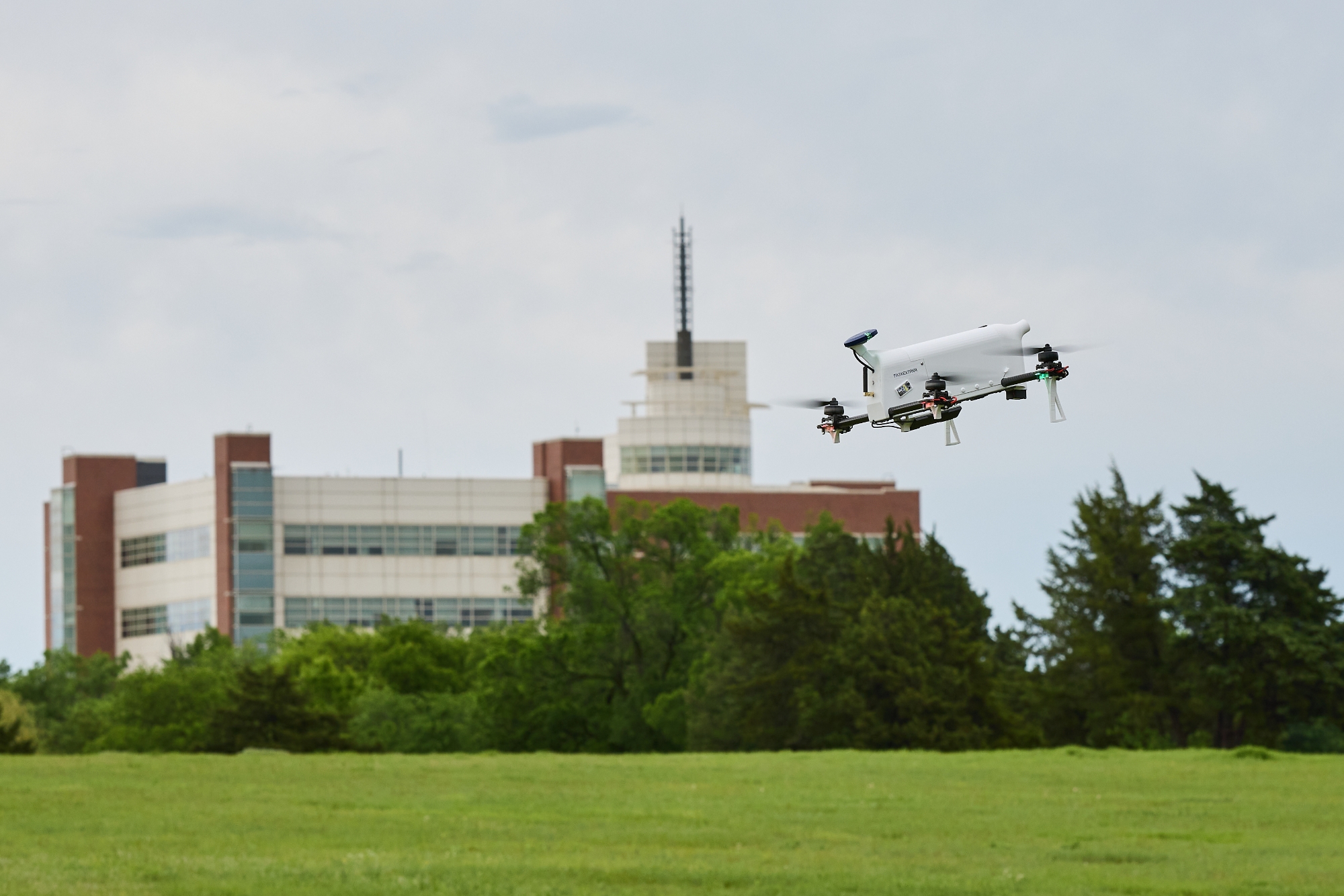
Flights at KAEFS use the CopterSonde-SWX, a weather-sensing drone developed by researchers at OU and the OU-NOAA Cooperative Institute for Severe and High-Impact Weather Research and Operations (CIWRO). Unlike weather balloons, which drift with the wind and are deployed only twice daily, the CopterSonde ascends vertically along a fixed GPS track and can be launched as often as every hour. The data it collects — atmospheric profiles at intervals of every 50 to 100 feet — streams in real time to the researchers on the ground.
“Oklahoma’s Mesonet has taught us a lot about how weather conditions vary across our state. Now, with the 3D Mesonet, each new profile shows us how those differences extend through the lower atmosphere,” said Chris Fiebrich, director of the Oklahoma Climatological Survey.
Because the drone will operate beyond visual line of sight, the OU team partnered with Oklahoma City TRACON, the FAA radar control facility responsible for regional air traffic. Under the agreement, the team notifies the control center before each flight, and TRACON vectors commercial aircraft at least five miles clear of the drone’s vertical corridor while it is operating.
“This is a virtual tower, an object that rises to 10,000 feet and comes straight back down over the same ground point,” said Ken Carson, FAA Liaison for OU Faculty for Research Flight Operations. “The Oklahoma City TRACON has been part of OU’s aviation safety committee for over 20 years, and that relationship made this possible.”
OU has operated drones for weather research at KAEFS since 2011, when it became one of the first universities in the nation to receive an FAA certificate of authorization for non-military UAS flights. The 3D Mesonet project, launched through a contract from NOAA’s National Mesonet Program with OU’s Oklahoma Climatological Survey, began quasi-operational weekly flights at the station in late 2025. Those flights make Oklahoma the first state to supply that data type through the National Mesonet Program. In a related milestone, the National Weather Service has begun buying data from OU and partner Meteomatics, the next step forward for the 3D Mesonet program.
The team is now in Stage 2 of the project, which includes weekly flights through early August and the addition of a drone hangar to support automated launch-and-recovery testing. Bell said the long-term goal is a system that can operate without an on-site pilot — a drone that autonomously ascends, collects data, returns to its station and recharges, then repeats.
The 10,000-foot waiver is also laying groundwork beyond KAEFS. OU is partnering with Oklahoma State University to pursue a similar waiver for a second site near Bixby, south of Tulsa.
“We set the model,” Bell said. “The goal is for other institutions to be able to follow what we’ve done here.”
The 3D Mesonet project is led by Cindy Luttrell of the Oklahoma Mesonet, Bell, Fiebrich and Tony Segales of CIWRO. Learn more about the project at 3dmesonet.org.
About the University of Oklahoma
Founded in 1890, the University of Oklahoma is a public research university located in Norman, Oklahoma. As the state’s flagship university, OU serves the educational, cultural, economic and healthcare needs of the state, region and nation. For more information about the university, visit www.ou.edu.
The University of Oklahoma has received a transformative gift from Jon and Shannon McCartney, which will name the McCartney Family Tunnel of Champions, the McCartney Family Gate of the Gaylord Family - Oklahoma Memorial Stadium and the McCartney Family Grand Lecture Hall in the Michael F. Price College of Business. The gift will also support the Inspiring Champions and the Athletic Director’s Discretionary Fund, in addition to establishing the McCartney DFW Career Trek program at Price College.
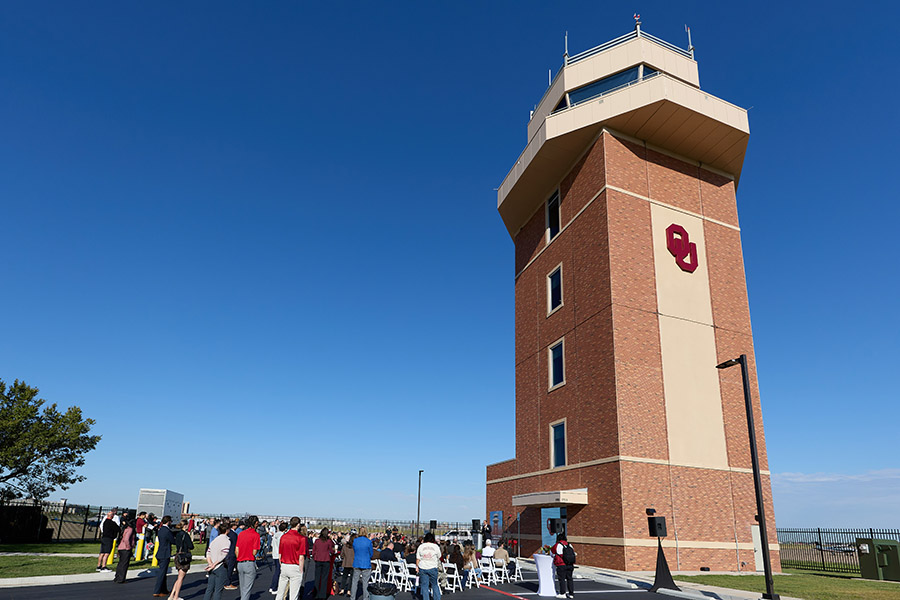
The University of Oklahoma today celebrated the opening of a new air traffic control tower at the OU Max Westheimer Airport. Standing 106 feet tall, more than double the current 52-foot facility, the new tower will modernize air traffic control operations and improve safety for pilots and students operating in the airspace.
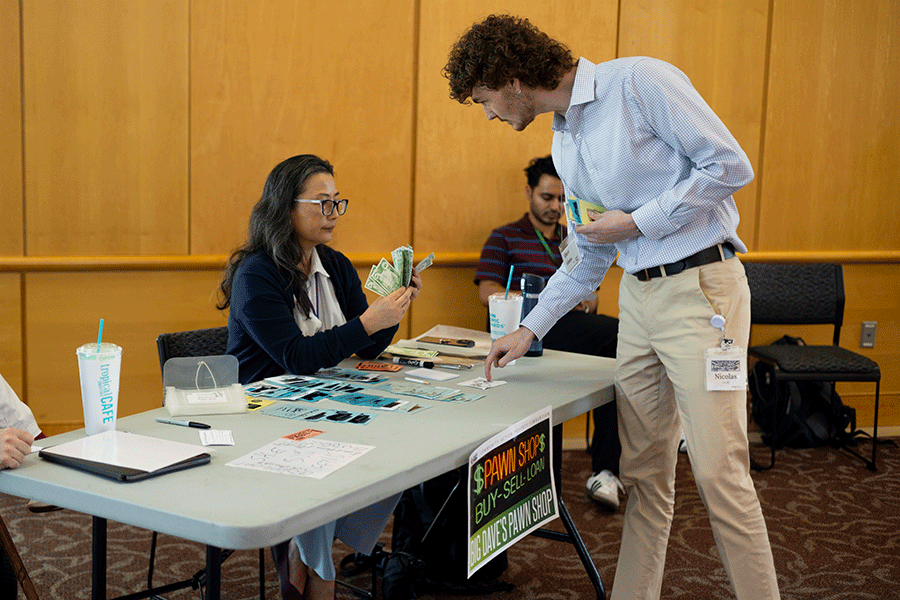
Do I buy groceries or pay the electric bill? Should I pawn some of my belongings to afford my prescription? My child is sick, so I will have to miss work to take care of him. Those are just a few of the difficult choices that OU-Tulsa health professional students confronted during the Community Access to Resources Experience. The role-playing activity challenged students to navigate the financial, family and other pressures that can affect a person’s health and ability to follow medical advice. Held annually during the SCM Institute orientation week, the experience is designed to generate understanding and build empathy.