NEWS

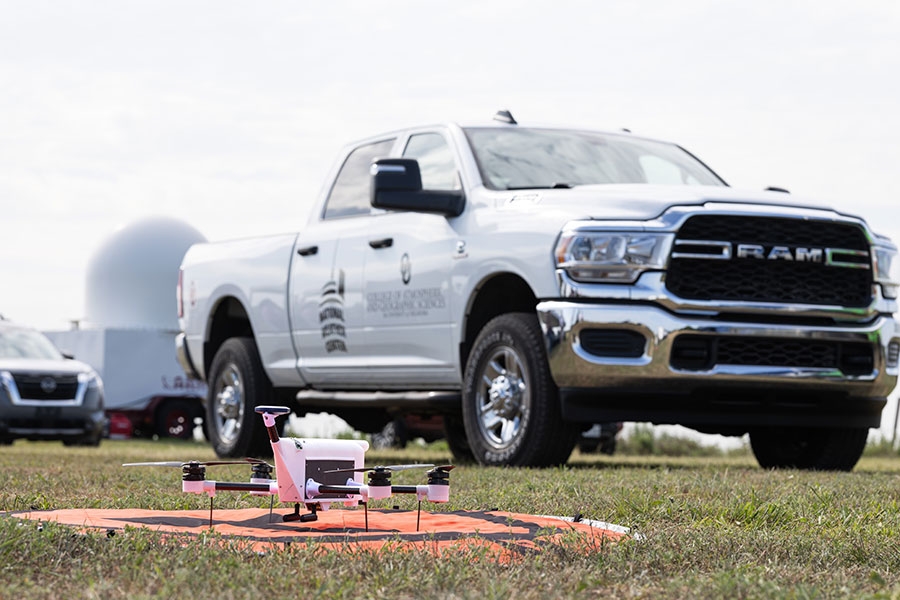
NORMAN, Okla. – The National Weather Service has, for the first time, purchased vertical atmospheric profiles collected by drones — data collected by the University of Oklahoma (OU) and Meteomatics. The milestone is the next step forward for the Oklahoma 3D Mesonet, a first-of-its-kind observation system that integrates uncrewed aircraft systems (UAS) technology with the Oklahoma Mesonet ground network to capture real-time, three-dimensional data across the lower atmosphere.
The data buy, facilitated through the NWS Commercial Observations Program and its National Mesonet Program (NMP), marks a pivotal shift in how the federal government acquires critical weather data. Rather than relying solely on its historic network of upper-air balloon sites — which have provided vertical profiles of wind, temperature, humidity and pressure for decades — the NWS is now purchasing that data commercially, at greater frequency, from OU and Meteomatics.
"The National Mesonet Program is a gold standard for public-private partnerships. It's how other agencies want to establish commercial programs. It's how the rest of NOAA wants to do it. It really is the template,” said Ajay Mehta, director of the Office of Observations of the National Weather Service, during the event.
Since December 2025, scientists from the Oklahoma Mesonet, the OU School of Meteorology and the Cooperative Institute for Severe and High-Impact Weather Research and Operations (CIWRO) have been conducting quasi-operational UAS flights at the Washington, Oklahoma, Mesonet station. Oklahoma’s position at the forefront of this effort reflects more than a decade of investment in UAS atmospheric research.
The Oklahoma 3D Mesonet features two complementary UAS systems flying at the Kessler Atmospheric and Ecological Field Station. OU’s CopterSonde, developed by researchers at OU and CIWRO, is engineered for high-quality data collection in extreme conditions, most importantly high wind environments that produce severe weather. Operating alongside it is the Meteodrone system from NMP partner Meteomatics, which specializes in fully autonomous, deep vertical profiling — capable of launching from a drone-in-a-box Meteobase station, ascending to 20,000 feet, and returning without a human operator on site.
“These exciting new systems build on the established infrastructure of the Oklahoma Mesonet, a network of 120 automated environmental monitoring stations jointly operated by OU and Oklahoma State University,” said Chris Fiebrich, director of the Oklahoma Climatological Survey. Commissioned in 1994, the Mesonet covers all 77 Oklahoma counties, collecting and transmitting observations every five minutes around the clock.
"Working with the private sector, if you do it right, can make a lot of progress and have a real impact on the nation,” said Dean of the College of Atmospheric and Geographic Sciences Bob Palmer. "Today is interesting — you think it's all about drones, but it really is not. And it's not about technology either. It's about partnerships. University, government, and private sector."
OU celebrated this milestone on July 30, 2026, at the Kessler Atmospheric and Ecological Field Station, with live UAS flight demonstrations, remarks from NOAA leadership and members of Congress, and seminars at the National Weather Center in Norman.
To learn more about the 3D Mesonet project, visit 3Dmesonet.org.
About the University of Oklahoma
Founded in 1890, the University of Oklahoma is a public research university located in Norman, Oklahoma. As the state’s flagship university, OU serves the educational, cultural, economic and health care needs of the state, region and nation. For more information about the university, visit www.ou.edu.
The University of Oklahoma College of Medicine has honored two residents with the Lloyd Rader Award, which recognizes outstanding clinical and research achievements in residency.
The University of Oklahoma will receive up to $220 million over five years from the U.S. Department of Commerce and the National Oceanic and Atmospheric Administration to continue the life-saving weather research led by the OU-NOAA Cooperative Institute for Severe and High-Impact Weather Research and Operations, extending a nearly 50-year partnership that has helped give Americans earlier, more accurate weather warnings
The OU Food Pantry won the annual Red River Food Fight, collecting 31,815.9 pounds of shelf-stable food and drinks to top UT Outpost’s 22,567 pounds. OU has won the competition four years in a row.