NEWS


By
Greg Bruno
Date
Media Contact
ounews@ou.edu
For most smokers, quitting is an eventual, if distant, goal – a day that will come later rather than sooner.
Health experts at the University of Oklahoma are using technology and the power of persuasion to move up the timeline.
A new five-year, $3 million grant from the National Cancer Institute will enable researchers at OU’s TSET Health Promotion Research Center (HPRC) to scale up a smartphone-based mHealth solution that uses targeted and tailored messages to motivate smokers to kick the habit. The project, which will begin recruitment in November, builds on a smaller pilot study that demonstrated the effectiveness of the approach.
“Most smokers have tried to quit at least once, but having failed, they may have bad memories of what it was like and how difficult it can be,” said Jordan Neil, Ph.D., an HPRC researcher who specializes in translational cancer communication science. “One benefit of using digital interventions is that you can provide highly tailored messages to promote behavior change.”
Typical smoking cessation programs are designed for those who are committed to quitting and provide tools to replace nicotine, such as patches and gum, said Neil. But research has shown that only about 20% of regular smokers have a plan to quit. Most see a smokeless future as a distant objective.
The new mHealth app will serve this unmotivated majority.
Cigarette smoking is the leading cause of preventable death and disease in the United States and kills more than 480,000 Americans annually, according to the U.S. Centers for Disease Control and Prevention. Smoking-related health care costs exceed $240 billion a year, with nearly $372 billion more lost to reduced productivity. In Oklahoma, 14.1% of adults smoke, compared with the national average of 11.6%.
To move these numbers, Neil and Michael Businelle, Ph.D., co-director of HPRC and a professor in the OU Department of Family and Preventive Medicine, will build, test, and scale an app to help smokers set a quit date and stay smoke-free.
The solution will be built on the Insight mHealth Platform, which Businelle designed to help researchers create and deploy smartphone- and tablet-based assessments and interventions.
Researchers will recruit more than 1,000 U.S. adult smokers for a randomized, controlled trial. Participants will be paid to complete weekly surveys during their 12-month enrollment period.
During the study, smokers will receive messages that align with the “phase-based model of tobacco treatment,” which divides quitting into four stages: motivation, pre-cessation, cessation, and maintenance.
During the motivation phase in the app, smokers will receive two daily alerts with information aimed at building confidence in quitting. Messages at this point will be generalized and include simple benefits of not smoking, such as improved taste and increased longevity.
The goal of the motivation phase will be to encourage users to voluntarily set a quit date, Neil said. Once users do, the app will begin delivering tailored messages preparing users for their quit attempt. Themes will include smoking triggers and tips for managing cravings.


During the cessation phase, participants will be offered support based on reported urges, stressors, and exposure to other smokers. Participants will also receive resources for evidence-based tobacco treatment. Messages during the final stage, maintenance, will reinforce the benefits of abstaining.
A unifying theme of the app is a behavioral health concept called catastrophe theory, which suggests that impactful messages or traumatic events can trigger sudden changes in habits.
“Say your aunt smokes and you find out she has lung cancer,” said Businelle. “Catastrophe theory in psychology suggests that external influences can push people to adapt their own behaviors quickly. That’s what this grant seeks to capitalize on.”
The current study builds on a pilot program, called Phoenix, which Neil and Businelle conducted between 2018 and 2022. In that study, 152 adult smokers were recruited from Texas and Oklahoma to complete weekly surveys for 26 weeks and engage with cessation messages. Those who reported quitting at the end of Phoenix were given a carbon monoxide testing device to verify their abstinence.
Results were encouraging. Smokers in the test group were four times more likely to set a quit date than those in the control group, Businelle said. They also set their first quit date sooner, reported more weeks of abstinence, and were 2.5 times more likely to report having abstained from smoking for at least a week at the end of the trial.
The current study will test whether those results translate into sustained smoking cessation on a larger scale.
If effective, the intervention could offer a convenient, scalable way to reach people who might otherwise delay seeking help, the researchers said. Potential applications include corporate and university wellness programs and health insurance initiatives.
“This tool could help many people not currently ready to quit smoking find the courage and strength to finally kick a deadly habit,” said Businelle.
About the project
The project, “A Novel Intervention to Increase Smoking Quit Attempts and Cessation Among Adults Initially Unready to Quit” is funded through National Cancer Institute Award No. 1R01CA315811-01. Funding has also been provided by the Oklahoma Tobacco Settlement Endowment Trust (TSET).
About the University of Oklahoma
Founded in 1890, the University of Oklahoma is a public research university located in Norman, Oklahoma. As the state’s flagship university, OU serves the educational, cultural, economic and healthcare needs of the state, region and nation. For more information about the university, visit www.ou.edu.
Researchers at the OU Health Harold Hamm Diabetes Center are investigating diabetes from numerous angles, including how the disease affects other organs, what factors contribute to its development and complications, and how new approaches to prevention and treatment could improve health.
A new five-year, $3 million grant from the National Cancer Institute will enable researchers at OU’s TSET Health Promotion Research Center (HPRC) to scale up a smartphone-based mHealth solution that uses targeted and tailored messages to motivate smokers to kick the habit.
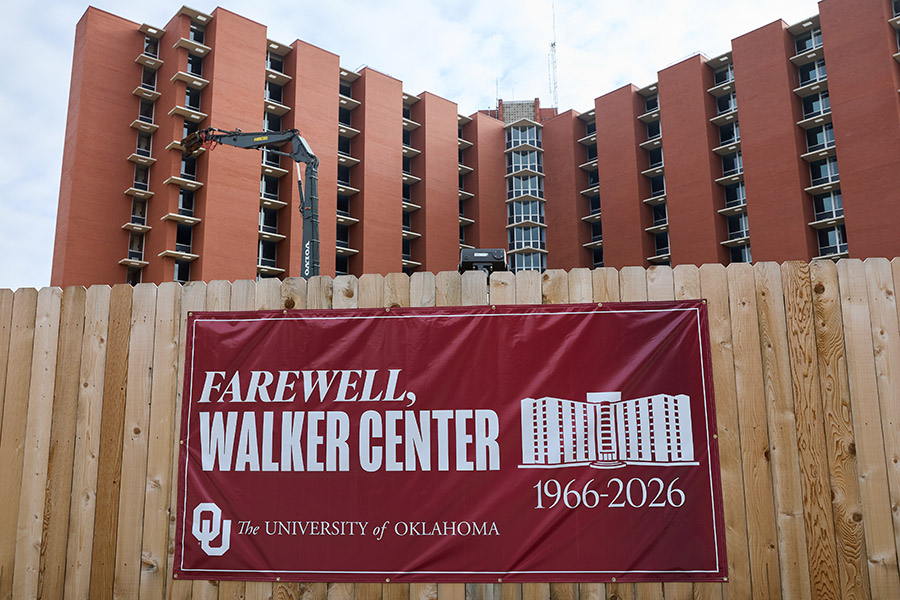
The University of Oklahoma has begun the demolition of Walker Center, marking a new step in the university’s refresh of student housing. The 12-story building has served as a home for thousands of students on the Norman campus.