
Skip Navigation

Graduate

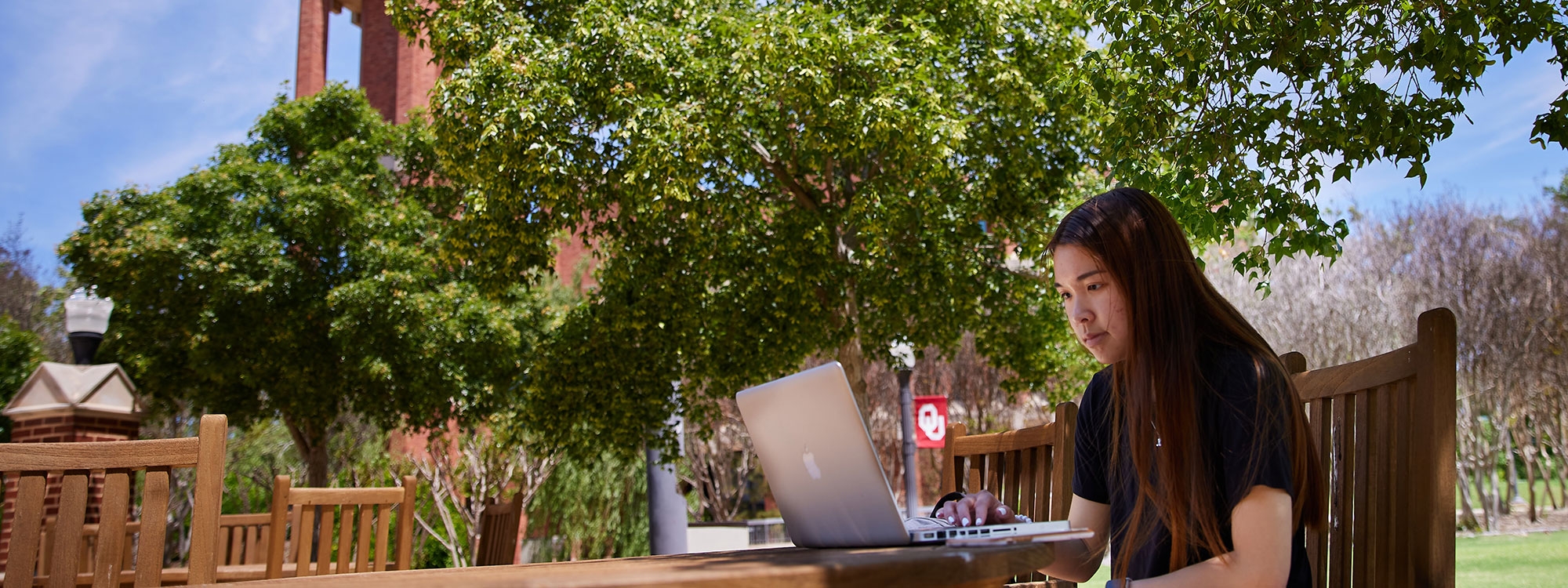
A student sitting at a table outside, working on a laptop.

Graduate

The graduate program of the Department of Sociology at the University of Oklahoma is nationally ranked. We provide rigorous training for our graduate students and cultivate a collaborative and collegial atmosphere. Our faculty members and graduate students work closely together to develop cutting-edge research.


Areas of Study

Inequality & Social Differentiation

Faculty interests include income and wealth inequality, educational disparities, health disparities, residential segregation, social inequality in political participation, stratified health outcomes, and environmental sociology.

Faculty interests focus on gender ideology, sexuality, gender differences in the transition to adulthood, and gender differences in juvenile delinquency, income, crime, values, and in educational plans.

Faculty interests include health disparities, residential segregation, the interaction of culture and power in processes of domination, educational attainment, life outcomes, and collective identity.

Criminology & Deviance

Faculty interests include juvenile delinquency, LGBT youth and sexualities, deviant identities, control theory, family and crime, gender differences in the causes of crime, crime and the life course, child maltreatment, gangs, drugs/crime nexus, deception detection, and criminal justice program evaluation.

Global & Environmental Sociology

Faculty interests include globalization, immigration, integration of immigrant populations, international development, cross-national inequality, the world economy, the diffusion of world culture and political and economic models, education and HIV/AIDS in South Africa, and comparative/historical institutions.

Faculty interests include culture and the environment, environmentally-related illness and health, environmental social movements, structural human ecology, and social and demographic drivers of environmental pollution, deforestation and greenhouse gas emissions.

Faculty interests include residential segregation, rural-to-urban migration, immigrant adaptation, household demography and children's health and well-being, sexuality and health risks, contraception, and marriage and fertility.

Family & Religion

Faculty interests include family-related attitudes, family formation behaviors, religion's relationship to family formation and functioning, co-parenting and fathers’ parenting of their non-resident children, family and crime, work-family conflict, the division labor in the home, health and aging with an emphasis on long-term care, transition to adulthood, and the life course.

Faculty interests include religious demographics, inequality in religious organizations,  religions in their comparative and historical contexts, religion and Family, religion and politics, and the links between religion and education, gender, sexuality,  and social inequality.

Stylized crimson line.

Methods of Study

Faculty interests focus on the techniques, strategies, and processes of using mathematically, statistical, and computational based  models to explain social phenomena with an emphasis on study design, sampling, and statistical analysis.

Faculty interests focus on collecting and analyzing non-numerical data to understand concepts, opinions, and experiences to explain social phenomena, with emphasis on grounded theory, ethnography, action research, phenomenological research, and narrative research.

Faculty combine elements of both quantitative research and qualitative research in the same study, collecting and/or analyzing both quantitative and qualitative data, and “mixing” them to explain social phenomena and answer research questions.

Faculty use evaluation methods to determine the impact of a social intervention or a particular program with emphasis on assessing the design, implementation, improvement or outcomes of a program.

A student sitting at a desk in a common area, working on a laptop.

Graduate Faculty

Our award-winning graduate faculty are active in research, demonstrating a clear adherence to our department’s mission of fostering state-of-the-art research. Our faculty have published in top sociology and criminology journals as well as books in top academic presses.  The sociology/criminology faculty have also won numerous awards and honors at the university and national level, celebrating both our excellence in research and in teaching.

Research Published In:

  • American Sociological Review
  • Criminology
  • Annual Review of Sociology
  • Social Forces
  • Social Problems
  • Sociological Science
  • Justice Quarterly
  • Sociological Methods & Research
  • Journal of Quantitative Criminology
  • Journal of Marriage and Family
  • Sociology of Education
  • and many more

University Awards Received:

  • Distinguished Teaching Award
  • Irene Rothbaum Award for Outstanding Assistant Professor
  • General Education Teaching Award
  • Kinney-Sugg Outstanding Professor Award
  • President’s Outstanding Mentor Award
  • Holden Teaching Faculty Award 
  • Longmire Prize for Innovative Teaching
  • Regents Award for Superior Teaching
  • Community Engagement Award for Research
  • Scholarship and Creative Activity Award
  • Award for Excellence in Research Grants
  • Excellence in Social Science Research
  • Outstanding Research Impact Award

Academic Books Published By:

  • Oxford University Press
  • Duke University Press
  • New York University Press
  • Routledge Press
  • Palgrave Macmillan
  • Lynne Rienner Publishers

National Awards Received:

  • Evelyn Gilbert Unsung Hero Award from Academy of Criminal Justice Sciences
  • NAS Jefferson Science Fellowship
  • Society for the Scientific Study of Religion Distinguished Book Award
  • William Foote Whyte Career Award in Sociological Practice and Public Sociology
  • Cora Richey Mann Inconvenient Woman of the Year Award

Graduate Training

Across all these degrees/certificates, we provide rigorous training in methods, statistics, and theory as well as advanced coursework in the substantive areas of inequality/stratification, criminology/deviance, global/environmental sociology, family, gender, race/ethnicity, sexualities, and sociology of religion. Our programs also offer numerous research opportunities through collaborative work with faculty.

The program offers three-degree tracks:

We also offer a certificate in:


A Note from the Graduate Liaison

 Welcome to the graduate program in Sociology at OU! Our program is built upon three pillars: excellence and rigor in cutting-edge research; creating a warm, collegial, and inclusive learning environment; and fostering dynamic connections with our local and national collaborators through community outreach and the development of strategic partnerships. We are building something special here in Norman and we are excited to share that with you! 
   

Cyrus Schleifer.
Cyrus Schleifer

Associate Professor and Graduate Liason


Office: Kaufman 343
Phone: (405) 325-1751
Email: cyrus.schleifer@ou.edu

Ph.D., Duke University, 2015


Placement

Over the years, the department has placed its graduates in tenure-track jobs in universities and colleges including West Virginia University, The University of New Hampshire, Brigham Young University, The University of Arkansas - Fayetteville, The University of Nevada – Las Vegas, Sam Houston State University, The University of Wisconsin – River Falls, The University of Louisiana – Lafayette, to name some recent examples. We have also placed several graduates in postdoctorial positions at Indiana University and Purdue University. Our graduates have also achieved positions in a wide variety of public and private agencies including the Office of the US Census, Federal Bureau of Investigation, Oklahoma Department of Corrections and the Oklahoma Department of Human Services, to name some recent examples.

Application Process

If you are interested in applying to our graduate program, please download our application packet. 

If you have any additional questions about the program or the application process, contact Dr. Cyrus Schleifer, the graduate director, at cyrus.schleifer@ou.edu or (405) 325-3647.


Master's Degree Application Requirements

  • Statement of Purpose
  • Curriculum Vitae
  • Three Recommendation Letters
  • Writing Sample
  • College Transcript(s)

Ph.D. Application Requirements

  • Completed MA Degree in Sociology, Criminology, or associated field
  • Statement of Purpose
  • Curriculum Vitae
  • Three Recommendation Letters
  • Writing Sample
  • College Transcript(s)

Master's Degree Program

The University of Oklahoma Department of Sociology offers a Master’s Degree in Sociology. We designed this program to be completed in 2 years and to provide rigorous theoretical training in graduate level sociology/criminology, state-of-the-art approaches towards social scientific research methods, and a strong foundation in producing publication quality sociological/criminological research. Those who complete this degree will be well positioned to pursue a PhD in sociology, criminology, or related fields as well as be in a competitive position for a non-academic research jobs both at the local and national level.

Why Complete an MA Degree in Sociology?

The MA degree in Sociology is centered on providing students with a wide variety of tools to produce high quality academic and non-academic social scientific research. This degree will focus on building a strong foundation for research, starting with a blank slate and moving students towards producing publication quality work. Students who have completed our MA degree have gone on to pursue PhD degrees in our department as well as other highly ranked sociology departments such as Duke, Indiana, Vanderbilt, Georgia, and Colorado as well as criminology departments such as the University of California-Irvine and University of Maryland. Many of our MA graduates also go on to work as researchers in a wide variety of public and private agencies including the Oklahoma Department of Corrections and the Oklahoma Department of Human Services.


Curriculum

Complete 34 hours of graduate course work

  • Sociological Theory - 3 credit hours
  • Social Research Methods - 3 credit hours
  • Three Course Social Statistics Sequence - 9 credit hours
  • Professionalization Seminar - 1 credit hour
  • Master's Thesis Research - 3 credit hours
  • Elective Coursework - 15 credit hours

12 or more hours must be housed in the Department of Sociology at the 5000-level or above. The remaining 3 hours of electives may be Directed Readings (SOC 5960), a cross-listed course housed outside the department or another course outside the department.

Stylized crimson line.

Basic Timeline to Complete MA Degree

MA Year One

Fall Semester

Spring Semester

Fundamentals of Social Statistics (5283)Advanced Regression Analysis (5483)
Sociological Theory (5933)Advanced Methods of Social Research (5293)
Professionalization Seminar (5821)Graduate Elective Course
Graduate Elective Course 
  • Apply for Summer Research Funding in April
  • Chose an MA Thesis advisor and begin discussing thesis and MA

MA Year Two

Fall Semester

Spring Semester

Cat, Panel, and Advanced Soc Stats (5683)Research Hours for Master's Thesis (5980)
Graduate Elective CourseGraduate Elective Course
Graduate Elective Course 
  • Form MA Committee by September
  • Defend MA Proposal by November
  • Apply to graduate in January
  • Defend Thesis by mid-late April
Stylized crimson line.

Funding

We strive to provide up to 2-years of funding to most of our MA students through graduate assistantship positions. This includes a monthly stipend (for 9 months), a tutition wavier, and student health insurance. We also offer competative opportunities for summer funding through our Grasmick/Riddle Summer Research Fellowships. To assist with travel to national and international conferences, the department and university also provide travel grants to graduate students who are presenting their own research.

Doctoral Degree Program

The University of Oklahoma Department of Sociology proudly offers a PhD Degree. This is a highly competitive program that provides rigorous theoretical training and a state-of-the-field foundation in social scientific research methods. Students who complete this degree are expected to produce cutting-edge, high impact sociological/criminological research. Those who complete this degree will also be well positioned to serve as faculty at research universities, excel as instructors at teaching focused institutions, and will also be competitive to pursue non-academic research jobs anywhere in the world.

Why Complete a PhD Degree in Sociology?

The PhD degree in Sociology is the pinnacle research degree offered in our discipline. Our program prepares students to conduct the highest levels of sociological and criminological research along with developing and implementing a wide variety of courses in the classroom. Students who have completed our PhD have gone on to fill tenure-track positions in sociology/criminology departments such as:    

  • West Virginia University
  • University of New Hampshire
  • Brigham Young University
  • The University of Arkansas - Fayetteville
  • The University of Indiana - Bloomington
  • Sam Houston State University
  • The University of Nevada - Las Vegas
  • The University of Wisconsin - River Falls
  • The University of Louisiana - Lafayette
  • among many other examples 

Those who have emphasized their teaching have gone on to be professors at Oklahoma State University-Tulsa, Texas Tech University, Northern Arizona University, and many other universities and colleges in Oklahoma and beyond. We have also placed graduates in postdoctorial positions at the University of Indiana, Bloomington and Purdue University. Many of our graduates also go on to work as researchers in a wide variety of public and private agencies including Department of the US Census, Federal Bureau of Investigation, the Oklahoma Department of Corrections, and the Oklahoma Department of Human Services.


Curriculum

Complete 90 hours of graduate course work

  • Two Course Sociological Theory Sequence-  6 credit hours
  • Social Research Methods -  3 credit hours
  • Three Course Social Statistics Sequence - 9 credit hours
  • Professionalization Seminar - 1 credit hour
  • Teaching Seminar - 1 credit hour
  • Master's Degree Transfer Credits - up to 34 credit hours
  • Elective Coursework - minimum of 21 credit hours
  • Doctoral Dissertation Research - 2-24 credit hours

Beyond the required coursework, 6 or more hours must be housed in the Department of Sociology at the 5000-level or above. The remaining 15 hours of electives may be additional courses in department, Directed Readings (SOC 5960) or courses housed outside the department.


Graduate Teaching

Our PhD program also emphasizes the importance of teaching. All of our PhD students receive hands-on training and experience in teaching. Our training program includes an orientation workshop for new teaching assistants, a teaching seminar for PhD students, and an opportunity for PhD students to design and teach their own courses. The university also offers extensive resources including the Graduate Teaching Academy through the University of Oklahoma Center for Teaching Excellence.

Stylized crimson line.

Basic Timeline to Complete PhD Degree

PhD Year One

Fall Semester

Spring Semester

Fundamentals of Social Statistics (5283)Advanced Regression Analysis (5483)
Sociological Theory (5933)Advanced Methods of Social Research (5293)
Professionalization Seminar (5821)Issues in Sociological Theory (6903)
Graduate Elective CourseTeaching Seminar (5831)
  • Apply for Summer Research Funding in April
  • Chose an PhD advisor to oversee Advisory Conference Report (ACR) 

PhD Year Two

Fall Semester

Spring Semester

Cat, Panel, and Advanced Soc Stats (5683)Graduate Elective Course
Graduate Elective CourseGraduate Elective Course
  • Apply for Summer Research Funding in April (Max 2 summers)
  • Complete Advisory Conference Report (ACR) by Spring
  • Choose Comprehensive Exam Areas in Spring
  • Reorganize Committee to Exam Graders
  • Submit co-authored paper to peer reviewed journal
  • Present research at a professional meeting

PhD Year Three

Fall Semester

Spring Semester

Complete General ExamsDefend Dissertation Proposal
Form Dissertation CommitteeComplete Any Remaining Coursework
Complete Any Remaining Coursework 
  • Submit additional articles to peer-reviewed journal, first or solo authored if ready
  • Present research at a professional meeting
  • Prepare an upper level undergraduate course to teach
  • Seek out research funding

PhD Year Four

  • Make substantial progress on your dissertation
  • Apply for external and university level funding for dissertation research 
  • Submit multiple articles to peer-reviewed journals
  • Present research at a professional meeting
  • Prepare for academic market in Fall of Year Five

PhD Year Five

  • Apply for jobs in the Fall and early Spring
  • Apply for additional year of funding from department by December
  • Apply to Graduate in Spring
  • Complete and Defend Dissertation by mid-late April 
  • Submit additional articles to peer-reviewed journal
  • Present research at a professional meeting
Stylized crimson line.

Funding

We strive to provide up to 5-years of funding to most of our PhD students through graduate assistantship positions. This includes a monthly stipend (for 9 months), a tutition wavier, and student health insurance. We also offer competative opportunities for summer funding through our Grasmick/Riddle Summer Research Fellowships. To assist with travel to national and international conferences, the department and university also provide travel grants to graduate students who are presenting their own research.