NEWS

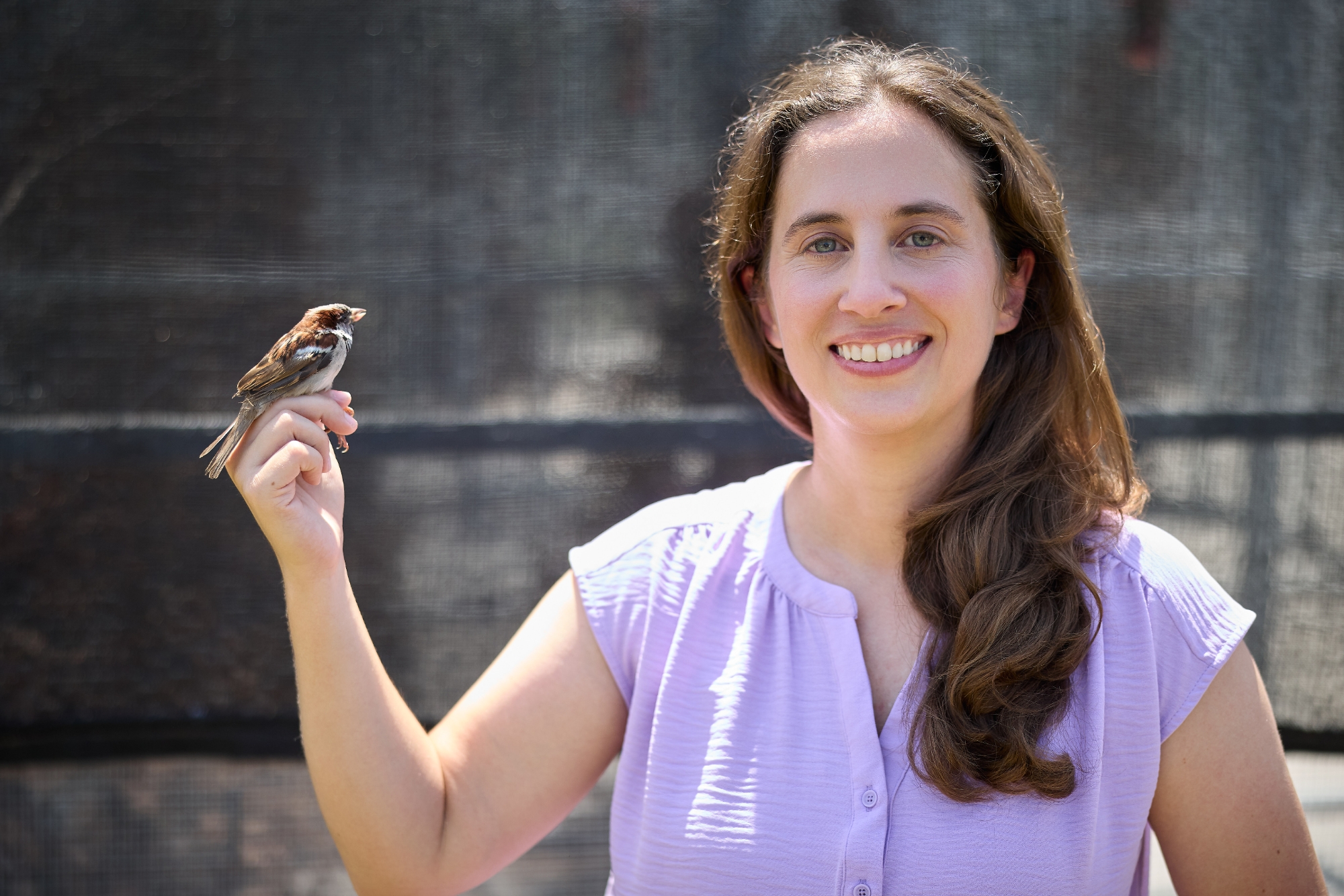
NORMAN, OKLA. – Alexandra Bentz, a professor in the School of Biological Sciences at the University of Oklahoma, has received a prestigious National Science Foundation (NSF) Early Career award to investigate how mother birds chemically communicate about their environment to unborn offspring and the effects of that chemical communication. The findings will be translatable across species, providing a deeper understanding of how mothers prepare their young for their future environments.
The study will focus on testosterone exposure in House sparrows. Early exposure of developing young to testosterone can cause many traits, including increased growth and aggression, which can be potentially beneficial in competitive situations, but does not come without risk.
“If you enter a more competitive environment and you’re already a little bit bigger or already tuned to be more aggressive, it might give you some sort of advantage. And so, it seems that females, through these hormones, can communicate the current environment and give their offspring a heads up,” said Bentz.
Aggression itself is costly, said Bentz, and if a bird is programmed for a competitive environment where there isn’t one, increased aggression can lead to injury, disease and other risk factors.
The research will identify gene networks in the hypothalamus—a region of the brain that controls hormones and social behavior—that respond to early testosterone exposure. The team will then track changes from development through adulthood, testing how well hormone-induced traits actually help birds succeed in different environments.
As a subject, House sparrows present several benefits for this research. They are easily accessible, and it is easier to manipulate hormones in a closed egg system than it is to do so in utero. Significantly, there is a strong foundation of work on House sparrows and the effects of testosterone on eggs.
“That allows us to take the next steps and really look at the mechanisms,” said Bentz. “These maternal effects, you find them from fish to birds to humans, and a lot of those early developmental processes and even neurogenomic mechanisms that underlie a lot of our social behaviors are really shared among all these different taxa.”
The education component of the grant will be twofold. The data collected and the hands-on research opportunities provided by the project will benefit Bentz’s students. Collected tissues will enable students in an endocrinology class to pose their own questions about genes potentially affected by testosterone exposure. Students will be able to practice behavioral coding with videos taken of the birds, an integral technique to behavioral endocrinology.
Additionally, in partnership with the K20 Center, Bentz plans to develop a mobile app that will allow the public to directly participate in the science. Because House sparrows are easily found in places like parking lots or at backyard bird feeders, she imagines this app will be a tool that individuals can use to test their own hypotheses on what prompts aggression, such as time of day or proximity of food. Each dataset collected through the app will be treated as its own study, which Bentz and her team can then examine for overarching patterns or trends.
“It’ll be a nice introduction to animal behavior for the general public,” she said. “This lets people do more than just collect data. This is inquiry-based, so they get to ask their own questions and actually do the science.”
Bentz has worked with birds and hormonal communication between mothers and offspring since her undergraduate years. Both her master’s and doctoral work, completed at Appalachian State University and the University of Georgia, respectively, were on the topic.
“In those early days, I was running around the mountains, checking nest boxes and seeing how social density affected the hormones that went into an egg. Now, we’re getting a lot more mechanistic. I’ve built up the toolkit over time to be able to ask these questions.”
About the Project
“Developmental Programming of Behavior by Maternal Hormones” is funded by a $1,188,131 CAREER Award from the National Science Foundation, 2439462. It began in July 2025 and is expected to end in June 2030. Alexandra Bentz, Ph.D., is an assistant professor in the OU School of Biological Sciences, Dodge Family College of Arts and Sciences, and leads the Bentz Lab.
About the University of Oklahoma
Founded in 1890, the University of Oklahoma is a public research university located in Norman, Oklahoma. As the state’s flagship university, OU serves the educational, cultural, economic and health care needs of the state, region and nation. For more information about the university, visit www.ou.edu.
The Michael F. Price College of Business announced Wednesday the launch of the Center for the Business of Sports and Entertainment. As an umbrella organization for existing Price programs, the Center will support growing the college's sports industry faculty, increasing thought leadership, and developing the next generation of leaders.
A team of researchers headquartered at the University of Oklahoma is taking an innovative approach toward advancing grassland conservation and management, with grant support from the the U.S. National Science Foundation. The project brings together experts and observatory sites from across the state.
Dorothy A. Rhoades, M.D., M.P.H., has been recognized for her impact on improving Native American health outcomes. She was honored by the Association of American Indian Physicians at its 54th Annual Meeting & Health Conference.