NEWS

OKLAHOMA CITY – A newly approved National Cancer Institute-funded clinical trial aims to improve survival for head and neck cancer patients whose disease returns after radiation therapy – a setback that affects up to 40% of patients and is often associated with poor outcomes.
For these patients, surgery is currently the standard treatment, typically targeting tumors in the mouth, throat or lymph nodes of the neck. This Phase II trial will examine whether giving chemotherapy, or chemotherapy combined with immunotherapy, before surgery can improve survival compared with surgery alone.
“Even when a patient is a good surgical candidate, the operation is often aggressive and life-altering. It can mean losing the voice box, removing much of the tongue, or risking serious complications in the neck, and despite all that, outcomes are still not where we want them to be. We hope this trial identifies a treatment that will help patients live longer without the cancer returning,” said Christina Henson, M.D., associate professor at the University of Oklahoma College of Medicine and radiation oncologist at the OU Health Stephenson Cancer Center. Henson is the radiation oncology chair for the trial, which will enroll patients in Oklahoma and across the United States.
Patients deemed surgical candidates will be randomly assigned to receive chemotherapy (carboplatin and paclitaxel) before surgery; the same chemotherapies plus the immunotherapy drug cemiplimab before surgery; or surgery alone. Cemiplimab, which harnesses the body’s own immune system to fight the cancer, is a PDL1 inhibitor. The drug targets cancers that are positive for PDL1, a protein marker indicating the tumor may be vulnerable to immunotherapy. Most head and neck cancers are PDL1-positive, Henson said.
Henson’s colleague Mark Newpower, Ph.D., an assistant professor in the OU College of Medicine, is the medical physics chair for the trial. Patients with especially high-risk cancer may receive radiation therapy following surgery.
“We have worked to standardize the technical details of this trial. It has been gratifying to contribute the institutional knowledge of our radiation oncology department,” said Newpower, who is the lead proton physicist for OU Health Stephenson Cancer Center.
For more information about the trial, visit https://clinicaltrials.gov/study/NCT07195734.
About the University of Oklahoma
Founded in 1890, the University of Oklahoma is a public research university with campuses in Norman, Oklahoma City and Tulsa. As the state’s flagship university, OU serves the educational, cultural, economic and health care needs of the state, region and nation. In Oklahoma City, the OU Health Campus is one of the nation’s few academic health centers with seven health profession colleges located on the same campus. The OU Health Campus serves approximately 4,000 students in more than 70 undergraduate and graduate degree programs spanning Oklahoma City and Tulsa and is the leading research institution in Oklahoma. For more information about the OU Health Campus, visit www.ouhsc.edu.
The University of Oklahoma has received a transformative gift from Jon and Shannon McCartney, which will name the McCartney Family Tunnel of Champions, the McCartney Family Gate of the Gaylord Family - Oklahoma Memorial Stadium and the McCartney Family Grand Lecture Hall in the Michael F. Price College of Business. The gift will also support the Inspiring Champions and the Athletic Director’s Discretionary Fund, in addition to establishing the McCartney DFW Career Trek program at Price College.
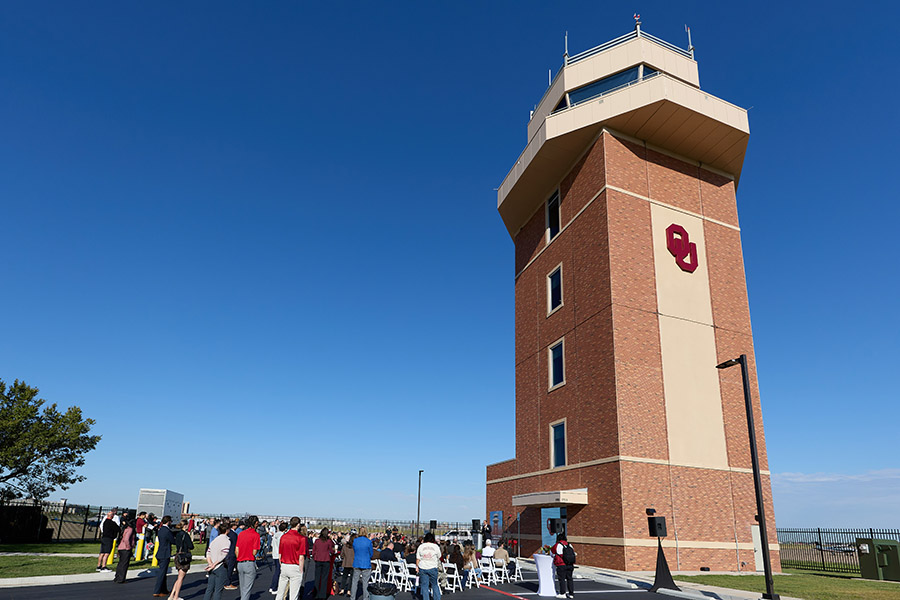
The University of Oklahoma today celebrated the opening of a new air traffic control tower at the OU Max Westheimer Airport. Standing 106 feet tall, more than double the current 52-foot facility, the new tower will modernize air traffic control operations and improve safety for pilots and students operating in the airspace.
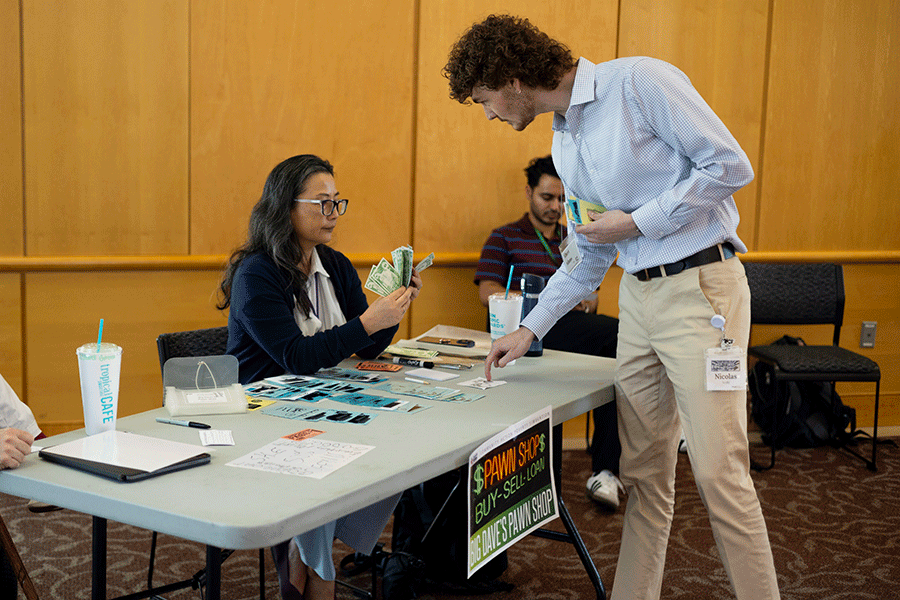
Do I buy groceries or pay the electric bill? Should I pawn some of my belongings to afford my prescription? My child is sick, so I will have to miss work to take care of him. Those are just a few of the difficult choices that OU-Tulsa health professional students confronted during the Community Access to Resources Experience. The role-playing activity challenged students to navigate the financial, family and other pressures that can affect a person’s health and ability to follow medical advice. Held annually during the SCM Institute orientation week, the experience is designed to generate understanding and build empathy.