NEWS

NORMAN, OKLA. – With funding from the U.S. Department of Energy, the University of Oklahoma is helping build AI into the future of American science. Two OU-led research teams have been awarded nearly $1.4 million in funding under the DOE’s Genesis Mission, with a third researcher providing significant support for a Genesis Mission project being led by Los Alamos National Laboratory.
U.S. Secretary of Energy Chris Wright announced the selections at the inaugural Genesis Mission Summit in Washington, D.C., placing OU among only 168 universities chosen from more than 5,000 applications submitted by over 800 institutions nationwide. OU’s projects not only address the Genesis Mission’s pillars of Energy Dominance and Discovery Science but align with the university’s impact-centers research priorities.
“This is a tremendous recognition of the caliber of research happening at the University of Oklahoma. The Department of Energy's Genesis Mission is accelerating discovery at a pace and scale our nation hasn't attempted before, and having our researchers selected to help lead that effort speaks to the strength and relevance of the work happening here," said OU Vice President for Research and Partnerships Matt Hulver, Ph.D. “Energy dominance, discovery science and national security are not separate challenges. They're deeply connected, and OU is proud to be part of the team pushing those breakthroughs forward. I'm grateful to our researchers for their vision and to our partners at DOE for this opportunity to contribute to something this consequential.”
Ahmad Ghassemi, McCasland Chair Professor of petroleum engineering in the Mewbourne College of Earth and Energy, will lead the project titled “AI-Enabled Rapid Analysis and Control of EGS Stimulation Using Machine Learning & Physics-Based Hydraulic Fracture/Natural Fracture (HF/NF) Interaction Modeling” with support from Jie Cao, an assistant professor in the School of Computer Science, and Hao Hu, an assistant professor in the School of Geosciences. This project will apply machine learning and physics-based modeling to analyze and control hydraulic stimulation in enhanced geothermal systems; technology DOE estimates could ultimately supply on the order of 90 gigawatts of capacity nationwide. Ghassemi’s selection carries a budget of $734,129 of Phase I funding.
“Plentiful energy can become available from enhanced geothermal systems. The key is fracturing rocks at great depths to create permeability, which experience has shown to be a challenging, complex process,” Ghassemi said. “Our goal is to use AI and geomechanics and fracture mechanics principles to improve the design and operational effectiveness of reservoir creation.”
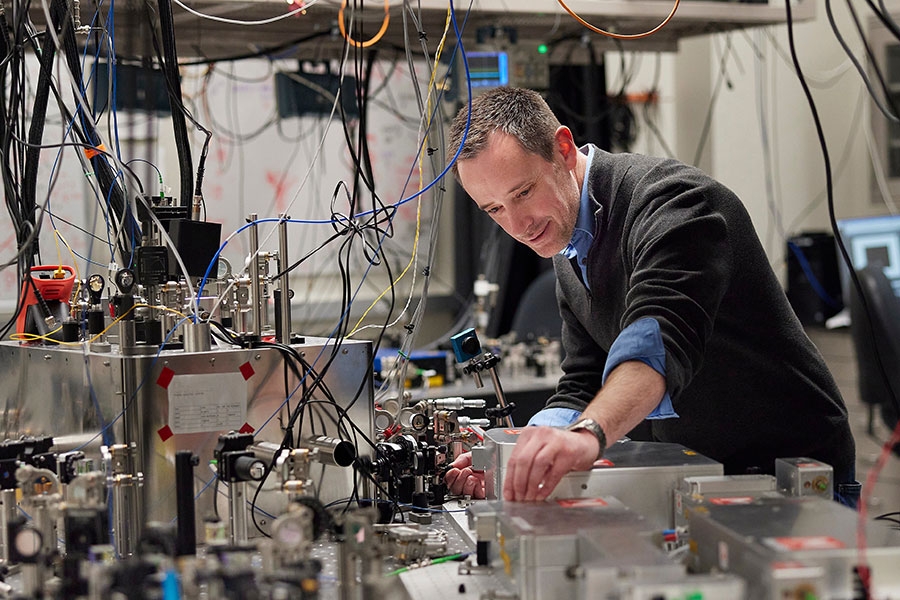
Grant Biedermann, Homer L. Dodge Endowed Chair and associate professor of physics in the Dodge Family College of Arts and Sciences, was awarded $651,891 for “AI-Driven Control and Optimization of QuDit Platforms in Rydberg Arrays.” This project will use AI as a real-time control system for arrays of individually trapped Rydberg atoms, one of the leading hardware platforms being developed for quantum computing and connects to the Mission’s “Discovering Quantum Algorithms with AI” challenge.
“This is an incredible opportunity to bring together Oklahoma universities and a national laboratory to explore a new frontier in quantum computing,” Biedermann said. “We are fortunate to partner with world experts in AI-driven quantum control and optical tweezer arrays, including Drs. Martin, Zlotnik and Meier at Los Alamos National Laboratory, as well as Dr. Bilitewski at Oklahoma State University, a leader in atom-based qudit simulation.”
Xuguang Wang, Robert Lowery Chair Professor and Presidential Research Professor in OU’s School of Meteorology, is a research partner working with Lawrence Livermore National Laboratory to use AI to model turbulence and clouds for Earth-system prediction. Titled “Scalable Twin for Intelligent Turbulence and Cloud Heuristics,” or “STITCH,” the project connects to DOE’s “Predicting U.S. Water for Energy” challenge, since water availability affects power generation directly, including cooling for thermal and nuclear plants and hydropower output.
The Genesis Mission was established under Executive Order 14363 in November 2025 with a goal of doubling the nation’s scientific productivity within a decade through a system of the nation’s fastest supercomputers, AI models and emerging quantum systems with experimental facilities across DOE’s 17 National Laboratories. This round of funding, $293 million, is the first commitment of an estimated $5 billion investment over time.
Learn more about the U.S. Department of Energy’s Genesis Mission and find a full list of research projects selected for Stage I funding.
About the University of Oklahoma
Founded in 1890, the University of Oklahoma is a public research university located in Norman, Oklahoma. As the state’s flagship university, OU serves the educational, cultural, economic and healthcare needs of the state, region and nation. For more information about the university, visit www.ou.edu.
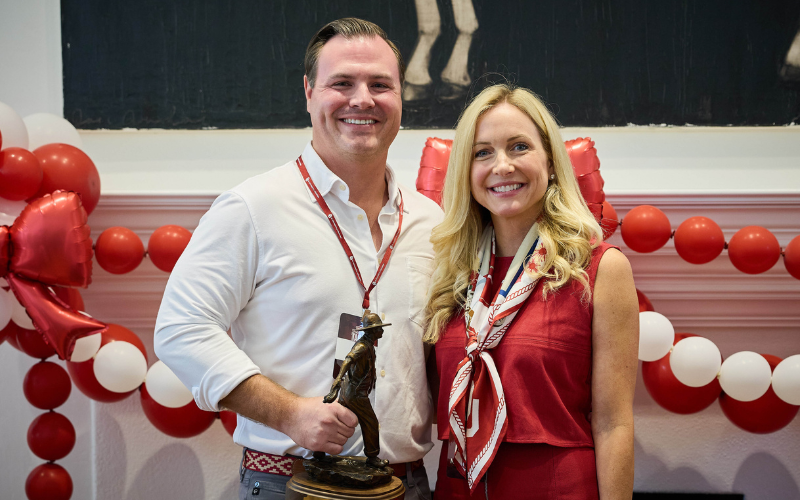
The University of Oklahoma has received a transformative gift from Jon and Shannon McCartney, which will name the McCartney Family Tunnel of Champions, the McCartney Family Gate of the Gaylord Family - Oklahoma Memorial Stadium and the McCartney Family Grand Lecture Hall in the Michael F. Price College of Business. The gift will also support the Inspiring Champions and the Athletic Director’s Discretionary Fund, in addition to establishing the McCartney DFW Career Trek program at Price College.
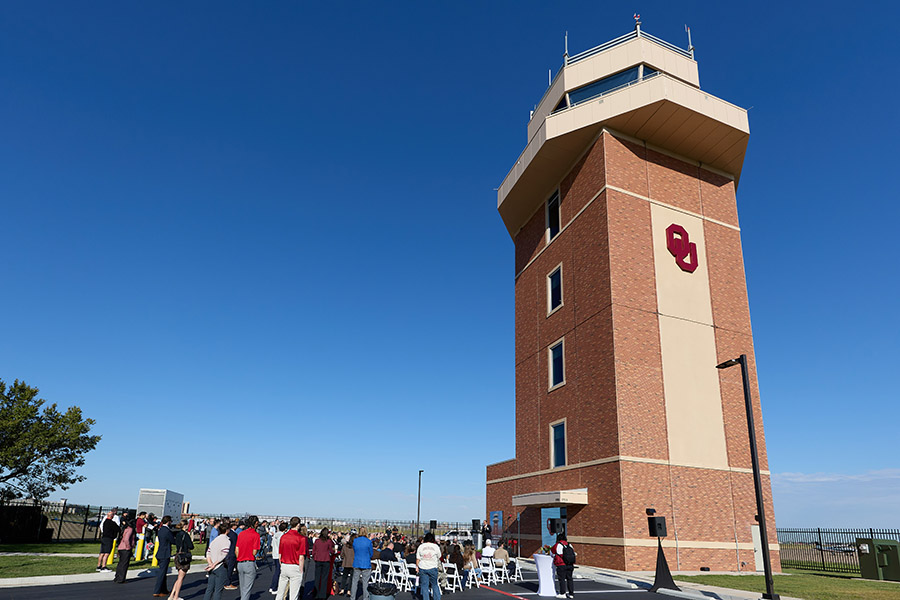
The University of Oklahoma today celebrated the opening of a new air traffic control tower at the OU Max Westheimer Airport. Standing 106 feet tall, more than double the current 52-foot facility, the new tower will modernize air traffic control operations and improve safety for pilots and students operating in the airspace.
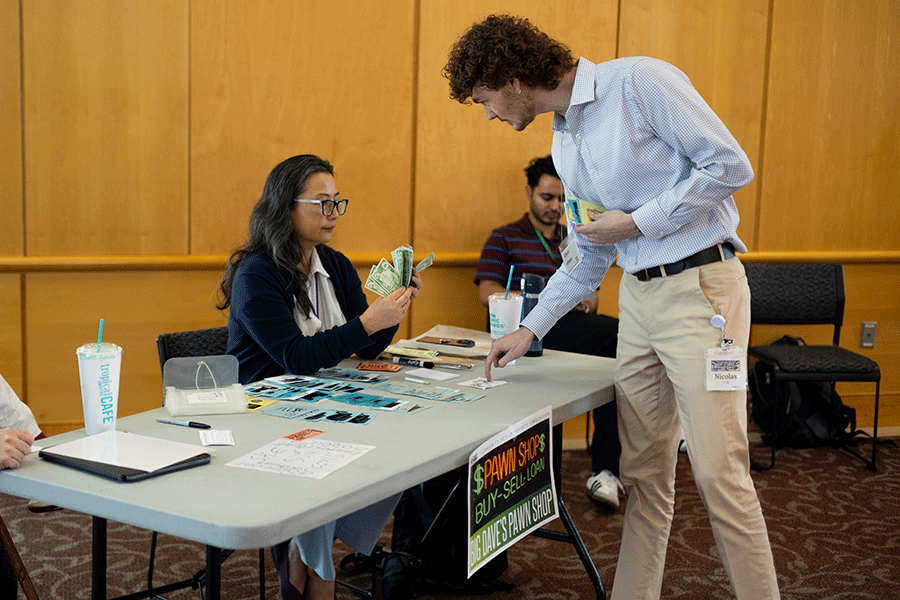
Do I buy groceries or pay the electric bill? Should I pawn some of my belongings to afford my prescription? My child is sick, so I will have to miss work to take care of him. Those are just a few of the difficult choices that OU-Tulsa health professional students confronted during the Community Access to Resources Experience. The role-playing activity challenged students to navigate the financial, family and other pressures that can affect a person’s health and ability to follow medical advice. Held annually during the SCM Institute orientation week, the experience is designed to generate understanding and build empathy.