NEWS

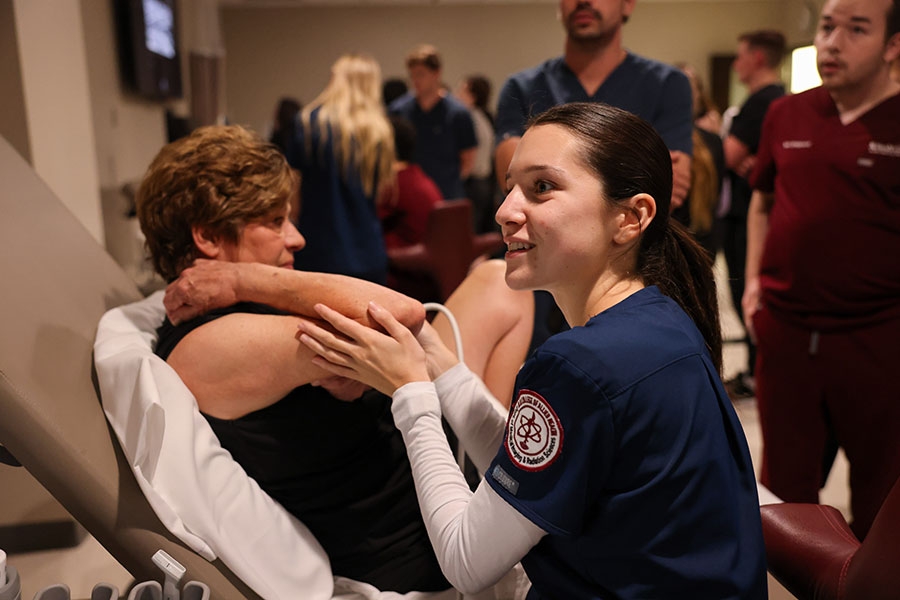
OKLAHOMA CITY – On a weekday afternoon, students from the University of Oklahoma College of Medicine pack into a room where friendly patients wait on adjustable beds beside modern ultrasound systems. These first-year medical students are getting their introduction to the Interprofessional Sonography (IPS) Laboratory, which opened in 2024 at the University of Oklahoma College of Allied Health.
Drawing on their knowledge of ultrasound and anatomy, experienced sonography students in the College of Allied Health show the medical students how to scan for anatomical structures before they try it themselves. Standardized patients in the room portray a realistic clinical setting for advanced learning.
“We're looking at muscles, nerves, arteries and vessels, and showing them how to differentiate them,” said Payton Simpson, a second-year sonography student. “It’s also their first time looking at ultrasound and being with the machine.”
“A lot of people might read ultrasounds, but they don’t know how it works,” she added. “So we’re teaching them the physics, what transducers are, how to angle, what to look for, and a little bit of how to optimize the image.”
The IPS lab is made possible through a 10-year Value Partnership with Siemens Healthineers and through funding from the Presbyterian Health Foundation. As part of their new four-year curriculum, medical students will receive eight of these lab experiences during the 18-month preclinical phase of their education.
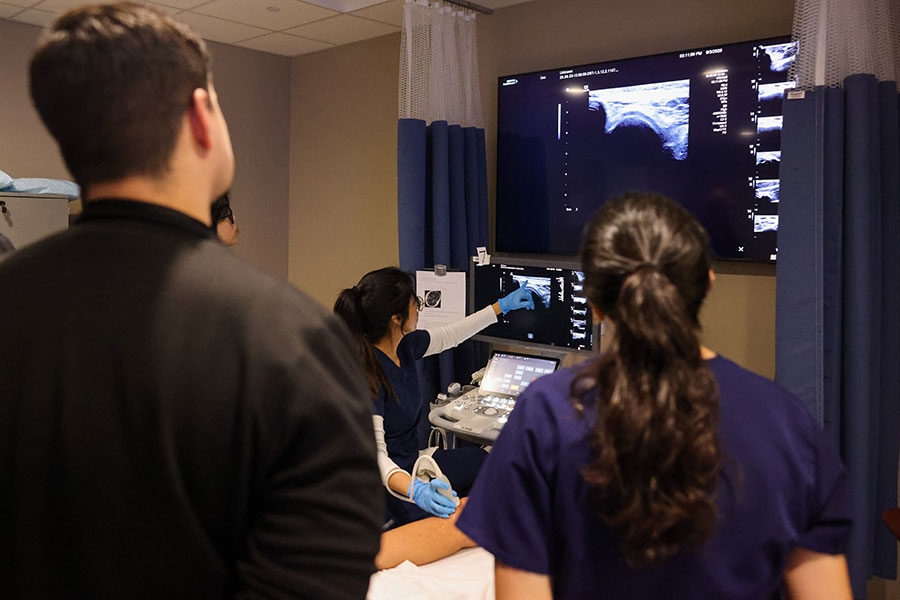
The College of Medicine began introducing ultrasound labs to its students about a decade ago to better prepare them for a changing landscape of physician duties. It moved the labs to the new IPS lab to accommodate growing class sizes and improve the experience for students.
Jason Wagner, M.D., a professor and the vice chair of the college’s Department of Radiological Sciences, also serves as medical advisor for the sonography program. He provides learning sessions for the sonography students right before the labs to guide them on how to best instruct the medical students and scan for physical structures they wouldn’t typically look for in a usual clinical ultrasound.
“The sonography faculty and I develop a specific set of instructions for each lab,” Wagner said. “In addition to medical students acquiring ultrasound skills, the other purpose of these labs is to reinforce what they're learning in the main curriculum. We try to closely align the topics of these scan labs with the organ systems the medical students are currently studying.”
Each of the IPS lab’s nine imaging stations includes both standard and limited specialty transducer selections, and can also be used through self-study open lab hours several days a month. These features offer a wide array of learning experiences for not only both medical and sonography students, but those across the OU Health Campus, such as physician associate and occupational therapy students.
“It's a great asset that we now have that available,” Wagner said. “For students that really resonate with it, they can use it during their whole four years. And if they stay here as an intern and resident, it's still open to them.”
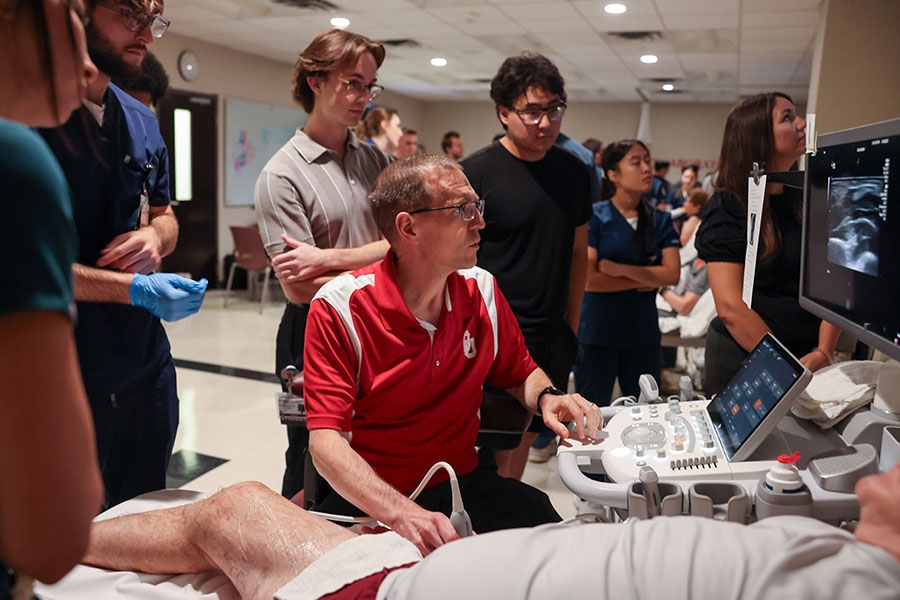
Aurora Jennings, a second-year medical student, said that before the lab, she “could have deciphered an ultrasound image about as well as hieroglyphics.” Since then, she has put her preclinical learning of diagnostic processes into practice.
“To be able to visualize first-hand the structures, pathologies and conditions that usually we are only reading about not only solidifies them in our memory, but gives us tangible exposure to the types of things we will see in our future patients,” Jennings said.
As medical students gain critical skills through the lab, sonography students also benefit from its interprofessional dynamics.
Alisha Elliott, M.S., is the IPS lab’s director and an assistant professor in the College of Allied Health’s Department of Medical Imaging & Radiation Sciences. She said that the use of point-of-care ultrasound is becoming more prominent, and that in this evolving ultrasound landscape, sonography students are gaining valuable experience communicating and collaborating with medical students in the lab.
“As a sonographer, I often get asked by providers, ‘What sonogram should I order if I wanted to evaluate for these particular pathologies,’” Elliott said. “And so we have to be able to foster those communications so that our patient gets the right test at the right time so they can get the right results to support the provider’s medical decisions and treatment plan.”
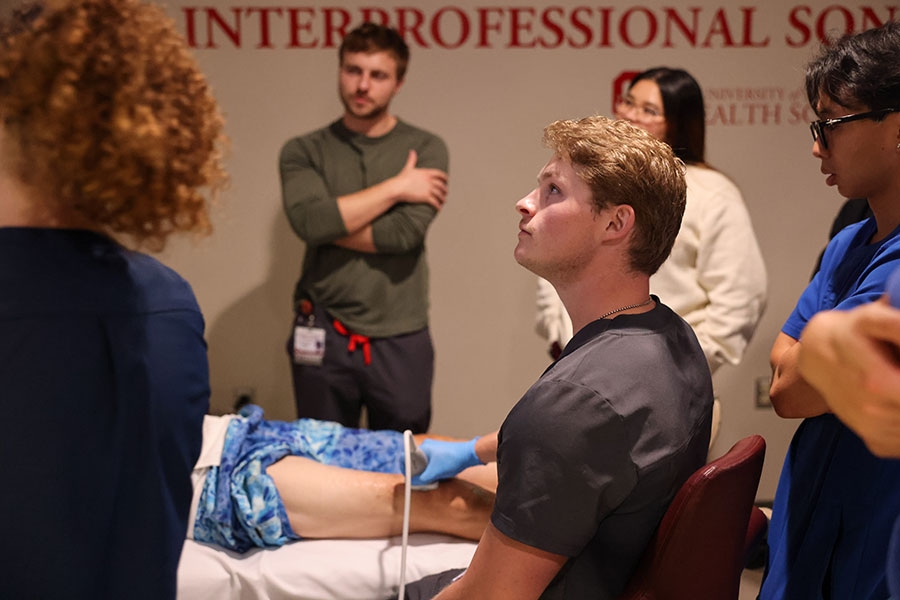
Because sonography students spend two years at the College of Allied Health before completing their four-year track, it’s critical that their time in labs is well spent. Elliott said college leaders collect data from these interprofessional sessions to continually enhance both sonography and medical students’ experiences.
“We can see what we're doing really well, and who's benefiting,” Elliott said. “We can also see areas we can grow in. For example, maybe it would benefit the sonography students to receive more pre-lab instruction or more exposure to the radiology residents. Or maybe, we bring in other experts in our field, like head and neck surgeons, to supplement the lab content that day for the medical students.”
For Simpson, her experiences in the IPS lab are also preparing her for her career. She recognizes that developing communication skills will help strengthen patient care. “Whenever we come here and work with them, it really shows us that we're all a team,” Simpson said.
“Our staff are amazing, and the resources we have here are absolutely amazing. I’m very blessed to be here.”
About the University of Oklahoma
Founded in 1890, the University of Oklahoma is a public research university located in Norman, Oklahoma. As the state’s flagship university, OU serves the educational, cultural, economic and healthcare needs of the state, region and nation. For more information about the university, visit www.ou.edu.
A team of researchers headquartered at the University of Oklahoma is taking an innovative approach toward advancing grassland conservation and management, with grant support from the the U.S. National Science Foundation. The project brings together experts and observatory sites from across the state.
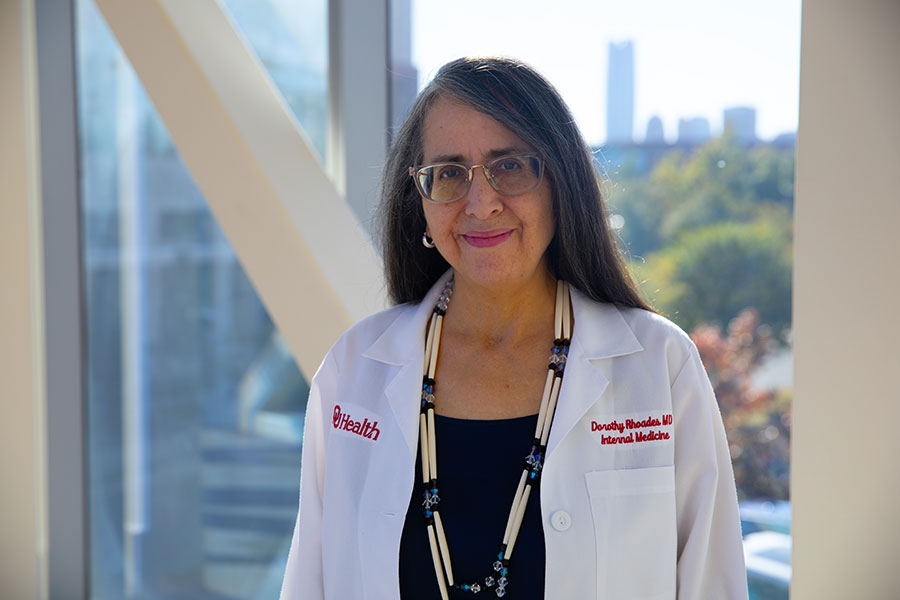
Dorothy A. Rhoades, M.D., M.P.H., has been recognized for her impact on improving Native American health outcomes. She was honored by the Association of American Indian Physicians at its 54th Annual Meeting & Health Conference.
New research from the University of Oklahoma shows how unusual atmospheric conditions linked to tropical cyclones can contribute to compound extreme heat and ground-level ozone pollution, even far from the storm, increasing risks to human health.