NEWS

OKLAHOMA CITY – Researchers from the University of Oklahoma Health Campus have published an article and podcast in the New England Journal of Medicine describing a novel care coordination and communication program and its potential for helping Indigenous people access the lifesaving cancer care that they need.
American Indian and Alaska Native residents in Oklahoma face significant cancer disparities. According to the Centers for Disease Control and Prevention and the Oklahoma State Department of Health, between 2016 and 2020, the rate of Indigenous cancer-related death was 44% higher than the general population in Oklahoma and 67% higher than the general population in the United States.
Many Indigenous people receive primary care services at Indian Health Service facilities, tribal health facilities and urban Indian health facilities, but they are usually referred out for specialty services like cancer care. That’s when they can face barriers like delays in treatment and potentially burdensome costs.
“The referral process can be lengthy and confusing for patients, clinicians and staff alike, and it requires a significant amount of communication between facilities,” said the article’s lead author, Amanda Janitz, Ph.D., MPH, an associate professor of epidemiology in the OU Hudson College of Public Health. “In addition, patients may have difficulty affording the gas to travel to our facilities or lodging if they come from a long distance. We want to make a difference for this patient population in a way that ultimately improves their health outcomes.”
Since 2012, OU Health Stephenson Cancer Center’s American Indian Navigation Program has served 4,463 Indigenous patients from 65 different tribes. The program has had a positive effect with its logistical and supportive guidance, but researchers sought to enhance it. A pilot project serving 128 patients from July 2023 to February 2025 resulted in a decrease in missed appointments from 19% to 11%. Depression screening rates increased from 72% to 100%, and two-thirds of patients received financial support for transportation and lodging. Additionally, patients reported an increased understanding of clinical trials, and clinicians and students received training on Indigenous perspectives toward research. The project was funded by the American Cancer Society.
Now, Stephenson Cancer Center has the opportunity to further expand and test what is called the Care Coordination and Communication Program in Oncology for Tribal Health Systems. The work is funded by a $17.2 million National Institutes of Health grant awarded to OU last year that focuses on several activities related to cancer prevention, cancer screening and cancer care coordination.
Through virtual “huddles,” teams from Stephenson Cancer Center and the referring facility will meet to discuss patients’ cases and any barriers they face to receiving treatment. The huddles will include clinicians from both facilities as well as American Indian and nurse navigators and case management staff. Clinicians may discuss the course of treatment and side effects, while navigators and case managers will address psychosocial needs and any referral roadblocks.
“These huddles allow the group to talk through the issues at the same time instead of going back and forth via email,” Janitz said. “There is value in having everyone on the same Zoom call.”
The huddles will also become part of a clinical trial in which participants are randomly assigned to receive the huddles or standard navigation services without huddles. At the end of the trial, everyone will receive the enhanced services.
“We hope this project shows that we can provide the huddles on a large scale,” Janitz said. “We’ll also be looking at patient satisfaction and whether the huddles lead to an improved time between the patient’s initial diagnosis and starting their cancer treatment. That’s the goal for this type of research – to increase the speed at which we can improve outcomes.”
About the University of Oklahoma
Founded in 1890, the University of Oklahoma is a public research university located in Norman, Oklahoma. As the state’s flagship university, OU serves the educational, cultural, economic and health care needs of the state, region and nation. For more information about the university, visit www.ou.edu.
The University of Oklahoma has received a transformative gift from Jon and Shannon McCartney, which will name the McCartney Family Tunnel of Champions, the McCartney Family Gate of the Gaylord Family - Oklahoma Memorial Stadium and the McCartney Family Grand Lecture Hall in the Michael F. Price College of Business. The gift will also support the Inspiring Champions and the Athletic Director’s Discretionary Fund, in addition to establishing the McCartney DFW Career Trek program at Price College.
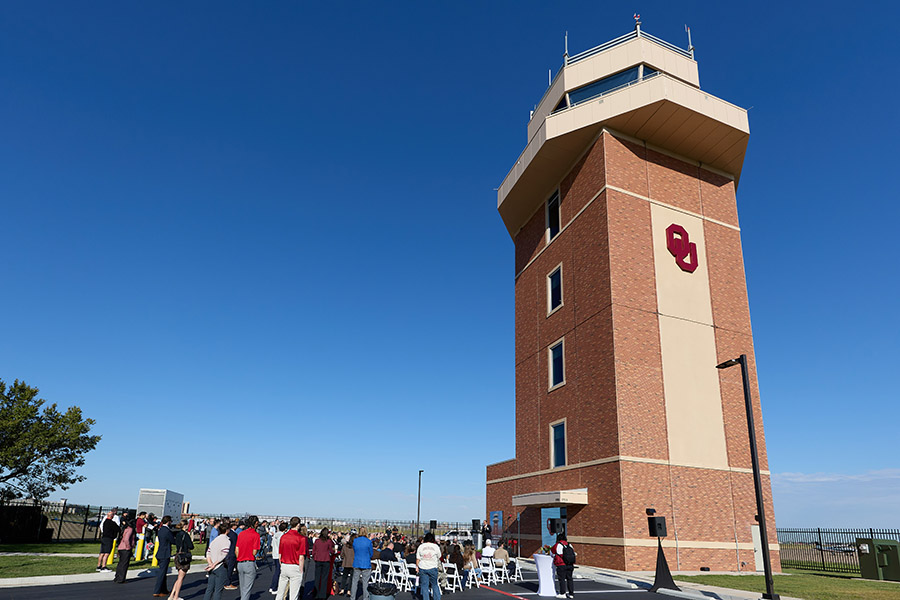
The University of Oklahoma today celebrated the opening of a new air traffic control tower at the OU Max Westheimer Airport. Standing 106 feet tall, more than double the current 52-foot facility, the new tower will modernize air traffic control operations and improve safety for pilots and students operating in the airspace.
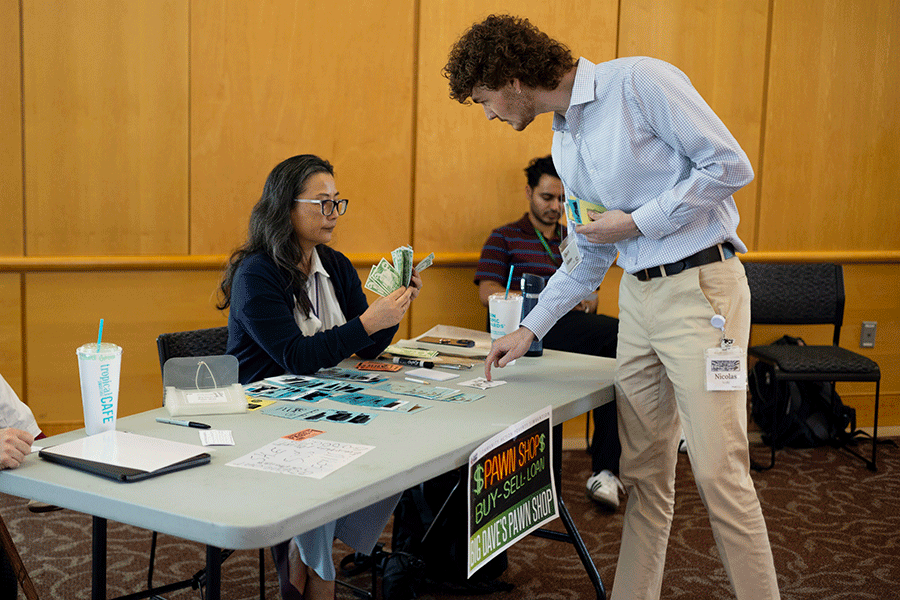
Do I buy groceries or pay the electric bill? Should I pawn some of my belongings to afford my prescription? My child is sick, so I will have to miss work to take care of him. Those are just a few of the difficult choices that OU-Tulsa health professional students confronted during the Community Access to Resources Experience. The role-playing activity challenged students to navigate the financial, family and other pressures that can affect a person’s health and ability to follow medical advice. Held annually during the SCM Institute orientation week, the experience is designed to generate understanding and build empathy.