NEWS


OKLAHOMA CITY, OKLA. – A University of Oklahoma researcher is the first to discover that the sequence of the genetic defect in the neuromuscular disease Friedreich’s ataxia isn’t always as uniform as previously thought, a breakthrough finding that could spark changes in how the condition is diagnosed and studied.
To further the research, Sanjay Bidichandani, MBBS, Ph.D., a professor of pediatrics at the University of Oklahoma College of Medicine, has received a $2.8 million grant from the U.S. Department of Defense.
Friedreich’s ataxia appears in the teenage years with balance and walking problems and can lead to heart issues, vision and hearing loss, and other symptoms. The disorder is inherited, caused by a defect in a gene called FXN, and it is recessive, meaning a person needs a copy of the gene defect from both parents to be affected.
Since the FXN gene was discovered in 1996, a finding in which Bidichandani played a role, the sequence of the genetic defect was thought to be standard. The disease is indicated by an expansion of the letters GAA in the gene sequence. A person without Friedreich’s ataxia typically has fewer than 30 of the triplet letters GAA in a row. However, people with the condition have 100 to 1,500 GAAs, an expansion of the naturally occurring sequence.
The test to discover this expansion is straightforward, but Bidichandani’s team wondered if there was more to the story than a greater length of GAA letters. When they used a new technology called long-read sequencing, they discovered something that no one had found before: “spelling errors” in the long string of GAA letters in some people with the condition.
“Instead of GAA expanded 1,500 times, we found different combinations of G’s and A’s that the original test could not detect,” Bidichandani said. “It is a whole new level of genetic variability that was not being taken into account in the diagnosis and prognosis of Friedreich’s ataxia.”
The discovery is significant for several reasons. Bidichandani’s preliminary research using long-read sequencing shows that people with GAA letter irregularities seem to have a milder version of the disease in which they experience slower progression. His data thus far also shows that about 30% of people with the condition have this irregular spelling.
“But they have been told they have the classic type of Friedreich’s ataxia,” he said. “Our first goal with this new grant is to determine the real diversity of genotypes in people with Friedreich’s ataxia, and then to determine whether their condition is actually less severe.”
The research has major implications for clinical trials, Bidichandani said. People in ongoing trials have been enrolled based on the assumption that there is one presentation of Friedreich’s ataxia with a straightforward expansion of GAA letters. If trial participants appear to be responding to a drug, they actually could have a milder version of the condition instead, Bidichandani said.
Understanding the different genotypes is also essential for people who want to undergo testing before deciding to have children. “Because the standard test performed by many clinical diagnostic labs does not detect the spelling errors, people may receive a false negative result for carrier testing,” he said. “We have already discovered several families who’ve been told they’re not carriers, but when we do our specialized test, it turns out that they are carriers.”
Bidichandani’s grant was one of only 19 Impact Awards funded nationally through the fiscal year 2024 Peer Reviewed Medical Research Program of the Congressionally Directed Medical Research Program within the Department of Defense. It is called an Impact Award because grant recipients are expected to make discoveries that have an immediate effect on patient care.
Friedreich’s ataxia is rare; about 5,000 people in the United States have the condition, and there is currently only one drug approved by the Food and Drug Administration for treatment. To expand his research on patients with Friedreich’s ataxia, Bidichandani is collaborating with David R. Lynch, M.D., Ph.D., of Children’s Hospital of Philadelphia, who shares a portion of the grant.
They have also been supported by the Friedreich’s Ataxia Research Alliance, the largest patient advocacy group in the world for the condition. The organization provided initial funding that allowed Bidichandani and Lynch to gather the data needed to apply for the Department of Defense grant.
“This is an exciting time for our research program,” Bidichandani said. “We believe our findings will have a beneficial impact on people with Friedreich’s ataxia and their families.”
About the project
The U.S. Army Medical Research Acquisition Activity, 808 Schreider Street, Fort Detrick MD 21702-5014, is the awarding and administering acquisition office. This work was supported by The Assistant Secretary of Defense for Health Affairs in the amount of $2.8 million through the Peer Reviewed Medical Research Program under Award Number HT9425-25-1-0541. Opinions, interpretations, conclusions, and recommendations are those of the author(s) and are not necessarily endorsed by the Department of Defense.
About the University of Oklahoma
Founded in 1890, the University of Oklahoma is a public research university with campuses in Norman, Oklahoma City and Tulsa. As the state’s flagship university, OU serves the educational, cultural, economic and health care needs of the state, region and nation. In Oklahoma City, OU Health Sciences is one of the nation’s few academic health centers with seven health profession colleges located on the same campus. OU Health Sciences serves approximately 4,000 students in more than 70 undergraduate and graduate degree programs spanning Oklahoma City and Tulsa and is the leading research institution in Oklahoma. For more information about OU Health Sciences, visit www.ouhsc.edu.
The University of Oklahoma has received a transformative gift from Jon and Shannon McCartney, which will name the McCartney Family Tunnel of Champions, the McCartney Family Gate of the Gaylord Family - Oklahoma Memorial Stadium and the McCartney Family Grand Lecture Hall in the Michael F. Price College of Business. The gift will also support the Inspiring Champions and the Athletic Director’s Discretionary Fund, in addition to establishing the McCartney DFW Career Trek program at Price College.
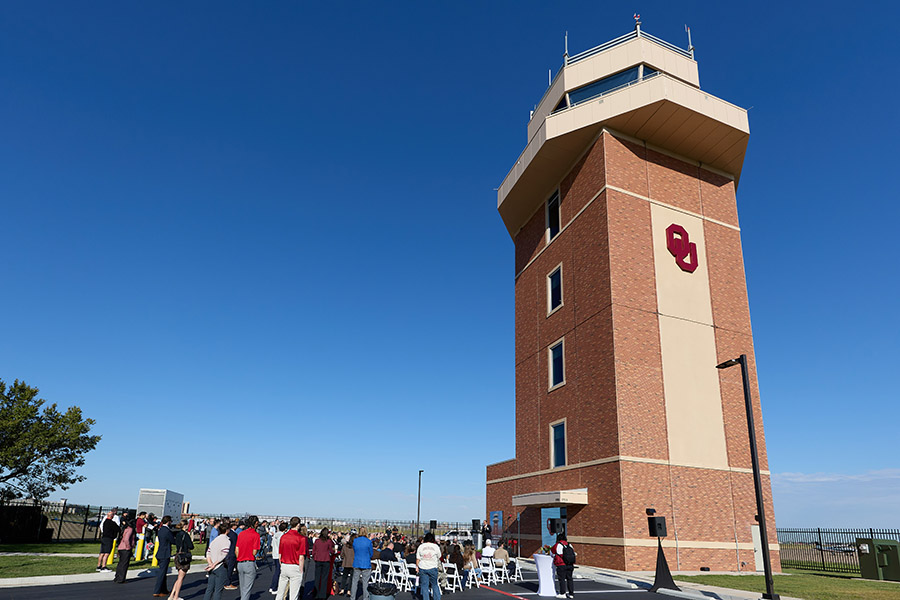
The University of Oklahoma today celebrated the opening of a new air traffic control tower at the OU Max Westheimer Airport. Standing 106 feet tall, more than double the current 52-foot facility, the new tower will modernize air traffic control operations and improve safety for pilots and students operating in the airspace.
Do I buy groceries or pay the electric bill? Should I pawn some of my belongings to afford my prescription? My child is sick, so I will have to miss work to take care of him. Those are just a few of the difficult choices that OU-Tulsa health professional students confronted during the Community Access to Resources Experience. The role-playing activity challenged students to navigate the financial, family and other pressures that can affect a person’s health and ability to follow medical advice. Held annually during the SCM Institute orientation week, the experience is designed to generate understanding and build empathy.