NEWS

By
Greg Bruno
Date
Media Contact
Kat Gebauer
kathryngebauer@ou.edu
NORMAN, OKLA. – For structural engineers, nature has always held a magnetic appeal. From Singapore’s towering Supertree Grove to Oklahoma City’s Skydance Bridge, the architectural pull of the natural world is evident in the glass, bricks and beams that shape our built environment.
But for Robert W. Nairn, Ph.D., director of the Center for Restoration of Ecosystems and Watersheds at the University of Oklahoma’s Gallogly College of Engineering, nature offers something even greater to infrastructure planners: itself.
“Infrastructure isn’t just roads and bridges and dams; it’s also wetlands, rivers and forests,” Nairn said. “We’re working to understand the services that these types of natural infrastructure provide to society.”
A new five-year, $3 million grant from the U.S. Army Corps of Engineers aims to expand that understanding. Awarded through the corps’ Engineering with Nature program, the funding will help researchers evaluate the long-term value of integrating natural systems into infrastructure planning.
Sometimes called nature-based solutions, natural infrastructure systems like grasslands and wetlands can provide flood control, improve water and air quality and enhance biodiversity – often in more sustainable and cost-effective ways than traditional solutions, such as concrete dams or levees.
“Aligning naturally occurring or restored ecosystems with engineering processes can unlock significant benefits,” Nairn said. “But what’s been missing are the tools and techniques to monitor and quantify those advantages.”
That’s where the new grant comes in. The project will focus on three main areas: ecosystem processes, geotechnical engineering and water resources modeling of different natural infrastructure practices. The goal is to advance natural infrastructure applications by developing and monitoring technologies.
For example, researchers plan to deploy unoccupied aerial systems equipped with advanced sensors to collect environmental data at very fine scales. “We can fly drones to collect information on native vegetation, telling us how healthy plant communities are – with resolutions down to centimeter-level grids,” Nairn said.
Other work will examine root structures to understand how plant varieties stabilize soil, and whether natural systems might support processes from biodiversity conservation to carbon cycling.
Designing with nature is not a new idea. From the Hanging Gardens of Babylon to turf roofs in ancient Norse settlements, civilizations have long understood the rewards of incorporating natural elements in building.
This concept has since evolved to include economic, ecological and social benefits intentionally aligned with modern engineering processes. In his 2001 book, A Prosperous Way Down, the pioneering ecosystem ecologist H.T. Odum even argued for rethinking economic and societal structures to align more closely with ecological realities.
Recognition of these ideas on a larger scale, however, has only recently gained momentum. As extreme weather events intensify and infrastructure systems age and fail, there is growing political and economic support for integrating natural infrastructure solutions.
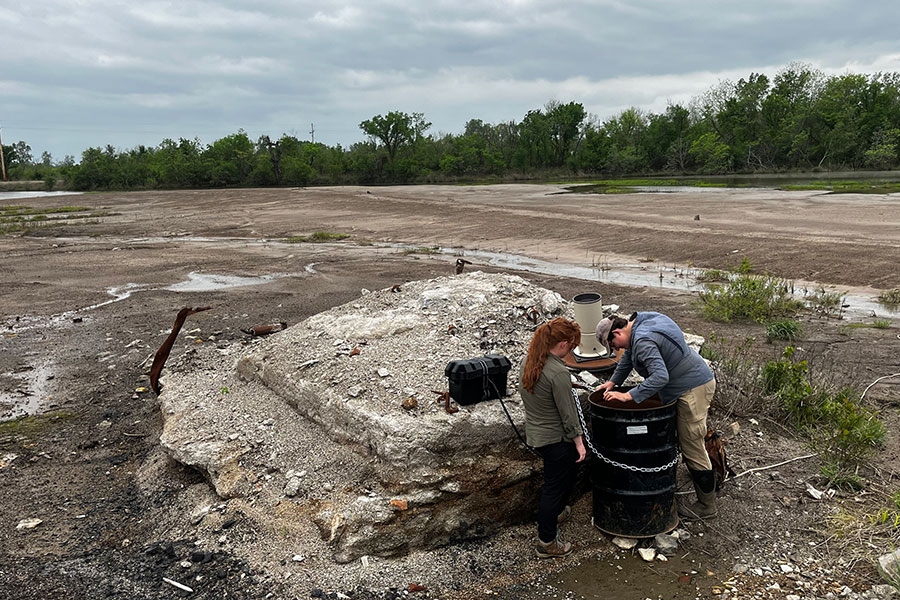
Nairn’s research will focus on natural, engineered and hybrid applications in inland rivers and streams of the Great Plains, as well as small and large multipurpose reservoirs and associated wetland ecosystems. Performance will be quantified by generating spatially and temporally explicit data, produced through field- and laboratory-scale experiments and models.
Dayton M. Dorman, an environmental engineering postdoctoral researcher in Nairn’s lab, said the timing is critical. “In the U.S., a lot of our infrastructure is at a point where it needs to be replaced. The question becomes: do we keep doing what we’ve been doing, or do we try to find new ways to apply natural solutions to augment these failing systems?”
She added: “Building resilience is at the core of this work.”
The new grant extends prior support, including a $2.25 million award in 2021. Nairn hopes the expanded research will help push natural infrastructure further into the mainstream of engineering and infrastructure planning.
“We need to find a better way,” he said. “We need to find a prosperous way down – a way to work with nature rather than against it.”
About the University of Oklahoma
Founded in 1890, the University of Oklahoma is a public research university located in Norman, Oklahoma. As the state’s flagship university, OU serves the educational, cultural, economic and health care needs of the state, region and nation. For more information about the university, visit www.ou.edu.
The University of Oklahoma College of Medicine has honored two residents with the Lloyd Rader Award, which recognizes outstanding clinical and research achievements in residency.
The University of Oklahoma will receive up to $220 million over five years from the U.S. Department of Commerce and the National Oceanic and Atmospheric Administration to continue the life-saving weather research led by the OU-NOAA Cooperative Institute for Severe and High-Impact Weather Research and Operations, extending a nearly 50-year partnership that has helped give Americans earlier, more accurate weather warnings
The OU Food Pantry won the annual Red River Food Fight, collecting 31,815.9 pounds of shelf-stable food and drinks to top UT Outpost’s 22,567 pounds. OU has won the competition four years in a row.