
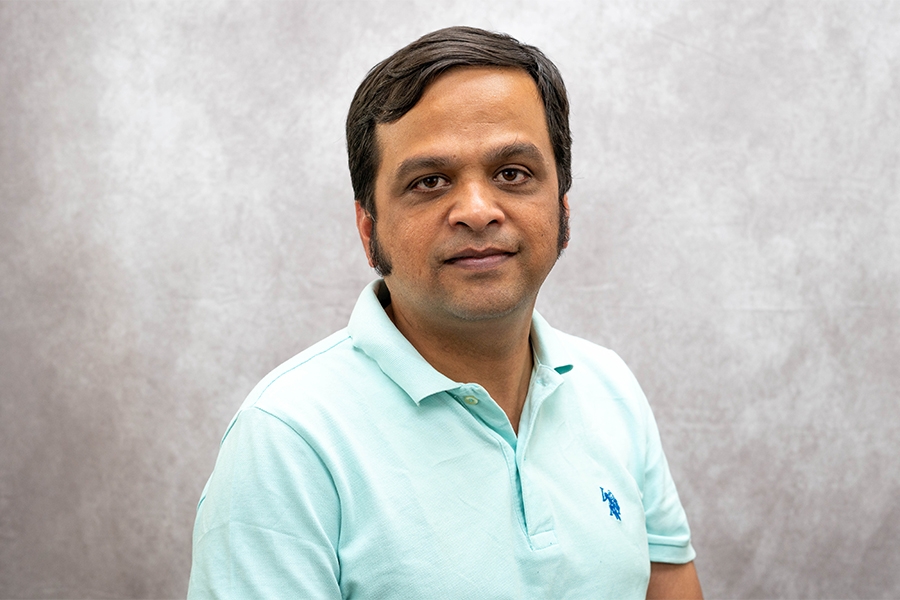
After a 15-year career in journalism in Bangladesh, where he rose from cub reporter to news manager overseeing a team of more than 75 journalists, Mohammad Al Masum Molla came to the University of Oklahoma seeking answers to the deeper questions his newsroom experience could not resolve. He had reported on environmental disasters, political unrest, and one of the world’s largest refugee crises, and his assignments had taken him into conflict zones across Africa, including South Sudan, Mali, and the Democratic Republic of Congo. Despite the breadth of his experience, Masum said he reached a point where professional instinct was no longer enough. “I realized that experience alone couldn’t answer how ethics and technology keep redefining the role of the journalist,” he said. “I came to OU to transform hard-won professional insight into systematic research and theoretical contribution—and Gaylord offered the ideal environment for that transformation.”
His years in the field now form the foundation of his research at Gaylord. Reporting under political pressure in a developing democracy, covering climate-driven crises along Bangladesh’s coast, and managing digital operations for a national newsroom with nearly fifteen million monthly page views shaped his interest in how journalists negotiate ethical dilemmas and maintain autonomy in rapidly changing environments. His sustained reporting on the Rohingya refugee crisis, which culminated in a published book, further deepened his commitment to studying how journalists work under conditions of conflict, displacement, and humanitarian emergency. “These experiences revealed the moral and structural limits of journalism,” he said. “They now ground my research in understanding how journalists adapt to digital, institutional, and political constraints.”
Masum said his first year in the program marked a dramatic shift in his professional journey. “When I first came to OU, I had no idea how to write a research paper,” he said. “I was starting over.” A year later, he has co-authored five peer-reviewed journal articles, presented six conference papers at major international academic venues—such as ICA, AEJMC, and WAPOR—and has several additional projects in progress. His work now focuses on how journalists navigate technological change, make ethical decisions under pressure, and communicate environmental crises more effectively. With guidance from faculty mentors including Dr. Chang Sup Park, he has published in journals such as Computers in Human Behavior Reports, The Howard Journal of Communications, and Communication & Society. He is especially proud of interdisciplinary collaborations with environmental scientists that led to studies on lightning patterns and heatwave trends, published in Earth Systems and Environment and Climate Services. “If the newsroom taught me to chase truth quickly, Gaylord has taught me to understand it deeply—and to build knowledge that lasts,” he said.
Masum’s research trajectory grew naturally from his career in journalism. Early in his reporting life, he covered environmental issues in Bangladesh, documenting the slow but devastating effects of saltwater intrusion, coastal erosion, and climate-driven migration. Those experiences pushed him to work alongside scientists to translate data into storytelling, a partnership that later shaped his academic interests. As he moved into digital leadership roles, he also confronted the growing influence of technology and algorithmic distribution on public information. Working in an authoritarian system, he witnessed firsthand how political and technological forces could narrow or distort public discourse. “I’ve lived at the intersection of AI, media autonomy, and environmental journalism,” he said. “Each part of my research reflects a part of my life.”
What Masum appreciates most about Gaylord, he said, is the program’s research-driven culture and its strong sense of community. “Gaylord transformed me from a reporter who chased stories to a researcher who investigates ideas,” he said. He credits the faculty and staff for creating an environment that supports both academic rigor and personal growth. “The people here understand that our work is tied to our lives beyond campus—to our countries, our professions, and our sense of purpose. I’ve found mentors who challenge me intellectually and a community that steps forward beyond the classroom.”
Looking ahead, Masum plans to pursue a Ph.D. in journalism with the goal of becoming a scholar-educator who bridges professional practice and academic research. He hopes to develop frameworks that help journalists maintain their moral compass amid shifting technological, political, and crisis-driven pressures. “My journey has always been about translation,” he said. “Now I want to turn lived experience into research that guides others—connecting the Global South and Western academia and building a body of work that serves both knowledge and action.”
