Skip Navigation

Farina King

Skip Side Navigation
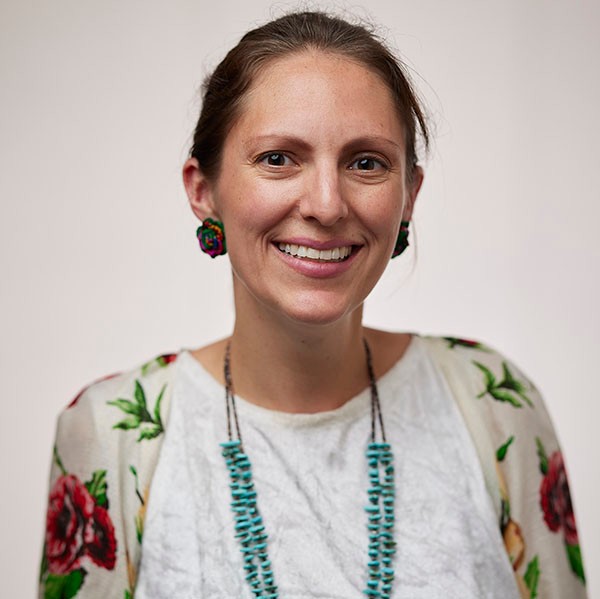
Dr. Farina King.

Farina King
(she/her)

 Full Professor
Horizon Endowed Chair of Native American Ecology and Culture

Copeland Hall, room 205
farinaking@ou.edu
405-325-2312

Ph.D. in History, Arizona State University
M.A. in History, University of Wisconsin-Madison
B.A. in History and French Studies with minors in Native American Studies and African Studies, Brigham Young University

Bilagáanaa niliigo’ dóó Kinyaa’áanii yásh’chíín. Bilagáanaa dabicheii dóó Tsinaajinii dabinálí. Ákót’éego diné asdzáá nilí. Dr. Farina King is Bilagáanaa (white American settler of English and Northwestern European descent), born for Kinyaa’áanii (the Towering House Clan) of the Diné (Navajo). Her mother is white American from Michigan, and her father is Diné from Tséyaaniichii’ (the Rehoboth, New Mexico checkerboard region) of Diné Bikéyah (Navajo land). Her maternal grandfather was white American, and her paternal grandfather was Tsinaajinii (Black-streaked Woods People Clan) of the Diné. She is a citizen of the Navajo Nation. King was born in Tó Naneesdizí (Tuba City) and lived in the Navajo Nation as a small child, until her family moved to the Washington, D.C. metropolitan area where her father worked for the Indian Health Service.

King is the Horizon Chair in Native American Ecology and Culture and Professor of Native American Studies at the University of Oklahoma, homelands of the Hasinais, or Caddo Nation, and Kirikirʔi:s, or Wichita & Affiliated Tribes. She served as the Interim Department Chair of Native American Studies at OU between 2023 and 2024.

Previously, between 2016 and 2022, she was an associate professor of History at Northeastern State University, Tahlequah, in the homelands of the Cherokee Nation and United Keetoowah Band of Cherokees. She was also an affiliate of the Cherokee and Indigenous Studies Department and the founding Director of the NSU Center for Indigenous Community Engagement. She is a past president of the Southwest Oral History Association (2021-2022).

During the 2016-2017 academic year, King was The David J. Weber Fellow for the Study of Southwestern America at the Clements Center for Southwest Studies of Southern Methodist University. She earned her Ph.D. in American history with an emphasis in Native American history at Arizona State University in 2016. Her first book, The Earth Memory Compass: Diné Landscapes and Education in the Twentieth Century, was published by the University Press of Kansas in October 2018.

She was the Charles Eastman Dissertation Fellow (2015-2016) at Dartmouth College. She received her M.A. in African history from the University of Wisconsin-Madison and a B.A. from Brigham Young University with a double major in History and French Studies. She has studied several languages including French, Portuguese, Yorùbá, Wolof, and Diné Bizaad (Navajo), and she plans to learn more languages in the future.

Her primary area of research is colonial and post-colonial Indigenous studies, mainly Indigenous experiences in colonizing forms of education, such as at federal American Indian boarding schools. Her research traces the changes in Diné educational experiences through the twentieth century, using a hybrid approach of the Diné Sacred Four Directions. She has facilitated oral histories with Diné boarding school survivors and alumni, involving former students at the Intermountain Indian School, Crownpoint Indian Boarding School, Tuba City Boarding School, Leupp Boarding School, and Kayenta Boarding School.

The University of Arizona Press published Returning Home: Diné Creative Works from the Intermountain Indian School, in November 2021, which she co-authored with Drs. Michael Taylor and James Swensen. Returning Home features Diné students’ art, poetry, and writing of the Intermountain Indian Boarding School (1950-1984) from a traveling exhibit that King, Taylor, and Swensen organized as well as some of the oral histories with King and Intermountain alumni.

King has also written and presented about Native American and Indigenous Latter-day Saint experiences in the twentieth century, drawing from some oral histories that she co-created with narrators for the Latter-day Saint Native American Oral History Project at the Charles Redd Center for Western Studies. She served on the steering committee of Global Mormon Studies and other organizations. In October 2023, the University Press of Kansas published her book Diné dóó Gáamalii: Navajo Latter-day Saint Experiences in the Twentieth Century through the Lyda Conley Series on Trailblazing Indigenous Futures.

King’s ongoing work explores Indigenous perspectives of health, healing, and education in the face of systemic violence. Her research includes “A Diné Doctor History,” which examines Diné healing practices and the impact of diseases through generations, and the anthology COVID-19 in Indian Country: Native American Memories and Experiences of the Pandemic (2024) that she co-edited with Wade Davies featuring 22 authors in 17 chapters. Referring to an array of sources, such as oral histories, archival materials, newspapers, and digital humanities, King contextualizes health disparities and resilience strategies among Diné and other Indigenous peoples.

At the University of Oklahoma, she builds interdisciplinary partnerships, such as collaborations with the Hydrometeorology and Remote Sensing Laboratory (HyDROS Lab) and Center for Spatial Analysis (CSA), to support Native Nations like the Otoe-Missouria Tribe in addressing climate change and environmental justice. Her community-engaged projects, including Mapping Tahlequah History and Indigenous Truthtelling of Boarding Schools, reflect her commitment to advancing Indigenous sovereignty, education, and cultural preservation.

She is one of the series editors for the Lyda Conley Series on Trailblazing Indigenous Futures of the University Press of Kansas as well as a series co-editor of the Palgrave Studies in Oral History. She co-founded the Native Circles podcast with Sarah Newcomb, which she co-hosts with Dr. Davina Two Bears and Eva Bighorse. She is Editor in Chief of the Oxford Research Encyclopedia of Indigenous Studies.

Her greatest inspirations are her family, especially her three children. Other than learning different languages and having fun with her family, King loves to sing and travel.

Native American and Indigenous Studies, Native American History, Ethnohistory of North America, Native American and Indigenous Ecological Knowledge, African History, Race and Ethnic Studies, Comparative Colonial History, U.S. History, Oral History, History of Native American Education, American West and Southwest Studies, Native American and Indigenous Women’s Studies, and Public History

Research Focus & Methodology: Indigenous hybrid methodologies, applications of socio-cultural history, Indigenous educational history, oral history, ethnohistory, and autoethnography

  • Utah Historical Society Fellow, selected 2025
  • NHPRC-Mellon Planning Grant for Collaborative Digital Editions in African American, Asian American, Hispanic American, and Native American History and Ethnic Studies for Indigenous Truthtelling of Boarding Schools, 2024-2026
  • University of Oklahoma Arts and Humanities Forum Public Fellow, 2023-2024
  • 2023 Honorable Mention for the Best First Subsequent Book Award of the Native American and Indigenous Studies Association
  • 2022 Donald L. Fixico Award of the Western History Association
  • Finalist for Best Book in Utah History 2022 by the Utah Division of State History
  • Stand Up Award, Association of University Presses, 2022
  • Mae Timbimboo Parry Award for Best Indigenous Studies from the Mormon History Association, 2021
  • Turning Points in History Grant for Native Circles podcast, The Albert Lepage Center for History in the Public Interest, 2021-2022
  • Top 10 Riverhawk Award, Northeastern State University, 2020-2021
  • Humanities Initiatives, Colleges and Universities, National Endowment for the Humanities (NEH) Grant for Mapping Tahlequah History co-directed by Dr. Farina King and Dr. John McIntosh, announced 2020, 2021-2024
  • Fellowship in Western American Studies, Charles Redd Center for Western Studies, 2020-2021
  • Japan Residency for Meiji Gakuin University, Organization of American Historians and Japanese Association for American Studies, 2020-2022
  • Mini-Grant, Southwest Oral History Association, 2019
  • Utah Humanities Oral History Grant, Utah Humanities and Utah Division of State History, 2018-2019
  • Interdisciplinary Grant, Charles Redd Center for Western Studies, 2017-2018
  • The Susan Kelly Power and Helen Hornbeck Tanner Fellowship, Newberry Library, July 2017
  • The David J. Weber Fellowship for the Study of Southwestern America, William P. Clements Center for Southwest Studies, Southern Methodist University, 2016-2017
  • Charles Eastman Fellowship, Dartmouth College, 2015-2016
  • P.E.O. Scholar Award, 2015-2016
  • Phillips Fund for Native American Research, American Philosophical Society, 2015

Co-edited with Wade Davies. COVID-19 in Indian Country: Native American Memories and Experiences of the Pandemic. Palgrave Macmillan: Cham, Switzerland, 2024.

Gáamalii dóó Diné: Navajo Latter-day Saint Experiences in the Twentieth Century. Lawrence: University Press of Kansas, 2023. Honorable Mention for the Best First Subsequent Book Award of the Native American and Indigenous Studies Association in 2023.

Co-authored with Michael Taylor and James Swensen. Returning Home: Diné Creative Works of the Intermountain Indian School. Tucson: University of Arizona Press, 2021.

The Earth Memory Compass: Diné Landscapes and Education in the Twentieth Century. Lawrence: University Press of Kansas, 2018. Nominated for Best First Book Published in 2018 by the Native American and Indigenous Studies Association.

“Interpreters of Diné dóó Gáamalii Oral Histories,” chapter in Translating Past to Present: Interpreters in the American West and Beyond (2025).

Co-authored with Iain Anderson, Christopher H. Clark, and Trico Blue, “Centering Indigenous Voices in the U.S. History Classroom,” Social Education 88, no. 5 (2024): 276-285.

Foreword to Three Roads to Magdalena: Coming of Age in a Southwest Borderland, 1890-1990, ix-xi. Lawrence: University Press of Kansas, 2024.

“Mapping Tahlequah History: A Collaboration to Learn and Teach about Cherokee Places in Northeastern Oklahoma,” co-authored with Dave Corcoran, Farina King, Justin T. McBride, and John McIntosh, Wicazo Sa Review 36, no. 2 (Fall 2021, printed in 2024): 25-55.

“This Is Native Land: Disentangling Indigenous Meanings of Homelands in State Histories,” co-authored with Jacob F. Lee, Register of the Kentucky Historical Society 121, no. 4 (2023): 301-304.

“Sacred Waters in Indigenous Homelands: History of Erasure and Hijacking,” Register of the Kentucky Historical Society 121, no. 4 (2023): 321-337.

“Future extreme rainfall and flood risks for Native America under climate and demographic changes: A case study in Oklahoma,” co-authored with Zhi Li, Theresa Tsoodle, Mengye Chen, Shang Gao, Jiaqi Zhang, Yixin Wen, Tiantian Yang, and Yang Hong, Weather, Climate, and Society (October 2023).

“‘Nihíká anánílwo’ (‘You will help us’): Voices of Diné Social Workers at the Turn of the Twenty-First Century,” Journal of Arizona History 64, no. 2 (Summer 2023): 265-292.

“Intergenerational Ties,” republished in Unequal Sisters: A Revolutionary Reader in U.S. Women’s History, eds. Stephanie Narrow, Kim Cary Warren, Judy Tzu-Chun, and Vicki L. Ruiz. Routledge, 2023.

“Diné Doctor: A Latter-day Saint Story of Healing,” Dialogue: A Journal of Mormon Thought 54, no. 2 (Summer 2021): 81-85.

“Roundtable: Latter-day Saint Indigenous Perspectives on Columbus,” Dialogue: A Journal of Mormon Thought 54, no. 2 (Summer 2021):101-121.

“Voices of Indigenous Dallas-Fort Worth from Relocation to the Dakota Access Pipeline Controversy,” Family & Community History Vol. 24, Issue 2 (Summer 2021): 147-174.

“A ‘Loyal Countrywoman’: Rachel Caroline Eaton, Alumna of the Cherokee National Female Seminary,” in This Land Is Her Land: Gendered Activism in Oklahoma, 1870s-2010s, edited by Sarah Eppler Janda and Patricia Loughlin, Norman: University of Oklahoma Press, 2021.

“Ina Mae Ance and a Crownpoint Indian Boarding School Family,” Journal of the West 59, no. 3 (Summer 2020): 3-10.

“An Indian Boarding School Family,” Phi Kappa Phi Forum 99, no. 4 (Winter 2019): 8-11. “Aloha in Diné Bikéyah: Mormon Hawaiians and Navajos, 1949-1990,” in Essays on American Indian and Mormon History, edited by P. Jane Hafen and Brenden Rensink, Salt Lake City: University of Utah Press, 2019. Best Anthology Award 2019, John Whitmer Historical Association.

“State of the Field: Indigenizing Mormonisms,” Mormon Studies Review 6 (2019): 1-16.

“Intergenerational Ties: Diné Memories of the Crownpoint Boarding School during the 1960s,” New Mexico Historical Review 93, no. 4 (Fall 2018): 399-420.

“Miss Indian BYU: Contestations over the Crown and Indian Identity,” Journal of the West 52, no. 3 (Summer 2013): 10-21.

“Homeland,” in Blossom as the Cliffrose: Mormon Legacies and the Beckoning Wild, edited by Karin Anderson and Danielle Beazer Dubrasky, Salt Lake City: Torrey House Press, 2021.

SCC-IRG: TREE-CARE: Treefall Risk Evaluation and Empowerment for Community Assessment and Resilience Enhancement, NSF, team member, 2025-2029

Collaborative Research: Optical Properties of Mineral Dust Aerosols: Building Capacity for Use-Inspired Applications Through Experimental and Theoretical Investigations, NSF, Co-I, 2025-2029

2025 NEH Summer Institute on Visual Wests, National Endowment for the Humanities, Co-I with PIs Drs. Kathleen Brosnan, Kalenda Eaton, and Emily Burns (funding canceled in 2025)

NSSC Grant: Building Co-Design and Co-Learning Digital Twins against Floods on Tribal Lands in Support of Indigenous Communities, NASA, Co-I, 2024-2027 (canceled in 2025)

Native American and Indigenous Boarding Schools Working Group organized by Dr. Maile Arvin (2024-present)

Storymapping Native Americans and the American West in Italy (2024-present)

Indigenous Truthtelling of Boarding Schools (Co-PI, 2024-present)

Collaborative Research Faculty Fellowship, Co-Investigator (Co-I), Dodge Family College of Arts and Sciences, University of Oklahoma, 2024-2025

Forum Faculty Colloquia Grant for “Emerging Visions of Native American and Indigenous Studies,” Arts and Humanities Forum, University of Oklahoma, 2024-2025

ICAST Grant for Interweaving Otoe-Missouria Oral History and Hydrology, University of Oklahoma, PI, 2023-2024

Founder and Co-Host of Native Circles podcast about Native American experiences, perspectives, and issues (2021-present) 

Co-Director of Workshop, “Indigenous Perspectives on the Meanings of 'Lamanite'” (2021-2023)

Revisiting The Peoples of Utah, research community for the Utah State Historical Society (2020-present)

BYU Slavery Project, advisory board for Brigham Young University (2020-present)

The Global Mormon and Restoration COVID-19 Stories Project, in cooperation with Global Mormon Studies and the Global Mormon Studies Center of Claremont Graduate University (2020-present)

Mapping Tahlequah History Project, Northeastern State University (2018-present)

Indigenous History Literacy Project, Northeastern State University (2018-present)

Women’s History Consultation, Maxwell Institute, Brigham Young University (2019-2022)

  • Introduction to Native American and Indigenous Studies textbook (under contract).
  • “Diné Doctor: Navajo Histories of Disease and Healing from the Nineteenth Century to COVID- 19 Era,” book manuscript in preparation for review (under contract).
  • “Miss Indian BYU Through Generations,” book manuscript in preparation for review.
  • "Indigenous Perspectives on the Meanings of 'Lamanite'" edited volume.

Chair of the Faculty Research Council, University of Oklahoma (2024-2025)

Interim Chair of the Native American Studies Department (2023-2024)

Director of the Center for Indigenous Community Engagement, Northeastern State University (2017-2022)