
OU is committed to delivering an exceptional education while remaining one of the nation’s best values in higher education.
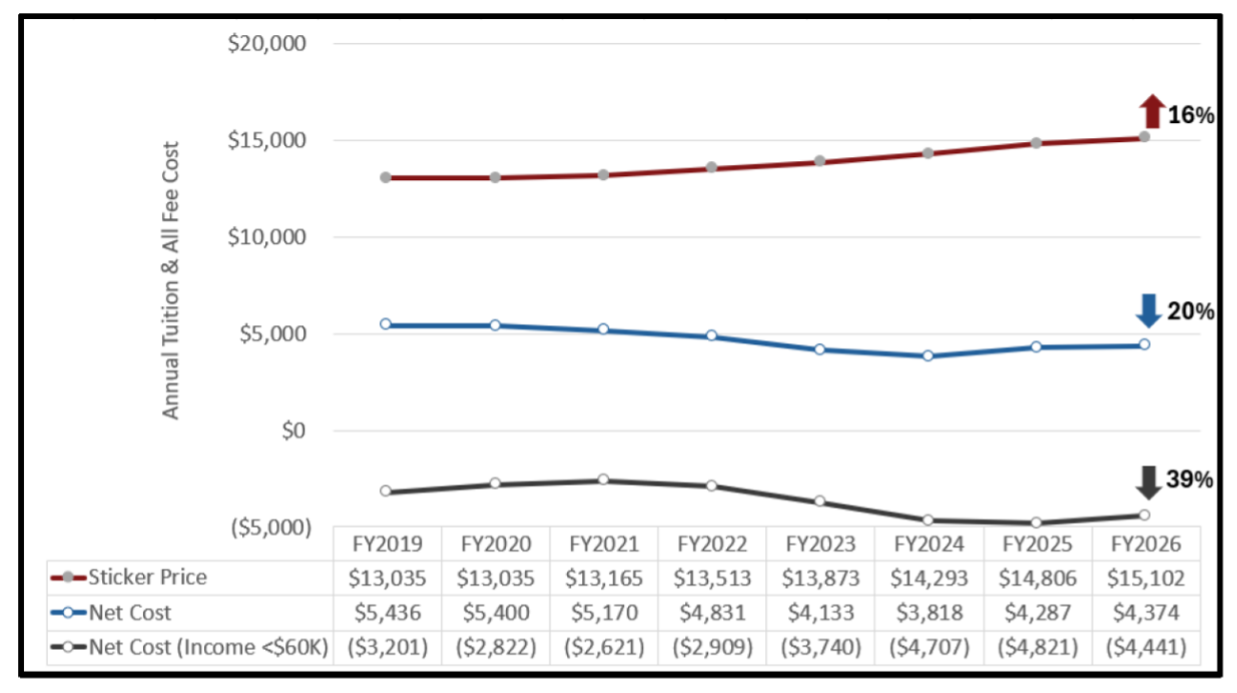
In fact, a degree from OU is more affordable today than it was seven years ago. Because student aid has increased faster than tuition, the average amount a resident freshman pays out of pocket or with loans has dropped by 20% over the past seven years, to $4,374 per year.
Over the last 7 years:
At the same time, 58% of OU undergraduates graduate debt-free, compared to 45% nationally.
The graph shows the difference between the listed tuition and fees for resident freshmen (red line) and what students actually pay after financial aid like waivers, scholarships, and grants (blue line).
This coming academic year, OU will adjust tuition and mandatory fees as follows.
Norman Campus Programs:
Estimated Average Increase to Students (Norman Campus Programs)
| Residency Type | Est. Increase: Full Academic Year | Est. Increase: By Semester |
|---|---|---|
| Residents | $305 | $153 |
| Non-Residents | $863 | $432 |
| Residency Type | Est. Increase: Full Academic Year | Est. Increase: By Semester |
|---|---|---|
| Residents | $288 | $144 |
| Non-Residents | $804 | $402 |
College of Law:
Health Campus Programs:
1 In addition, students in the Juris Doctorate program will also be assessed a $350 per-semester Academic Resources Program fee beginning Fall 2026. The fee will support bar exam preparation resources and is expected to reduce the cost of traditional bar prep courses paid by students by nearly $1,000.
2 Pharmacy (PharmD): 3% increase on resident tuition rates; 0% increase on non-resident tuition rates. As non-residents pay both resident and non-resident rates in accordance with the State of Oklahoma tuition and fee structure, the effective rate is 1.4% on non-residents.
3 DNP and MSN: 3% increase on resident tuition rates; 0% increase on non-resident tuition rates. As non-residents pay both resident and non-resident rates in accordance with the State of Oklahoma’s tuition and fee structure, the effective rate is 1.3% on DNP non-residents and 1.0% for MSN non-residents.
4 Medicine (M.D.): 4% increase on resident tuition rates; 3% decrease on non-resident tuition rates. As non-residents pay both resident and non-resident rates in accordance with the State of Oklahoma’s tuition and fee structure, the effective rate is 0.2% on non-residents.
5 Doctor of Dental Surgery (DDS): 4% increase on resident tuition rates; 0% increase on non-resident tuition rates. As non-residents pay both resident and non-resident rates in accordance with the State of Oklahoma’s tuition and fee structure, the effective rate is 1.8% on non-residents.
The new rates will be effective for the Fall 2026 semester.
This increase will help OU continue investing in the people and programs that make an OU education exceptional.
The increase will generate approximately $10 million for Norman and $3 million for Health Campus programs, which will be used to help fund the fourth year of a merit-based salary increase for eligible faculty, staff, qualifying graduate assistants, and postdoctoral scholars. That compensation program will cost approximately $30 million university-wide.
The faculty and staff who teach, mentor, support, and serve students are at the heart of the OU experience. Maintaining competitive compensation helps OU attract and retain outstanding educators, researchers, advisors, and staff whose work directly impacts student success.
At the same time, OU remains deeply committed to affordability and access. Over the last seven years, the actual amount the average resident freshman typically pays in net tuition and fees has declined 20% as scholarships, grants, waivers, and need-based aid have increased significantly faster than tuition and fees.
As Oklahoma’s flagship university, OU has a responsibility to provide students with an exceptional educational experience while remaining accessible and affordable. This tuition increase helps support both commitments by sustaining the excellence that defines an OU degree while continuing to invest in student success.
State Support Comparisons
OU has worked closely with state leaders to secure increased funding in support of workforce development, student success, research, and other priorities outlined in the “Lead On, University” Strategic Plan. As a result, OU’s recurring state appropriation has increased by $35 million, or 34%, since FY 2019.
While this progress is significant, state funding for OU only recently returned to levels comparable to those received nearly two decades ago. Even today, OU receives substantially less state funding per student than many comparable public research universities.
The chart below illustrates this gap. OU’s per-student state funding remains approximately half that of the median public peer institution – a difference of roughly $112 million annually.

Source: IPEDS (FY 2024, most recent available data)
Recent tuition increases have helped OU invest in the people, programs, and opportunities that enhance the value of an OU degree and support student success. Examples include:
OU recognizes that tuition increases have a real impact on students and families. That’s why affordability and access remain core priorities. In fact, a degree from OU is more affordable today than it was seven years ago.
Despite rising tuition costs nationwide, the actual amount the average resident freshman typically pays has declined 20% over the last seven years because OU has significantly expanded scholarships, grants, waivers, and need-based aid.
In the last 7 years:
Supporting Students With the Greatest Financial Need
OU is committed to ensuring that financial circumstances do not prevent talented students from pursuing an OU education.
Through the Crimson Commitment program, eligible Oklahoma students receive scholarships, grants, and tuition waivers that match the cost of tuition and average fees.
For academic year 2025-26:
Investing in Student Scholarships
Increasing the availability of need-based aid is the university’s top fundraising priority. As part of OU’s $2 billion fundraising campaign, $500 million has been designated for scholarships and student support to help expand opportunity for current and future students.
Providing Resources Beyond Financial Aid
OU also offers resources to help eliminate unnecessary barriers to college access and completion, including:
Importantly, increases in financial aid have benefited students across all resident income levels over the last 7 years. While students with the greatest financial need experienced the largest reductions in net cost, resident undergraduates across every income bracket have seen declines in net tuition and fee costs since FY 2019.
Income Bracket | FY26 Annual Sticker Price | FY26 Actual Net Cost | FY19 – FY26 Net Cost Trend |
|---|---|---|---|
AGI < $60k6 | $15,102 | $(2,910) | Down $2,771 or 1,997% |
$60k < AGI <= $100k | $15,102 | $5,175 | Down $1,649 or 24% |
$100k < AGI <=$150k | $15,102 | $7,135 | Down $987 or 12% |
AGI > $150k | $15,102 | $8,819 | Down $576 or 6% |
6 AGI < $60K reported in this table includes all enrolled undergraduate students. The Net Cost shown in the Annual Tuition and Fee Cost graph reflects first-time freshmen only.
OU is committed to operating efficiently and directing as many resources as possible toward its core mission of education, research, and student success.
Since FY 2019, OU has identified approximately $160 million in annual operating savings on the Norman campus through cost-reduction efforts, operational improvements, and strategic resource management. These efforts have helped OU invest in students, faculty, research, and other strategic priorities while maintaining a strong commitment to affordability.
One way to measure operational efficiency is to compare administrative and support costs – such as finance, human resources, I.T., and legal – across universities.
As the chart below illustrates, OU’s overhead costs per student are the 6th lowest of public universities within major athletic conferences. Compared to the median, OU spends approximately $57 million less annually on these activities, demonstrating OU’s continued focus on operational efficiency and responsible stewardship of resources.

Source: FY 2024 audited financial statements and Department of Education IPEDS database
For the most recent reporting period, 58% of OU undergraduates graduated with no debt7 (consistent with prior years), compared to 45% at four-year public universities nationwide. Those that did graduate with debt reported $31,694 in debt. These figures and other outcome metrics compare well with public SEC and Big 12 institutions. Using the U.S. Department of Education’s College Scorecard data and IPEDS database shows:
Student Outcome Metric | OU | SEC Median | Big 12 Median |
|---|---|---|---|
Median Debt After Graduation8 | $20,654 | $20,500 | $19,620 |
Students Receiving Federal Loans8 | 33% | 33% | 37% |
Median Earnings (4-year)8 | $73,280 | $69,651 | $68,091 |
Graduation Rate (AY2024)9 | 75% | 75% | 69% |
7 Common Data Set: https://www.ou.edu/irr/other-reports
8 Data from the College Scorecard only examines federal loan data and excludes Parent Plus loans. As such debt and loan data will not reconcile to the official debt and loan data the University publicly reports and is listed above in the OU/SEC/Big12 table.
9 From the Department of Education IPEDS database – FY24 most recently available data.
Using the most recent data published, OU’s student outcome data is the best of any higher ed institution in the state of Oklahoma, public or private:
Tuition and mandatory fees will increase by 3% for graduate students. For students on qualifying graduate assistantships, there will be no cost impact, as tuition is waived. For several years, OU has made significant progress toward increasing support for graduate education. In 2018, OU launched a multi-year initiative to lower fees for graduate assistants (GAs) on the Norman campus, saving these students $3,850 per year compared to seven years ago – bringing down fees to just over $1,000 annually, which is the public AAU average. OU implemented a 63% increase to graduate assistant stipend minimums, effective July 1, 2024, and graduate assistants are included in the 3% merit raise program for Fall 2026.
We understand this decision has real impacts; that’s why a core team of OU administrators engaged student leaders in extensive conversation, holding Fall and Spring meetings to better understand the effects of a tuition and fee increase on students.
Our professionals in the Student Financial Center stand ready to help as you seek financial aid options, and the MidFirst Bank MoneyCoach Program can assist with creating a financial plan to fund the upcoming year.
As always, we endeavor to be conscientious stewards of our resources and our purpose of changing lives. For any questions or concerns regarding funding a tuition increase, please contact the Student Financial Center.
