NEWS


NORMAN, Okla. – Irrigated agriculture is the largest freshwater consumer in the United States. Across the country, state agencies responsible for managing freshwater resources rely on irrigation maps to assess water use, manage supplies and plan infrastructure investments. However, these maps are often outdated, vary in accuracy and require substantial time and labor to update.
Researchers from the University of Oklahoma are tackling this challenge by leading two projects funded by the National Aeronautics and Space Administration (NASA). Yanhua Xie, an assistant professor in OU’s College of Atmospheric and Geographic Sciences, is the principal investigator of both projects, with collaborators from the Desert Research Institute, the University of Montana and state, interstate and federal agencies.
The first project aims to develop the Operational Satellite Irrigation Reporting Information System (OSIRIS). The system will integrate publicly available satellite observations from NASA, the European Space Agency, and other sources with artificial intelligence algorithms to improve the mapping and monitoring of irrigated lands across the contiguous U.S. The system will help water agencies access timely, reliable irrigation information.
“State water managers need to know how much water is used for irrigation to make informed decisions, given our very limited freshwater resources,” Xie said. “For example, irrigation relies heavily on groundwater in many states, like agricultural lands in the Oklahoma Panhandle that depend on the Ogallala Aquifer, where groundwater levels have declined significantly over the past century. It would take thousands of years for the aquifer to recharge, but we continue extracting large amounts of water every day.”
NASA funding for OSIRIS began in August and will last three years. The system will support multiple irrigation mapping models and data inputs, including methods being developed through Xie’s second NASA-funded project: transforming irrigation mapping using large Earth foundational models, which are AI models trained on extensive Earth observation data.
These efforts will have a real-world impact: state water agencies are end users in both projects. The Upper Colorado River Commission and two federal agencies – the U.S. Geological Survey and Bureau of Reclamation – are also collaborators on OSIRIS. These partners will contribute to system development and testing, offer internal support, provide feedback on usability and help assess long-term operational needs and sustainability.
“We’ve invited eight state agencies from across the country because they face different challenges related to water availability and irrigation needs,” Xie said. “In Idaho or Texas, irrigation is essential for agricultural production. But in Georgia or Alabama, it may serve a supplemental role.”
Xie noted that agencies’ feedback on the projects is critical and will inform his team’s work on both developing the software and creating state-specific maps. Agencies may have different requirements for mapping accuracy, update frequency and geographic detail. Understanding these priorities will help the team balance data quality, computational resources and the effort required to maintain reliable, up-to-date maps.
The team will also gather input through workshops where participating agencies can share their operational needs, priorities and thoughts on the projects. The first workshop is scheduled to be held next spring.
The NASA funding will also support two OU Ph.D. students, each working on one of the projects. While the team’s efforts are currently focused on responding to state-level needs through the funding, Xie aims for this work to have a translational impact and help a variety of communities.
“Even though the projects right now empower state agencies, we hope the data and software can also serve the broader scientific and operational communities,” Xie said. “Ultimately, we hope to build on these efforts to advance irrigation mapping and monitoring at wider, transnational scales.”
About the projects
"Toward Next-Generation Operational Irrigation Status Mapping and Reporting for Water Resource Agency Applications" is funded by a $196,051 grant from the National Aeronautics and Space Administration's Science Mission Directorate program, Award No. 80NSSC26K1082.
"Transforming Irrigation Mapping Using Large Earth Foundation Models for Water Resource Agency Applications" is funded by a $492,667 grant from the National Aeronautics and Space Administration's Science Mission Directorate program, Award No. 80NSSC26K0979.
About the University of Oklahoma
Founded in 1890, the University of Oklahoma is a public research university located in Norman, Oklahoma. As the state’s flagship university, OU serves the educational, cultural, economic and healthcare needs of the state, region and nation. For more information about the university, visit www.ou.edu.
The Health Resources and Services Administration has awarded two grants to the University of Oklahoma College of Dentistry, strengthening the college's efforts to recruit and retain faculty, and to improve dental care access in rural Oklahoma.
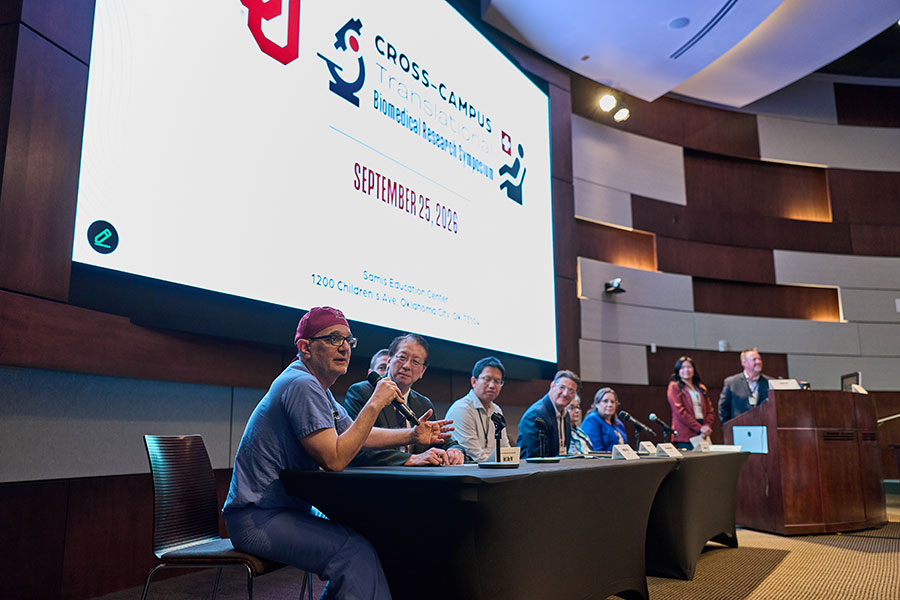
More than 250 researchers, clinicians, engineers, entrepreneurs and students gathered Sept. 25 for the University of Oklahoma’s first Cross-Campus Translational Biomedical Research Symposium.
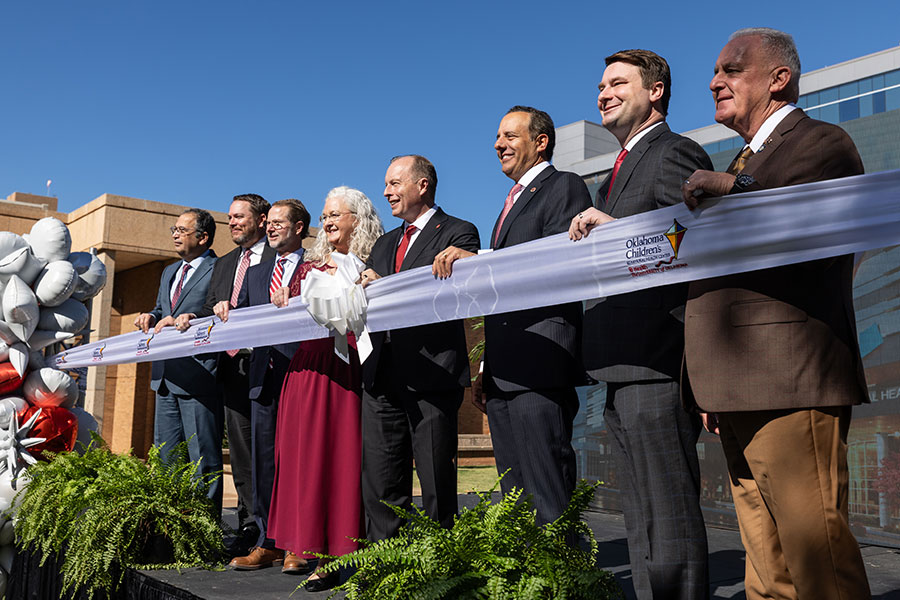
Oklahoma Children’s OU Health celebrated the grand opening of the Oklahoma Children’s OU Health Behavioral Health Center on Nov.4, Oklahoma’s first and only comprehensive pediatric behavioral health center integrated with a children’s hospital.