NEWS


By
Jacob Muñoz
jmunoz@ou.edu
Date
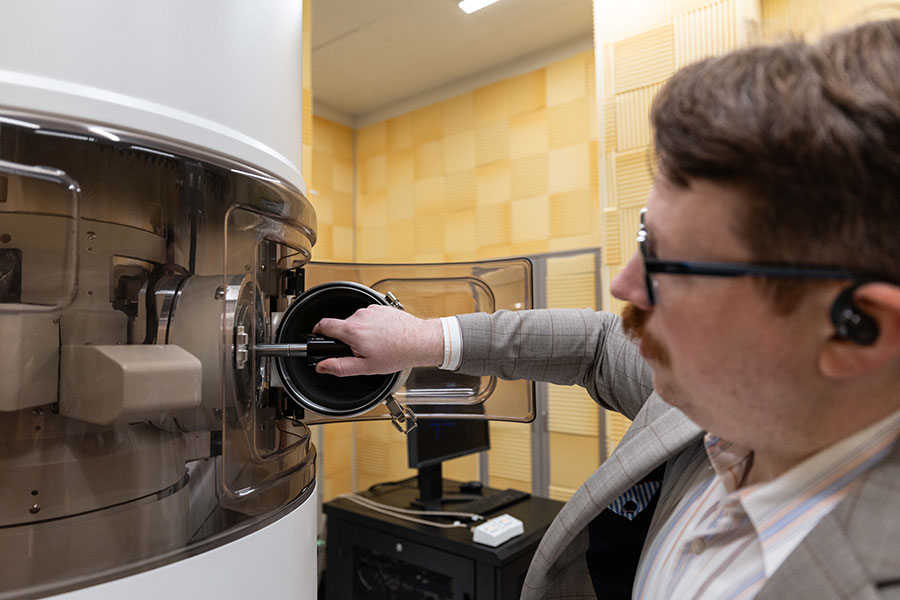
NORMAN, Okla. – After years of work, the University of Oklahoma’s Samuel Roberts Noble Microscopy Laboratory has officially installed a state-of-the-art transmission electron microscope on its Norman campus.
The new technology is the state’s most powerful microscope, supporting both OU researchers and non-university clients on projects involving quantum technology and microelectronics, materials discovery and other topics.
The National Science Foundation’s Major Research Instrumentation Program awarded the University of Oklahoma in 2023 a $2.5 million grant that allowed the university to acquire the JEOL JEM-ARM200F TEM, also known as the NEOARM.
The NEOARM allows researchers to characterize materials at an atom-by-atom level using a 70-picometer resolution in its conventional scanning mode, far beyond the previous 200-picometer conventional resolution achievable at OU. Using a new electron microscopy technique known as 4D-STEM, it can reach an even higher resolution of at least 40 picometers.
Laboratory Director Stefan Wilhelm, Ph.D., emphasized that the technology will strengthen its role as a critical resource for TEM projects – one of its multiple research specialties – thanks to the microscope.
“Our mission is to provide infrastructure, technical expertise and support for researchers across OU and the state of Oklahoma,” said Wilhelm, who is also an associate professor in OU’s Stephenson School of Biomedical Engineering. “These new capabilities will help us advance the cutting-edge materials research going on here and across the nation.”
The tool’s 70-pm conventional resolution gives researchers the ability to examine both the structure and chemistry of materials at a nanoscale level – as small as one billionth of a meter. This scale is valuable for examining advanced materials such as semiconductors, catalysts and 3D-printed objects.
Senior Research Scientist Julian Sabisch, Ph.D., who manages the NEOARM, noted that this research can lead to technological breakthroughs: for example, the catalysts that turn gases like methane into hydrogen for electric vehicles are nanoparticles.
“A lot of the macroscopic properties we see in our day-to-day lives are determined on the finest levels by how the atoms are arranged,” Sabisch said. “We can see the whole spectrum at SRNML, and this new microscope really fits a large range of the spectrum from all the way to the bottom to fairly far up.”
Iman Ghamarian, Ph.D., a co-principal investigator on the NSF grant and an assistant professor in OU’s School of Aerospace and Mechanical Engineering, highlighted the microscope’s potential to advance research at the intersection of materials science and artificial intelligence.
“The NEOARM can generate terabytes of data in just one minute,” Ghamarian said. “While collecting this data takes only minutes, extracting meaningful scientific insights can require months of analysis. Machine learning offers powerful tools to accelerate this process, uncover hidden patterns and enable discoveries that would otherwise be difficult or even impossible using conventional methods.”
The NEOARM is housed in its own room in OU’s Lin Hall. Michael Santos, Ph.D., the grant’s principal investigator, said that much preparation had to go into installing the microscope – including foam-lining the room’s walls to reduce noise.
“Achieving a stable enough laboratory environment for the microscope was critical,” said Santos, who is also Chair of the Department of Physics and Astronomy. “The laboratory in Lin Hall was already state of the art for environmental control, but further renovations were needed for the microscope to reach its best resolution.”
With NEOARM ready for operation, SRNML will continue to grow as a critical resource for advanced materials research. The lab supports OU research and also works with external parties such as Oklahoma State University, which had a faculty member contribute to the grant as a co-principal investigator.
The new microscope is also part of ongoing efforts to expand SRNML’s technology collection. Lab researchers are planning to pursue another NSF MRI grant to obtain a focused ion beam scanning electron microscope, a knife-like instrument that can cut material samples so thin that electrons can move between the slices.
“In order to really get the most out of this TEM microscope, it all comes down to the sample preparation,” Wilhelm said. “This equipment would allow us to have a workflow to both prepare the samples and then analyze them all in one facility.”
About the project
“Track 2 Acquisition of an Analytical Aberration-Corrected Transmission Electron Microscope for Research and Education” was funded by a $2,500,000 grant from the U.S. National Science Foundation, award no. #2320468. It began in September 2023 and ended in August 2026.
About the University of Oklahoma
Founded in 1890, the University of Oklahoma is a public research university located in Norman, Oklahoma. As the state’s flagship university, OU serves the educational, cultural, economic and healthcare needs of the state, region and nation. For more information about the university, visit www.ou.edu.
After years of work, the University of Oklahoma’s Samuel Roberts Noble Microscopy Laboratory has officially installed a state-of-the-art transmission electron microscope on its Norman campus.
Price College of Business associate professor Yaron Levi, Ph.D., has explored how changes to an app's dashboard affected thousands of users’ financial management over nearly two years.
Three University of Oklahoma graduate students earned top honors in the 2026 Three Minute Thesis (3MT) competition, an annual event that challenges students to explain their research to a general audience in 3 minutes.