NEWS

OKLAHOMA CITY – A powerful new $16 million cyclotron is arriving soon at the University of Oklahoma College of Pharmacy, marking a major expansion of advanced medical imaging, cancer treatment and research capabilities for patients across the state.
The GE HealthCare PETtrace 890 Cyclotron, acquired in collaboration with GE HealthCare and Cyclomedical International, will enable OU to produce advanced radiopharmaceuticals on site. Some radiopharmaceuticals are used to see disease, such as a PET scan. Others are used to treat it by delivering targeted radiation directly to tumors. For Oklahoma patients, this means access to technologies that previously required out-of-state travel or shipping.
“Many of these radiopharmaceuticals simply haven’t been available in Oklahoma before,” said Melissa Medina, Ed.D., dean of the OU College of Pharmacy. “Now we can produce them here, which opens the door to better imaging, faster decisions and more personalized treatments for Oklahomans.”
A cyclotron is a machine that accelerates tiny charged particles in a circular path. When those particles hit specific targets, they create short-lived radioactive materials. When incorporated into PET imaging tracers, those materials travel through the body and reveal how tissues and organs are functioning. In addition to detecting cancer and other conditions, the technology can determine whether a treatment is working – often allowing physicians to adjust care sooner.
“PET imaging allows clinicians to evaluate biological activity throughout the entire body with a single injection,” Medina said. “If a therapy isn’t effective, doctors can change course sooner. That saves time, money and, most importantly, lives.”
Beyond imaging, the cyclotron will be critical for developing drugs that deliver precise radiation directly to cancer cells. Because many of these drugs lose their radioactivity quickly, oncologists at OU Health Stephenson Cancer Center have relied on agents with a longer half-life to be shipped in from out of state, or patients have left the state to access novel drugs. The new cyclotron means drugs with a short half-life can be created just blocks away from where patients receive care.
“The presence of a cyclotron is transformational for our campus,” said Robert Mannel, M.D., director of the Stephenson Cancer Center, Oklahoma’s only National Cancer Institute-Designated Cancer Center, and a professor in the OU College of Medicine. “Many emerging diagnostic and treatment agents require close proximity to a cyclotron. This opens up options for Oklahoma patients that simply were not possible before.”
The cyclotron also expands OU’s ability to participate in leading-edge clinical trials. Many investigational imaging agents and therapies require on-site production, which has historically restricted patient access. With this capability in place, researchers can offer patients participation in trials involving next-generation cancer treatments.
“Now we can enhance clinical trials with new investigational products that we could not use before,” Mannel said. “That gives our patients access to tomorrow’s treatments today.”
In addition to advancing patient care and research, the cyclotron is expected to strengthen Oklahoma’s biomedical economy. The on-site production capability makes the campus more attractive to biotech companies, pharmaceutical manufacturers and research collaborators seeking partners with advanced radiopharmaceutical infrastructure.
“We anticipate this technology will help draw new industry partnerships, support commercialization efforts and position Oklahoma as a growing hub for precision medicine and cancer innovation,” Medina said.
About the University of Oklahoma
Founded in 1890, the University of Oklahoma is a public research university with campuses in Norman, Oklahoma City and Tulsa. As the state’s flagship university, OU serves the educational, cultural, economic and health care needs of the state, region and nation. In Oklahoma City, the OU Health Campus is one of the nation’s few academic health centers with seven health profession colleges located on the same campus. The OU Health Campus serves approximately 4,000 students in more than 70 undergraduate and graduate degree programs spanning Oklahoma City and Tulsa and is the leading research institution in Oklahoma. For more information about the OU Health Campus, visit www.ouhsc.edu.
The University of Oklahoma has received a transformative gift from Jon and Shannon McCartney, which will name the McCartney Family Tunnel of Champions, the McCartney Family Gate of the Gaylord Family - Oklahoma Memorial Stadium and the McCartney Family Grand Lecture Hall in the Michael F. Price College of Business. The gift will also support the Inspiring Champions and the Athletic Director’s Discretionary Fund, in addition to establishing the McCartney DFW Career Trek program at Price College.
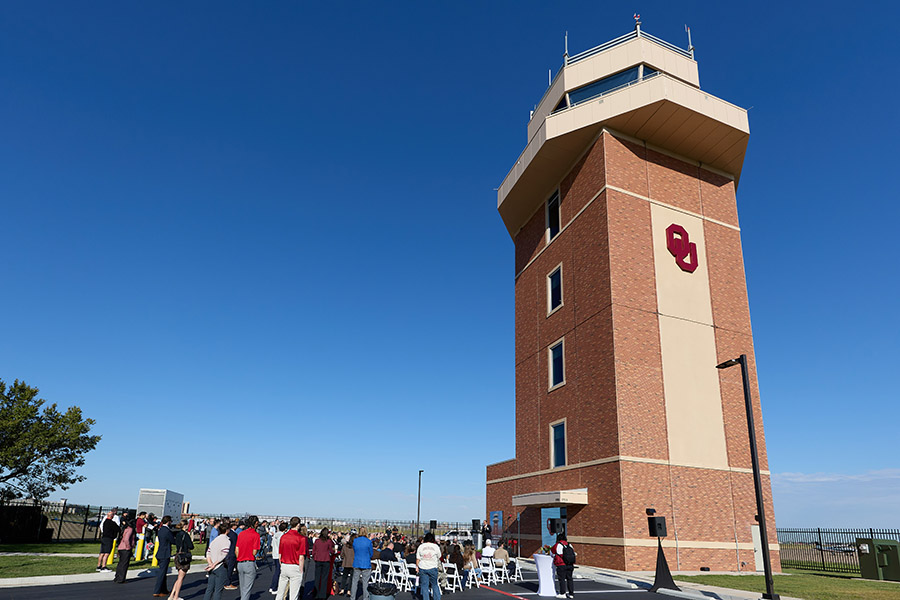
The University of Oklahoma today celebrated the opening of a new air traffic control tower at the OU Max Westheimer Airport. Standing 106 feet tall, more than double the current 52-foot facility, the new tower will modernize air traffic control operations and improve safety for pilots and students operating in the airspace.
Do I buy groceries or pay the electric bill? Should I pawn some of my belongings to afford my prescription? My child is sick, so I will have to miss work to take care of him. Those are just a few of the difficult choices that OU-Tulsa health professional students confronted during the Community Access to Resources Experience. The role-playing activity challenged students to navigate the financial, family and other pressures that can affect a person’s health and ability to follow medical advice. Held annually during the SCM Institute orientation week, the experience is designed to generate understanding and build empathy.