NEWS


At a time when Oklahoma’s public schools face complex and evolving challenges, a new pathway is opening for educators ready to lead at the systems level. The Collaborative Doctor of Education (Ed.D.) in Educational Leadership offers emerging leaders across Oklahoma’s PK–12 public education system a doctoral experience designed to be as relevant as it is rigorous.
Developed through a partnership between the University of Oklahoma and the Cooperative Council for Oklahoma School Administration (CCOSA), the program reflects a shared commitment to strengthening school and district leadership from the inside out. Rather than separating theory from practice, the Collaborative Ed.D. intentionally blends scholarly training with the realities educators navigate every day.
“CCOSA is proud to partner with OU‑Tulsa to offer a collaborative Doctorate in Education that connects practitioner insight with high‑quality academic study,” said Dr. Pam Deering, Ph.D., Executive Director for CCOSA. “This program provides a meaningful pathway for school leaders to strengthen their leadership practice, expand their professional expertise, and achieve their goal of earning a doctorate while remaining grounded in the day‑to‑day realities of educational leadership.”
Each year, CCOSA’s executive team will work in partnership with the University of Oklahoma to identify and select a cohort of 15 to 20 emerging leaders from across the state. These educators have demonstrated both the capacity for leadership and a deep commitment to serving schools and districts. Students begin together in the summer and progress as a cohort through the 36‑month program, building strong professional relationships that extend well beyond graduation.
The structure is intentionally designed for working practitioners. Students complete two eight‑week courses each semester over three years, with coursework offered in a blend of asynchronous and synchronous formats. One to two times per semester, the cohort gathers for in-person instruction at the OU-Tulsa campus, reinforcing collaboration and connection while maintaining flexibility for busy professionals.
Courses are delivered by both OU faculty and CCOSA leaders, ensuring learning is grounded in research and directly informed by the needs of today’s schools. CCOSA leadership also helps shape and guide the program, keeping it aligned with the evolving priorities facing districts statewide.
“The new OU and CCOSA Collaborative Doctoral Program in Educational Leadership blends practical leadership development with scholarly rigor,” said Dr. Daniel Hamlin, Ph.D., Oklahoma Secretary of Education and OU education faculty member. “Delivered in close partnership with CCOSA, the program is intentionally aligned with key priorities facing districts today, ensuring that learning is immediately actionable and highly relevant for leaders of school systems.”
The program culminates in a problem-of-practice dissertation completed during the student’s final year. This practice‑based dissertation allows students to conduct scholarly research focused on real challenges within their own districts, integrating academic research with practical application.
Dr. Stacey Butterfield, Ed.D., Superintendent of Jenks Public Schools, emphasized the value of that design. “The University of Oklahoma - Tulsa and CCOSA are providing a unique opportunity to lean into the idea of lifelong learning and achieve a doctorate through an Ed.D. collaborative cohort model,” Butterfield said. “The program is designed for busy practitioners to earn a doctorate and complete a ‘problem of practice’ dissertation in 36 months…making an even greater impact on the students and communities we serve.”
Guided by program leaders Robert Franklin, Ed.D., CCOSA/OU‑Tulsa Accelerated Ed.D. Program Coordinator, and Tim Ford, Ph.D., OU‑Tulsa Leadership Programs Director and Admissions Coordinator, the Collaborative Ed.D. is preparing the next generation of Oklahoma’s educational leaders—grounded in practice, strengthened by research, and ready to lead with purpose.
About the University of Oklahoma
Founded in 1890, the University of Oklahoma is a public research university located in Norman, Oklahoma. As the state’s flagship university, OU serves the educational, cultural, economic and health care needs of the state, region and nation. For more information about the university, visit www.ou.edu.
The University of Oklahoma has received a transformative gift from Jon and Shannon McCartney, which will name the McCartney Family Tunnel of Champions, the McCartney Family Gate of the Gaylord Family - Oklahoma Memorial Stadium and the McCartney Family Grand Lecture Hall in the Michael F. Price College of Business. The gift will also support the Inspiring Champions and the Athletic Director’s Discretionary Fund, in addition to establishing the McCartney DFW Career Trek program at Price College.
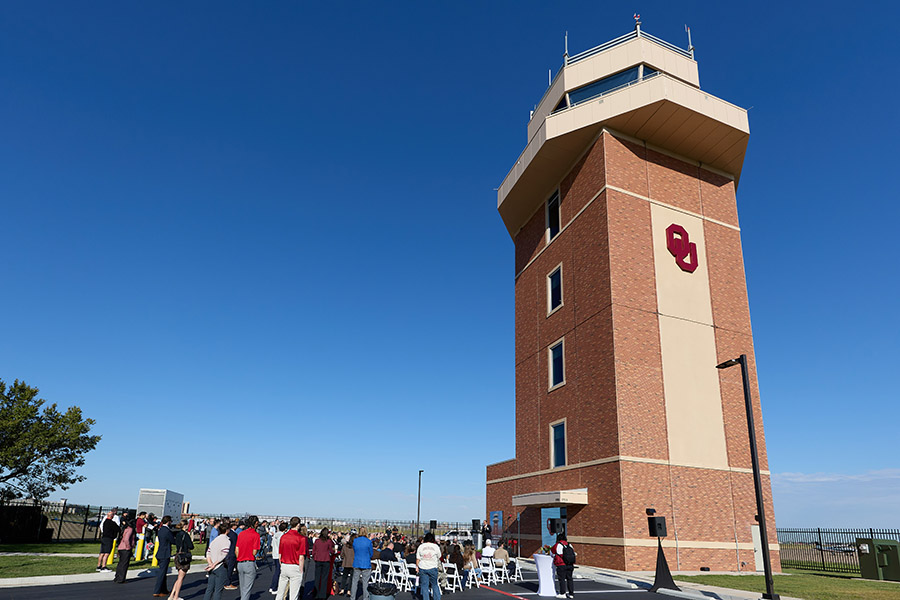
The University of Oklahoma today celebrated the opening of a new air traffic control tower at the OU Max Westheimer Airport. Standing 106 feet tall, more than double the current 52-foot facility, the new tower will modernize air traffic control operations and improve safety for pilots and students operating in the airspace.
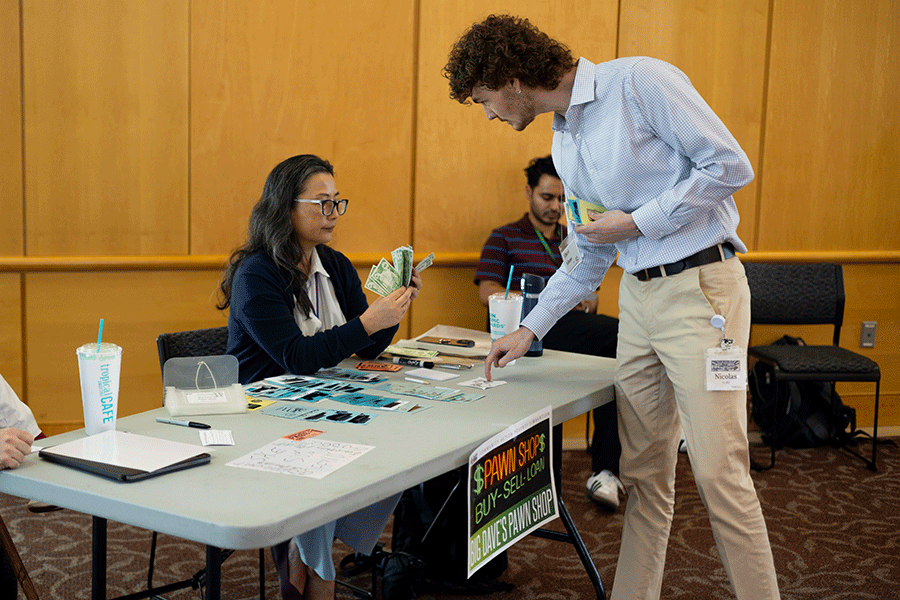
Do I buy groceries or pay the electric bill? Should I pawn some of my belongings to afford my prescription? My child is sick, so I will have to miss work to take care of him. Those are just a few of the difficult choices that OU-Tulsa health professional students confronted during the Community Access to Resources Experience. The role-playing activity challenged students to navigate the financial, family and other pressures that can affect a person’s health and ability to follow medical advice. Held annually during the SCM Institute orientation week, the experience is designed to generate understanding and build empathy.