NEWS


OKLAHOMA CITY – Recent research from the University of Oklahoma suggests that survivors of the 1995 Oklahoma City bombing carry physiological traces of the trauma, even though study participants have gone on to lead healthy and resilient lives. Essentially, their bodies “remember” the trauma even if they don’t have physical or mental health problems.
Previous studies have examined biological stress and psychological symptoms in terrorism survivors, but the recently published research is thought to be the first of its kind to study three different biological systems in medically healthy people who survived the same traumatic event: cortisol, which plays a crucial role in the body’s stress response; heart rate and blood pressure; and interleukins, which are inflammatory substances that play a role in the body’s immune system.
Research participants included 60 heavily impacted direct survivors of the Oklahoma City bombing, compared to a control group of local people who were not affected by the bombing. People in both groups were healthy. The study found that, counterintuitively, cortisol levels were lower in people who survived the bombing. Survivors had higher blood pressure but a lower heart rate in response to trauma cues, suggesting their response may have become blunted over time. Two interleukins were measured. Interleukin 1B, which is linked with inflammation, was significantly higher in survivors, and interleukin 2R, which plays a protective role, was lower.
“The main takeaway from the study is that the mind may be resilient and be able to put things behind it, but the body doesn’t forget. It may remain on alert, waiting for the next thing to happen,” said Phebe Tucker, M.D., lead author of the study and professor emeritus of psychiatry at the OU College of Medicine.
“We thought there would be a correlation between these biomarkers and the research participants’ psychological symptoms, but their PTSD and depression scores were not elevated and did not correlate with stress biomarkers,” she added. “That tells us there is a stress response in the body that is not present in the emotions they express. In addition, the elevated interleukin 1B is typically seen in people with illnesses and inflammation, but this group was pretty healthy. However, it raises concerns about potential long-term health problems.”
Tucker and her colleagues have regularly conducted studies involving bombing survivors beginning soon after the event occurred. In this new paper, they are using data obtained seven years after the bombing. At the time, they did not study the same biomarkers, making this new study unique.
“Basically, what this paper shows is that after you’ve experienced severe trauma, your biological systems may not be at a typical baseline any longer; things have changed,” said study co-author Rachel Zettl, M.D., clinical assistant professor in the Department of Psychiatry and Behavioral Sciences, OU College of Medicine. “It’s not just our minds that remember trauma; our biological processes do, too. It changes your actual physical being.”
Other authors of this paper were Betty Pfefferbaum, M.D., professor emeritus in the Department of Psychiatry and Behavioral Sciences, OU College of Medicine; Carol North, M.D., adjunct professor, University of Texas Southwestern Medical Center; Yan Daniel Zhao, Ph.D., professor, OU Hudson College of Public Health; Pascal Nitiema, Ph.D., Arizona State University; and Haekyung Jeon-Slaughter, Ph.D., University of Texas Southwestern Medical Center.
About the Project
Read the study, “Learning from Hindsight: Examining Autonomic, Inflammatory, and Endocrine Stress Biomarkers and Mental Health in Healthy Terrorism Survivors Many Years Later,” at https://doi.org/10.1017/S1049023X24000360.
About the University of Oklahoma
Founded in 1890, the University of Oklahoma is a public research university with campuses in Norman, Oklahoma City and Tulsa. As the state’s flagship university, OU serves the educational, cultural, economic and health care needs of the state, region and nation. In Oklahoma City, OU Health Sciences is one of the nation’s few academic health centers with seven health profession colleges located on the same campus. OU Health Sciences serves approximately 4,000 students in more than 70 undergraduate and graduate degree programs spanning Oklahoma City and Tulsa and is the leading research institution in Oklahoma. For more information about OU Health Sciences, visit www.ouhsc.edu.
The University of Oklahoma has received a transformative gift from Jon and Shannon McCartney, which will name the McCartney Family Tunnel of Champions, the McCartney Family Gate of the Gaylord Family - Oklahoma Memorial Stadium and the McCartney Family Grand Lecture Hall in the Michael F. Price College of Business. The gift will also support the Inspiring Champions and the Athletic Director’s Discretionary Fund, in addition to establishing the McCartney DFW Career Trek program at Price College.
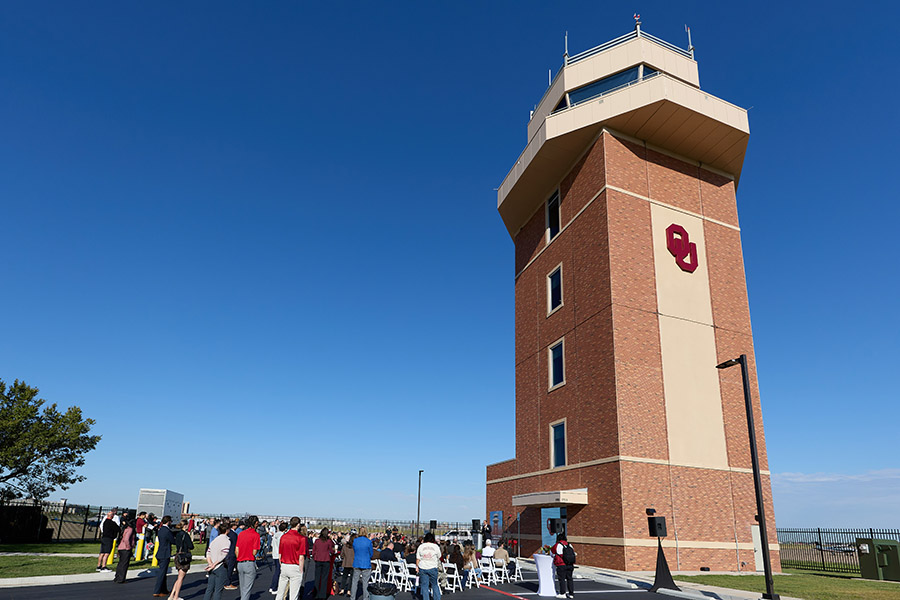
The University of Oklahoma today celebrated the opening of a new air traffic control tower at the OU Max Westheimer Airport. Standing 106 feet tall, more than double the current 52-foot facility, the new tower will modernize air traffic control operations and improve safety for pilots and students operating in the airspace.
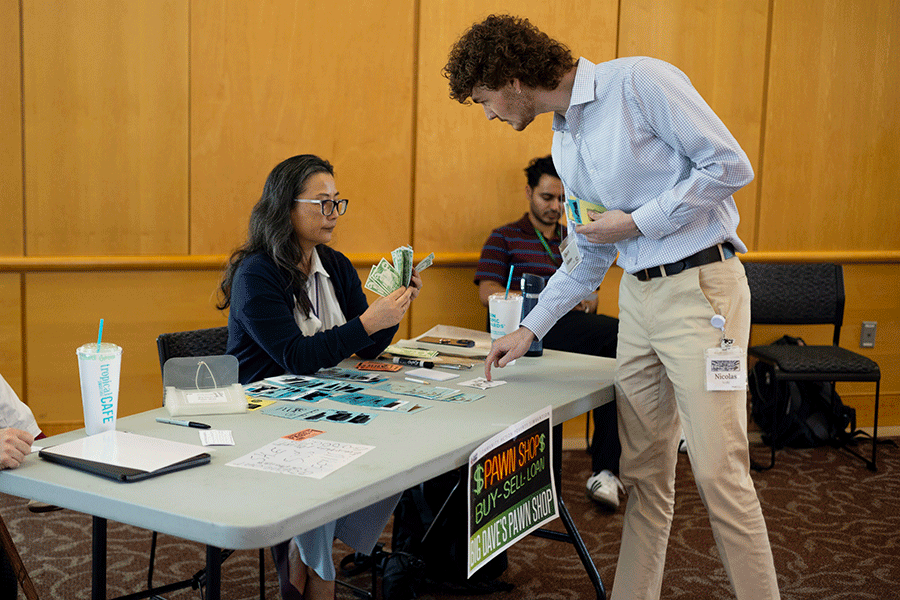
Do I buy groceries or pay the electric bill? Should I pawn some of my belongings to afford my prescription? My child is sick, so I will have to miss work to take care of him. Those are just a few of the difficult choices that OU-Tulsa health professional students confronted during the Community Access to Resources Experience. The role-playing activity challenged students to navigate the financial, family and other pressures that can affect a person’s health and ability to follow medical advice. Held annually during the SCM Institute orientation week, the experience is designed to generate understanding and build empathy.