
SovereignCast Live is a new endeavor that seeks to gather experts on NNCTPR topics of interest. Each gathering plants the seed for deeper understanding—connecting Tribal leaders, community voices, and research through dialogue grounded in sovereignty, governance, and the futures we’re cultivating together. Recorded live and later shared as episodes of our SovereignCast podcast, these sessions extend the dialogue to wider audiences.
Accompanied by our new SovereignCafé, these events invite participants to enjoy in-house crafted specialty coffee, pastries, and conversation in a relaxed setting that inspires thoughtful dialogue.

Latest Episode
Keywords: Data Centers, Data Privacy and Security, Tribal Sovereignty and Governance
Overview
In this episode of SovereignCast, we take a grounded look at the fast-growing conversation around data centers and security and what it may mean for Tribal Nations. As Tribal Nations across the country are trying to understand where AI is headed, tribes are weighing proposals, fielding questions about energy consumption and natural resources impacts, and how it will impact their lands, laws, and citizens. We let our curiosity explore these considerations and more.
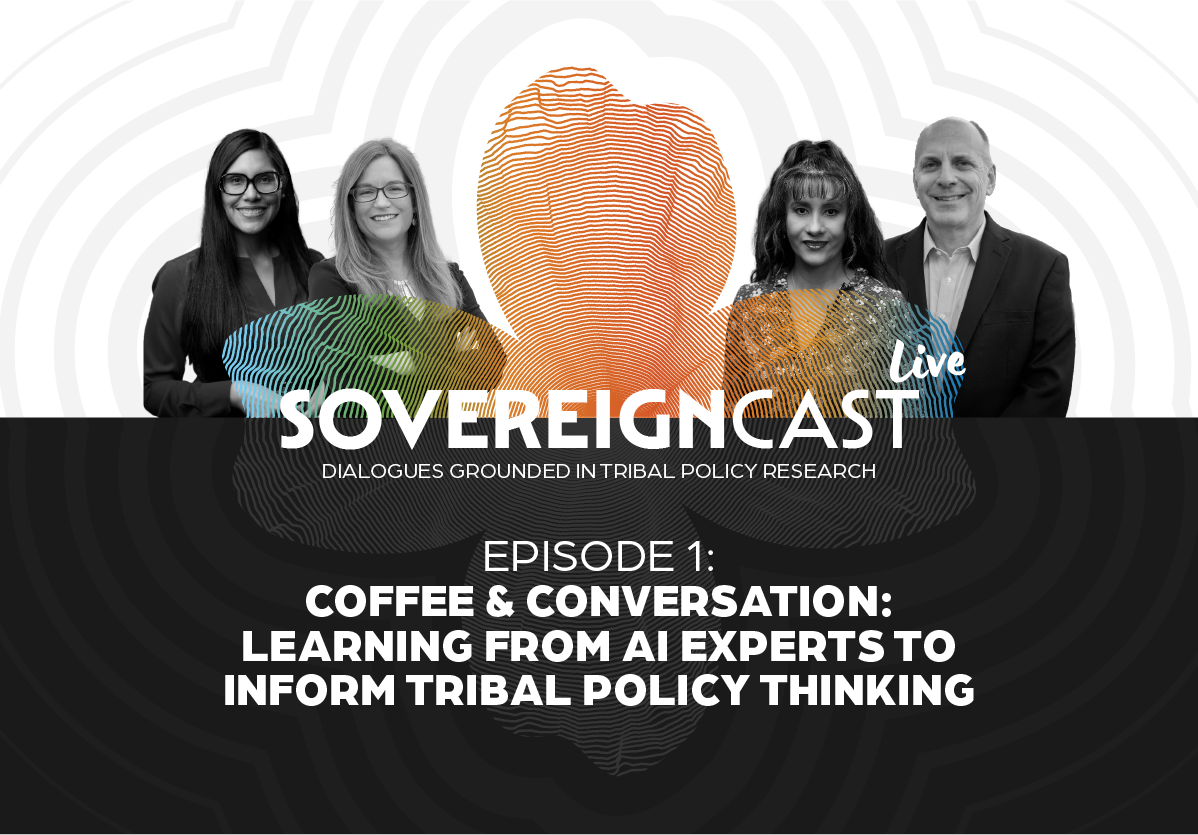
Tracy Pearl, J.D., John Hassell, Ph.D., together with Evelyn Cox, Ph.D., and moderator Tana Fitzpatrick, J.D., discuss why AI’s rise has raised new environmental and legal concerns in data centers and what tribes could consider when approached about data centers. Throughout the episode, we hear both the cautions and the opportunities, such as how to evaluate impacts on water and energy and how open-source AI can support tribal data privacy, in an effort to inform tribal governance and policy. For leaders and community members navigating these fast-moving issues, this conversation offers practical insight rooted in sovereignty and long-term thinking.
For curious listeners, a resource list of the information discussed can be found on our website at ou.edu/nativenationscenter/sovcast. Keep an eye on the Native Nations Center for Tribal Policy Research’s website for future SovereignCasts on a variety of topics.
SovereignCast Chronological References Addressed in Transcript via Conversation
DownloadEnergy Use for General Technology & Transportation (Dr. Hassell)
Malmodin, Jens, Åsa Moberg, Dag Lundén, Göran Finnveden, and Nina Lövehagen. 2023. “Greenhouse Gas Emissions and Operational Electricity Use in the ICT and Entertainment & Media Sectors.” Telecommunications Policy, 44(3). https://doi.org/10.1016/j.telpol.2023.102701. Concludes that the ICT sector used about 4% of global electricity and 1.4% of global GHG emissions in 2020.
Masanet, Eric, Arman Shehabi, Nuoa Lei, Sarah Josephine Smith and Jonathan G. Koomey. 2020. “Recalibrating global data center energy-use estimates.” Science 367: 984 - 986. Finds that from 2010–2018, global data-center energy use increased by only about 6% while workloads grew by roughly 550%, indicating rapid efficiency gains.
U.S. Energy Information Administration (EIA). 2023. “Use of energy for transportation,” August 16. https://www.eia.gov/energyexplained/use-of-energy/transportation.php - Reports that about 30% of total U.S. energy consumption in 2023 was for transportation.
Computing Power Needed for Languages Services, Interconnectedness, and Gaming (Dr. Hassell)
Jain, Pramesh. 2025. “How AI Is Breaking Language Barriers: The Power of Real-Time Translation Systems.” WebMob Technologies, August 20. https://webmobtech.com/blog/ai-real-time-translation-language-barriers/.
Johnson, Colin. 2024. “AI’s Increasing Power Needs – Communications of the ACM.” Communications of the ACM, August 14. https://cacm.acm.org/news/ais-increasing-power-needs/.
Eric Masanet et al., 2020. “Recalibrating global data center energy-use estimates,” Science 367(6481): 984–986. Finds that from 2010–2018, global data-center energy use increased by only about 6% while workloads grew by roughly 550%, indicating rapid efficiency gains.
Mills, Evan, and Nathaniel Mills. 2025. “Taming the Energy Use of Gaming Computers.” Taming the Energy Use of Gaming Computers | Building Technology and Urban Systems, 2025. https://buildings.lbl.gov/publications/taming-energy-use-gaming-computers.
Abraham, Ben. 2023. “How Much Electricity Do Gamers Use Annually? – Can We Put a Number on the Footprint of the Games Industry, Part 4.” Greening the Games Industry, November 27, 2023. https://gtg.benabraham.net/how-much-electricity-do-us-gamers-use/.
AI Driving Increase in Data Center Power Demands Over Time (Professor Pearl)
Goldman Sachs. 2025. “Ai to Drive 165% Increase in Data Center Power Demand by 2030.” Goldman Sachs, February 4. https://www.goldmansachs.com/insights/articles/ai-to-drive-165-increase-in-data-center-power-demand-by-2030.
Data Center Construction and Jobs (Professor Pearl)
Dotan, Tom. 2025. “The AI Data-Center Boom Is a Job-Creation Bust.” MSN, February 25. https://www.msn.com/en-us/money/companies/the-ai-data-center-boom-is-a-job-creation-bust/ar-AA1zMZ4t?ocid=msedgntp&pc=HCTS&cvid=d8c163784efd4ecbb7c3ec7b5b71c1b3&ei=47.
Opportunities for Collaboration around AI and Data Centers (Professor Pearl)
Reid, Juliana. 2025. “The Future of AI Runs through Indian Country.” Payne Institute for Public Policy, October 1. https://payneinstitute.mines.edu/the-future-of-ai-runs-through-indian-country/.
Data and Web Scraping (Dr. Cox)
Lakshmi, Aishwarya. 2025. “Is Web Scraping Legal? The Complete Guide for 2025.” ScraperAPI, January 26. https://www.scraperapi.com/web-scraping/is-web-scraping-legal/.
OKTA. 2025. “What Is Data Scraping? Definition & Usage.” Okta, April 8. https://www.okta.com/identity-101/data-scraping/.
Rodriguez, Leonardo. 2025. “What Is Web Scraping Used For?” ScraperAPI, September 11. https://www.scraperapi.com/web-scraping/use-cases/.
Innovative Opportunities & Self Driving Cars (Professor Pearl)
Dinamani, Anant, Jeff Hood, Rodolfo Dominguez, and Tiffany Fishman. 2025. “Self-Driving Cars Are on the Way-Is Your City Ready?” Government & Public Services, May 15. https://www.deloitte.com/us/en/insights/industry/government-public-sector-services/autonomous-vehicles-deployment-in-cities.html.
Norman, Brian. 2025. “Autonomous Vehicles Thrive in Arizona’s Free-Market Fast Lane.” Goldwater Institute, April 1. https://www.goldwaterinstitute.org/policy-report/autonomous-vehicles-thrive-in-arizonas-free-market-fast-lane/.
Waymo. 2025. “Self-Driving Cars - Autonomous Vehicles - Ride-Hail.” https://waymo.com/.
Legislation on AI and Data Center Environmental Impacts (Professor Fitzpatrick)
Library of Congress. 2025. “Text - H.R.5227 - 119th Congress (2025-2026): Unleashing Low-Cost Rural Ai Act | Congress.Gov | Library of Congress.” Congress.gov, September 9. https://www.congress.gov/bill/119th-congress/house-bill/5227/text.
CA Law Regulating Enviro Impacts (Professor Fitzpatrick)
Martinez, Eduardo. 2025. “California Legislation Introduced Impacting Data Centers amid Concerns over Resource Use.” Manatt, Phelps & Phillips, LLP, February 4. https://www.manatt.com/insights/newsletters/california-legislation-introduced-impacting-data-centers-amid-concerns-over-resource-use.
Energy Tax Benefits & Clean Energy Credits (Professor Fitzpatrick)
Buffie, Nicholas E. 2025. “Energy Tax Benefits for Data Centers: In Brief | Congress.Gov | Library of Congress.” Congress.gov, June 25. https://www.congress.gov/crs-product/R48583.
Data Center Gamesmanship and Transparency Citation (Dr. Hassell)
Kainz, Natalie. 2025. “How Big Tech Uses Ndas to Hide AI Data Center Details from Americans.” NBCNews.com, October 29. https://www.nbcnews.com/tech/tech-news/data-center-ai-google-amazon-nda-non-disclosure-agreement-colossus-rcna236423?fbclid=....
Redfern, Eli F., and Sean P. Byrne. 2025. “Public Records Issues and Solutions in Data Center Deals.” NAIOP, Winter 2024/2025. https://www.naiop.org/research-and-publications/magazine/2024/Winter-2024-2025/development-ownership/public-records-issues-and-solutions-in-data-center-deals/.
Margin of Profit in Construction of Green Data Centers (Professor Pearl)
The Economist. 2024. “Data Centres Improved Greatly in Energy Efficiency as They Grew Massively Larger.” Technology Quarterly, January 29. https://www.economist.com/technology-quarterly/2024/01/29/data-centres-improved-greatly-in-energy-efficiency-as-they-grew-massively-larger.
Data Centers and Water Consumption (Professor Pearl)
Taqi, Joanne E., and James Johnson. 2024. “Data Centers and Water: From Scrutiny to Opportunity.” White & Case LLP, December 18. https://www.whitecase.com/insight-our-thinking/data-centers-and-water-scrutiny-opportunity.
Yanez-Barnuevo, Miguel. 2025. “Data Centers and Water Consumption.” Advancing Science-Based Climate Solutions, June 25. https://www.eesi.org/articles/view/data-centers-and-water-consumption#:~:text=Making%20Data%20Centers%20More%20Water,process%20data%20and%20AI%20requests
Legal Implications & Issues Associated with Data Center Construction (Professor Pearl)
Rueger, Jane., and Camarin Madigan, Michael Herrera, and Dania Asses. 2025. “Key Legal Issues of Data Center Development.” Key Legal Issues of Data Center Development | Perkins Coie, April 30. https://perkinscoie.com/insights/article/key-legal-issues-data-center-development.
Moore’s Law (Dr. Hassell) & Data Centers and End of Moore’s Law Citation (Dr. Hassell)
Intel. 2023. “Press Kit: Moore’s Law.” Newsroom, September 18. https://newsroom.intel.com/press-kit/moores-law.
Tozzi, Christopher. 2024. “What Does the End of Moore’s Law Mean for the Data Center Industry?” DataCenterKnowledge, June 4. https://www.datacenterknowledge.com/regulations/what-does-the-end-of-moores-law-mean-for-the-data-center-industry-
State Bills on Data Centers (Professor Fitzpatrick)
California Legislative Information. 2025. “AB-222 Data Centers: Power Usage Effectiveness: Cost Shifts.” July 7, 2025. https://leginfo.legislature.ca.gov/faces/billTextClient.xhtml?bill_id=202520260AB222.
Massachusetts Legislature. 2022. “Bill HD. 4192.” The 193rd general court of the Commonwealth of Massachusetts. https://malegislature.gov/Bills/194/HD4192/House/Bill/Text.
Mechanisms for Governance - Keeping Up with Innovative Technology (Professor Pearl)
Hresko Pearl, Tracy. 2025. "Governance in the Absence of Government." February 01. http://dx.doi.org/10.2139/ssrn.5120832
Data Center Partnerships Between Universities, Businesses, and Tribes (Dr. Cox)
Butler, Georgia. 2025. “Armada and UnityCloud to Build Sovereign Cloud Infrastructure for Tribal Nations - DCD.” DCD. September 12. https://www.datacenterdynamics.com/en/news/armada-and-unitycloud-to-build-sovereign-cloud-infrastructure-for-tribal-nations/.
Oxendine, Chez. 2025. “Tribally Owned Data Center Partners with Internet Exchange to Boost Regional Connectivity.” Tribal Business News, September 21. https://tribalbusinessnews.com/sections/economic-development/15293-tribally-owned-data-center-partners-with-internet-exchange-to-boost-regional-connectivity.
Reid, Juliana. 2025. “The Future of AI Runs through Indian Country.” Payne Institute for Public Policy. October 1. https://payneinstitute.mines.edu/the-future-of-ai-runs-through-indian-country/.
Tonawanda Seneca Nation Data Center Near Tribal Land (Dr. Cox)
Native News Online. 2025. “Tonawanda Seneca Nation and Sierra Club File Litigation Challenging Environmental Review Process of Massive Data Center.” https://nativenewsonline.net/environment/tonawanda-seneca-nation-and-sierra-club-file-litigation-challenging-environmental-review-process-of-massive-data-center.
Trumps Recommendation to Build Data Centers from America’s AI Plan (Professor Pearl)
Trump, Donald J. 2025. “Accelerating Federal Permitting of Data Center Infrastructure.” The White House Executive Orders, July 23. https://www.whitehouse.gov/presidential-actions/2025/07/accelerating-federal-permitting-of-data-center-infrastructure/.
U.S. Leader in Data Centers Globally (Dr. Cox)
Chompff, Louis. 2025. “US Data Centers: Why America Dominates the Global Data Center Market and Cable Products.” AnD Cable Products, July 14. https://andcable.com/data-center-trends/us-data-centers-global-market/.
Visual Capitalist. “The U.S. Has 46% of the World’s Data Centers.” Voronoi, February 7, 2025. https://www.voronoiapp.com/technology/The-US-Has-46-of-the-Worlds-Data-Centers-3710.
Data Center Staff Needs
Chung, Wen. 2025. “Data Center Staffing Levels: How Many People Does a Facility Need?” Broadstaff, October 6, 2025. https://broadstaffglobal.com/data-center-staffing-levels-how-many-people-does-a-facility-need.
Tozzi, Christopher. 2025. “How Many Jobs Do Data Centers Create? It Depends.” DataCenterKnowledge, August 28. https://www.datacenterknowledge.com/operations-and-management/how-many-jobs-do-data-centers-create-it-depends.
AI Frontier Models and Data (Dr. Hassell)
Syal, Anirudh. 2024. “Frontier vs. Open-Source AI Models: A Strategic Guide for Businesses in 2025 | by Anirudh Syal | Medium.” Medium, December 15. https://medium.com/@anirudhsyal/frontier-vs-open-source-ai-models-a-strategic-guide-for-businesses-in-2025-9dbc91bd7c7c.
Opting Out of Data for Training AI Models (Dr. Hassell)
Burgess, Matt, and Reece Rogers. “How to Stop Your Data from Being Used to Train AI.” Wired, October 12, 2024. https://www.wired.com/story/how-to-stop-your-data-from-being-used-to-train-ai/.
Open-Source Models of AI for Utility and Economic Effectiveness (Dr. Hassell)
Bisht, Ankit, Lareina Yee, and Roger Roberts. 2025. “Open Source Technology in the Age of Ai.” McKinsey & Company, April 22. https://www.mckinsey.com/capabilities/quantumblack/our-insights/open-source-technology-in-the-age-of-ai.
Wheeler, Kitty. 2024. “How Meta’s Open Source AI Is Giving Us the Edge in AI Race | Technology Magazine.” AI & Machine Learning, November 14. https://technologymagazine.com/articles/how-metas-open-source-ai-is-giving-us-the-edge-in-ai-race.
Data Scraping (Dr. Cox)
OKTA. 2025. “What Is Data Scraping? Definition & Usage.” Okta, April 8. https://www.okta.com/identity-101/data-scraping/.
Rodriguez, Leonardo. 2025. “What Is Web Scraping Used For?” ScraperAPI, September 11. https://www.scraperapi.com/web-scraping/use-cases/.
Cyber Security Needs for Tribal Data Protection (Dr. Cox)
Behe, Rege. 2025. “Tribal-ISAC Cybersecurity Report Delivers Data, Insights into Risks.” CDC Gaming, October 1. https://cdcgaming.com/tribal-isac-releases-the-pulse-the-state-of-cybersecurity-within-tribal-nation-report/.
Doster, Jacob. 2025. “Strengthening Data Security Posture Management (DSPM) for Tribal Nations.” Varonis, September 9. https://www.varonis.com/blog/dspm-for-tribal-nations.
Pickens, Rusty. 2025. “Protecting Tribal Data Sovereignty in the Age of Ai.” LinkedIn, April 17, 2025. https://www.linkedin.com/pulse/protecting-tribal-data-sovereignty-age-ai-rusty-pickens-fgx9e.
ChatGPT Model Used by OU Law School (Tracy Pearl)
ChatGPT. 2025. “ChatGPT Business.” https://chatgpt.com/business/.
Economic Benefit for Creation of Personalized ChatGPT Models (Tracy Pearl)
Lightcap, Brad. “How We’re Responding to the New York Times’ Data Demands in Order to Protect User Privacy | Openai.” OpenAI, June 5, 2025. https://openai.com/index/response-to-nyt-data-demands/.
Water Usage and Golf Course (Tracy Pearl)
Lyman, Gregory. 2012. “How much water does golf use and where does it come from.” United States Golf Association. https://www.usga.org/content/dam/usga/pdf/Water%20Resource%20Center/how-much-water-does-golf-use.pdf.
Nguyen, Britney. 2025. “Google’s Data Centers Use as Much Water as 41 Golf Courses. Here Are the 10 Thirstiest.” Quartz, February 14, 2025. https://qz.com/google-data-center-consume-water-energy-climate-change-1851760734#googles-data-centers-use-as-much-water-as-41-golf-courses-here-are-the-10-thirstiest.
Human Driven Cars vs Automated Cars Safety (Professor Pearl)
Abdel-Aty, Mohamed, and Shengxuan Ding. 2024. “A Matched Case-Control Analysis of Autonomous vs Human-Driven Vehicle Accidents.” Nature News, June 18. https://www.nature.com/articles/s41467-024-48526-4.
Limón, Raúl. 2024. “Study Finds Self-Driving Cars Are Safer than Human-Driven Vehicles.” EL PAÍS English, June 18. https://english.elpais.com/technology/2024-06-18/study-finds-self-driving-cars-are-safer-than-human-driven-vehicles.html#.
Water Usage Regarding Agriculture (Dr. Hassell)
Potter, Nicholas. 2025. “Irrigation & Water Use.” September 22. https://www.ers.usda.gov/topics/farm-practices-management/irrigation-water-use.
Ren, Shaolei, and Amy Luers. 2025.“The Real Story on Ai’s Water Use–and How to Tackle It.” IEEE Spectrum, September 10, 2025. https://spectrum.ieee.org/ai-water-usage#:~:text=AI%20data%20centers’%20water%20use,of%20the%20overall%20water%20use.
Agentic AI: Environmental Impacts & Security Challenges (Dr. Cox)
Berreby, David. 2024. “As Use of A.I. Soars, so Does the Energy and Water It Requires.” Yale Environment 360, February 6. https://e360.yale.edu/features/artificial-intelligence-climate-energy-emissions.
Das, Dipayan. 2025. “The Impact of Agentic AI on Energy & Utilities: Addressing Key Challenges and Enabling Deployment with Amazon Bedrock Agentcore | by Dipayan Das | Medium.” Medium, July 8. https://dipayan-x-das.medium.com/the-impact-of-agentic-ai-on-energy-utilities-addressing-key-challenges-and-enabling-deployment-46d2a20cd1ca.
Moss, Yuval. 2025. “The Agentic Ai Revolution: 5 Unexpected Security Challenges.” Identity Security and Access Management Leader, February 28. https://www.cyberark.com/resources/blog/the-agentic-ai-revolution-5-unexpected-security-challenges.
Snake Oil Citation (Dr. Hassell)
Narayanan, Arvind, and Sayash Kapoor. 2024. AI Snake Oil: What Artificial Intelligence Can Do, What It Can’t, and How to Tell the Difference. 1st ed. Princeton: Princeton University Press, 2024. doi:10.1515/9780691249643.
AI as Normal Technology (Dr. Hassell)
Narayanan, Arvind, and Sayash Kapoor. 2025. “Ai as Normal Technology.” Knight First Amendment Institute & Columbia University, April 15. https://knightcolumbia.org/content/ai-as-normal-technology.
Transcript
Download[Tana Fitzpatrick] My name is Tana Fitzpatrick, I am the Associate Vice President of Tribal Relations here at the University of Oklahoma, but I'm also the director of the Native Nation Center for Tribal Policy Research. SovereignCast Live is a new endeavor from The Native Nations Center and each episode plants a seed for deeper understanding, where we connect tribal issues, research and lived experience through open, authentic conversation. Today's conversation is learning from AI experts to inform tribal policy thinking. And it invites us to think about technology, data, and how that intersects with sovereignty.
We're joined by two OU experts who will help us unpack the opportunities and challenges of artificial intelligence, data centers, we might get into some data privacy and security issues, and we'll explore together what these developments might mean for tribal governance, and tribal policy, and policy research. This is a true information exchange, and we want to be able to learn from one another. Our guests bring deep technical and legal expertise. Evelyn and I will bring questions from a sovereignty and governance perspective. And this is a conversation where we'll follow our curiosity wherever it leads us and see what new connections can emerge from that. I want to actually kick this over to Dr. Evelyn Cox to introduce herself, and then we'll ask our guests to introduce them.
[Evelyn Cox] Thank you so much for being here today, everyone, and also our online audience.
My name is Evelyn Castro Cox, and I'm CHamoru, Indigenous to the Island Territory of Guam. I am the Native Nations Center for Tribal Policy Research, Research Project Manager. I just recently graduated from the School of Information Studies here at the University of Oklahoma. Just released on our website today, our Sovereign Snapshot titled, “AI in a Tribal Context.” If you want to check it out, you can go to our Native Nations Center website at ou.edu/nativenationscenter.
[Tana Fitzpatrick] Thank you, Evelyn. Next, we'll turn to Professor Tracy Pearl. How about you introduce yourself and maybe give us a little background on what brought you to the field that you practice in.
[Tracy Pearl] Yeah, so, I'm Tracy Pearl. I'm the William J. Alley Professor of Law here at the University of Oklahoma. And my research and scholarship focuses on emerging technologies and how they challenge our existing frameworks of liability and regulation here in the United States.
My work has mostly focused on autonomous vehicles, generative AI, and how police are using new forms of technologies in ways that both enhance policing and challenge individual rights.
I'm thrilled to be here.
[Tana Fitzpatrick] Thank you so much Professor Pearl. And Dr. Hassel, a little bit about yourself and what brought you to… you have a long history with… in your career with artificial intelligence.
[John Hassell] Yes, I'm also thrilled to be here. I am a…a little bit about my background. I am a native of Seminole County, Oklahoma. So, I am an associate professor of software development and integration at the, the OU Polytechnic Institute on the Tulsa campus. I've spent 35 years in the industry as a software development engineer and developer, and sort of a newly minted professor. This is my second-year teaching at OU, and I like to tell people it's the best job I ever had, so I have a passion for individualized learning leveraging AI.
[Tana Fitzpatrick] Very Nice. Well, we're so happy both of you are here. Our first topic that we want to get into involves data centers. And the reason why that's our first topic is because we've been hearing a lot about tribes and their considerations around data centers on their lands, or maybe near their lands. What are you all hearing or seeing or any thoughts that come to mind about data centers? Just in general, it doesn't have to be specific to tribal lands.
[John Hassell] There are absolutely valid concerns about data centers on tribal lands, issues regarding energy and water usage. They are location-specific issues. There are various issues around the cost of energy, the availability of water, but it's…it's very location-specific. I've studied, in general, technology as a whole, in the U.S. only uses less than 6% of all energy. Compare that with transportation, which uses 40%. There are energy issues that need to be taken into account of as far as local issues that need to be considered.
[Tana Fitzpatrick] One thing I've been thinking about is data centers aren't new. They've been around. I'm really interested to know - What is it about AI and data centers that is causing so much concern and that pull on energy and natural resources and water, the environmental impacts? Can you help explain what that gap is?
[John Hassell] They've only recently discovered throwing massive amounts of computing power
at the cadre of language, the total accumulated language that we have, has yielded a lot of benefits as far as making it easy to gather information in a way that, as a species, we've never been able to catalog relationships like we have recently. But it takes a huge amount of power to make all these interconnectedness happen. Just in the last couple of years, they discovered, because of
things like, the massive parallelization in something as simple as video games, they have discovered that we can throw this type of architecture at a problem. And… look what we get, something that we've never had before. And so, it's just this rapid discovery of this new type of reasoning power that we are seeing that's warranted all of this massive investment. So, it's definitely a new frontier for us.
[Tracy Pearl] I think it's also a new economic opportunity that's very exciting, understandably, for a lot of different kinds of communities. The amount of computing power that we need is going to just increase sharply over time. That's not going to diminish, and so I think communities are looking at that and making the very rational decision that this might be something that they want to explore.
And I think with that becomes a lot of potential upsides and a lot of potential downsides. Like, if you are a desert community a data center's probably not a great option for you. The water resources may be so scarce that might be a very irresponsible decision. I think we're still trying to kind of wrap our heads around what that looks like for communities.
I think sometimes the number of jobs created can be overstated a little bit. There might be a massive need for jobs in the construction of a data center, and then that might fall off pretty sharply. But there's also really interesting opportunities for collaboration. If tribal communities are worried about things like data privacy or data sovereignty, agreeing to build a data center on their, on tribal lands, gives them the opportunity to enter into a contract with an AI company that, you know, agrees to provide them with land in exchange for greater data privacy protections. And so I think there, there's a cool legal opportunity for tribes to achieve some of the things that they want while also giving AI companies some of the things that they want in a way that's very nicely symbiotic.
[Evelyn Cox] I know that tribal leaders and tribal community members are wondering how can we get into this conversation in a way that can positively enhance our community and, for not just now, but for years to come. Seven generations down the line and beyond. I think this is not just a short-term thing, but a long-term thing. So, along those lines, what kinds of things should tribal leaders and tribal community members be looking at to form these collaborative relationships that can benefit the tribes for the long term?
[Tracy Pearl] I think that by creating skin in the game for AI companies and tribal communities, it becomes easier to attain other goals that you want. You can extract benefits via contracts or agreements, or even things like procurement, agreements, and you can build into those contracts
things that are important to your community. And so, I think instead of thinking about data centers as this sort of monolithic: How much money are we going to make? How many jobs is it going to create?
By thinking a little bit more holistically about how does this help us enter into conversation
with companies who are doing things that we're excited about, but also very worried about. It creates a legal opportunity to create enforceable obligations to each other. And so, I think tribal communities need to think about how they can use these data centers as opportunities to think about other things as well.
[John Hassell] I just wanted to echo what you said. I hope the tribes are recognizing the inherent value of data itself that the tribes actually have. I hope the tribes are recognizing they need to be the stewards of their own data and gather their own data, as opposed to relying on a government agency or outside companies. And so the importance of data to a tribe cannot be understated, in my opinion, and so… I think that's maybe one thing that I want to emphasize, is the importance of…of data in this world, controlled completely by the tribes, gathered by the tribes.
[Evelyn Cox] I think that's a great thing to think about. How tribes can think about the location of these data centers not just in an extractive way where someone comes to you and they are trying to barter an agreement that's all on the terms that they've set, but tribes setting the pace and driving the conversation in the way that's going to benefit them. Can you give us maybe some examples of how having a data center on tribal land, in a contract that has been tribally driven from the get-go, from the start, can really benefit tribal leaders? Because I know that they're thinking about these things. This is not a new conversation, and with data scraping, how can we protect and ensure tribal sovereignty of tribal information?
[Tracy Pearl] I don't know that I have an example of a tribal-community-centered. It's so new, right? But I think there's a really interesting parallel in the autonomous vehicle context. So, autonomous vehicles started fully autonomous vehicles started being tested on U.S. roads about 10 years ago. And that's a scary thing, and that's an exciting thing. What I've noticed watching that evolution is that the cities who have been willing to say, “Come test them here.” They have been able to operate more control over what that rollout looks like. So, the City of Phoenix said, “Yes, let's bring Waymo's to public roads. But we want to be a part of the decision-making process and what that's going to look like, and we have some thoughts on safety in that context, and what we need to be thinking about as we develop infrastructure.” So, Phoenix is way out ahead of other cities in the U.S. in terms of being prepared for this massive transition that we're about to see. Between roads being primarily human-driven cars, and roads becoming primarily autonomous vehicles, right? That's going to happen in our lifetime.
And so just in that context you know, the cities that have been willing to stick their necks out and to be in dialogue and partnership and to make some of those contracts wind up very ahead of the game and also have…have a stake in shaping what it looks like. And so, I think that provides an interesting parallel to this. It's an opportunity for tribes to be ahead of the game on AI, and to, like I said, be able to attain some of the things that are very important to them in the process.
[Tana Fitzpatrick] I wanted to circle back to the environmental, energy, and water considerations that have been a part of this dialogue involving data centers. I've been looking at how states are thinking about this, and I even looked to see what's going on in Congress. And just in September, Congress proposed legislation to kind of wrap their hands around the environmental and natural resources impacts.
And the state information that I've pulled there's a lot going on in California, trying to get their hands around...Are there going to be any impacts to the ratepayers? And protecting citizens from having to foot the bill of these big, huge tech giants who want to do data centers. Also, trying to get that information from these data companies about, “tell us what your impacts are...figure it out and tell us what your impacts are to the environment, to water, to energy.” And then also, I have seen tax credits to those data companies who do use alternate forms of energy, like solar to operate their data center.
And so, other sovereigns are also thinking about this. They're weighing the opportunities and challenges, and they're governing around it as well. What have you seen? And then also, I'm really curious too, John, what you come across in just those types of impacts?
[John Hassell] I do know that corporations… they, from a competitive standpoint, they do not want to share the size of their data center or the capacity of their data center. There is some amount of gamesmanship going on now, as far as our company controls such amounts of GPUs or processors. And so you know, they have a motivation from a competitive standpoint to not share. And I think it's up to the landowners and the tribal agencies to say, “Listen, before we talk, you have to share with us.” And so, to get the data regarding footprint, regarding energy usage, regarding you know water usage, maybe the tribes, instead of thinking of it, look, you know, AI is happening to us, maybe flip it on its head and say, “Listen, the tribes are happening to AI,” and retain their agency as far as data centers are concerned. They are in the driver's seat.
[Tracy Pearl] I agree. I think the other problem is the technology is evolving so incredibly quickly that it's, like, trying to hold on to Jell-O. And I think even in the context of data centers and energy usage, there is so much money to be had in making that process more energy efficient, less water dependent. And so what the impact of data centers looks like today is not what they're going to look like two years from now, five years from now, definitely 10 years from now. And I think that makes it really difficult if you're a community to try to project out the long-term impact of one of these centers in your area. And that's not a fixable problem, and I don't think that's a problem that's anybody's fault. But that's problem number one.
Problem number two is exactly what John said, which is that there are legal, intellectual property protections here that give companies the right to say, we're not telling you anything. We have legal protections for our internal processes and explanations about how our companies work, and that can make it doubly difficult to sort of figure out what this landscape looks like.
[John Hassell] So, another thing that's happening is we've all… most of us have heard of Moore's Law. The density of transistors and computer chips are doubling every two years, or something to that effect. What I'm hearing now is that the efficiencies of data centers are now at a rate that is faster than Moore's Law. We are getting more and more efficient, so… you've got that happening also. And so you have promises of greater efficiency, but even those are promises. It's just a very complex target.
[Tana Fitzpatrick] That was one thing that I noticed in the bills that I was reviewing is almost every one of them said--We need to get our hands around this, especially from an energy context. When you get your hands around what these data centers are doing, and then they're like, “But AI might also be helping us be more efficient at energy.” And so it's a real, almost a catch-22. How do we innovate and also regulate at the same time so that we can see those benefits of using AI?
[Tracy Pearl] I think the problem, too, I was a public policy major as an undergraduate. And I remember working on a case study where, like, a community was going to add a power plant, and there was, like, an algorithm that you use, and there was a spreadsheet that you would create, and you would enter all of the numbers, and it would give you these very nice projections. And just our models of public policy generally just don't work in this space, because it's moving so quickly, and because nobody fully understands what it's doing now, much less what it's going to do in 5 years.
And so I just published a paper called “Governance in the Absence of Government,” because our existing government mechanisms and bureaucracies just can't function in this kind of environment at the speed at which it's changing.
[Evelyn Cox] That's a great point, and I wanted to kind of circle back as well and pick up on some of the things that I'm hearing. In my research, also, I'm finding from a scholarly perspective, there's a lot to be said about, trying to find solutions. I'm seeing that scholars are partnering with universities, with communities and some of these conglomerates to find models for more efficient, more effective uses that can be implemented, but at the same time in my research, I found there are real concerns.
One example is the Tonawanda Seneca Nation in New York is very concerned about the air quality, the water, and the wildlife that will be directly affected by a 900,000square foot data center that's going to be in close proximity to tribal land. And that's not something that has been a conversation he's able to drive, because the construction plans are already in place. He is currently seeking a lawsuit, uh, just to seek an environmental review of what this data center is going to contain, and what it's going to be comprised of. I think that is a valid point for tribes if they're affected already, or going to be affected by something. It's going to have a footprint. And it's going to be very real for environmental issues.
What are some of the options that they can seek? I know that you said corporations are going to be very tight-lipped about what they want to say because of a competition standpoint, and I never considered that. But legally, what's the recourse, or what kind of options do they have with some thing like that's already taking place?
[Tracy Pearl] The good news, when it comes to things like environmental impacts, it is still the case that environmental laws exist in the United States. It is still the case that court law exists in the United States, and so if there's pollution blowing onto tribal lands that could be a negligence suit, that could be a trespass suit, that could be any number of federal environmental statute kind of litigations. If a data use center moves in next door, and it's depriving the tribe of water, or energy, or it's polluting their land, I think the models that we have in place are very strong and very good, and I don't see that changing anytime soon.
[Evelyn Cox] Is there anything that can be more proactive. I guess, the construction's already underway for the plants, but the site maybe hasn't started being completely built yet.
[Tracy Pearl] One of the things I always tell my law students is that clients come to lawyers too late, they come to lawyers when it's a $50,000 problem, rather than when it's a $500 problem, and it's better to come earlier. Things like filing a request for an injunction can be a way to stop the construction before further harm takes place. You can use the bureaucratic mechanisms of your state or locality to demand the environmental impact report or assessment.
[Tana Fitzpatrick] There's also cultural sites consideration, too.
[Tracy Pearl] I think in some ways, tribes have an advantage over local communities that are not tribal in the United States because they are sovereign nations under the law. And that puts them in a really interesting legal posture. I also think I think there's a real opportunity here for tribes to enter into symbiotic relationships with AI companies in which they enter into contracts, in which they create a binding obligation in and around things that are important to them, while providing the land or whatever else it is that AI companies need to build these data centers. Tribes are one of the things I'm actually very optimistic about in the AI space, because they're sovereign nations.
And also, the federal government has said we need to build as many data centers as possible. There's an international component, which is that we're in a rush with China to just out-build data centers, and so that's a pressing federal issue of importance, and I agree, I think that that changes the posture of the federal government with respect to some of the subsidiary concerns like, environmental protection.
[Evelyn Cox] I think to add to that we are leaders right now in data centers, like globally right. We have, like, 5,000plus that's, like, 43% of data centers globally are in the United States, so we have already these established data centers that are leaving a huge environmental imprint. So as far as the tribal communities that are concerned that it is going to draw on their land and their resources for the long term, those are very real issues. But you also talked about the data centers that are coming in. It might be a short-term gain as far as jobs. But the long-term gain, and when those construction workers go away and the data centers can, if they're AI data driven, be sufficient pretty much on their own. What would be the long-term benefit for Tribal Nations to have a data center that maybe they don't have a partnership, they're not driving the conversation, to have that on their land or close to their land?
[Tracy Pearl] Well, if they enter into a contract, that contract is still binding. So even once the construction workers leave, that’s sort of what he said, you can build into the contract, well, look, if this data center starts doing things that we don't like, we have options under the contract, or it kicks in another set of obligations that you have to. So, I think by inviting the data centers onto your land, you can exert more control, both over the data centers and also over the people running the data centers.
[Tana Fitzpatrick] > A point you kind of alluded to earlier, Dr. Hassel, about data sovereignty and owning your own data. It's very much a topic of conversation across Indian Country, and it has been for a while. But I think it's in a renewed light with artificial intelligence. So one of the things I've been thinking about is--so I do use ChatGPT, and I type information in there, and then where does that go and live? And then I think if you're a sovereign nation, and let's say you're wanting to use, or you are using AI for efficiency for your government operations. And you're… even if it's a closed system, or if it's not, you're using it, your employees are using it. Where does it go, and where does it live? And is there benefit to potentially having a data center on your lands, and then you know that's where your data is going?
[John Hassell] I'll speak to the technical aspect. When you use what's called a frontier model these days, the ChatGPTs. the Geminis, the… the Anthropic solutions. Yes, you are typing data in, and you can specify “Do not use my data for future training.” But you're right, they're private companies. You don't know where the data goes. Fortunately, there is a solution for tribes that want to leverage AI, they want to fully containerize their data--make sure it lives on tribal land, using tribal resources, and that is completely technically possible through various open-source models, like Llama. So, tribes can have their own AI agents with investment. It is the only way to ensure that the data will stay where it is within the tribe. And be used how they want it to do, and that would be a way of maintaining agency.
[Tana Fitzpatrick] Earlier you also spoke of the increasing, in two years, what we're using now is it's gonna be outdated, and that there's gonna be increasing capacity needed to store this data. If tribes do a closed… what did you call it, a closed circuit system, or what you're just describing, and choose to have it all in-house on their lands, will they have enough on their internal systems to house all of that data, or will it require something like a data center for them to be able to utilize artificial intelligence as it continues to grow and expand?
[John Hasell] So, if tribes want to reinvent, like ChatGPT, we're talking about hundreds of million dollars of investment. Tribes, I don't think, want to do that. However, they can take the open source, the freely available resources that are out there now and have an AI-based solution that is of utility to them that will house their own data. And we're talking low tens of thousands of dollars to a few hundred thousand dollars. Will that type of scheme be outdated in 5 years? Maybe, but I also think it's a mistake for tribes and any company to wait. Equipment will go out of date, there'll be more things, but there is a lot more upside to investing right now for the tribes in AI than waiting.
[Tana Fitzpatrick] Where's that data being housed? If it's not within their boundaries or within their jurisdiction, if it’s just an open-source model, it's going to live somewhere. Where is that? Would it be better if they knew it was going to this data center that we just approved on our tribal lands versus somewhere two states away, and if that facility were to get hacked--those are some of the things that I've been thinking about.
[Evelyn Cox] That's a great point, because they recently had the data center in New York that was hacked. Even if tribes have an internal data center, what are the possibilities and what kind of security, because we're talking also about data security and sovereignty of the information about commercial security. Because you have these companies but their whole job is to scrape data on the back end. And then to sell it for whoever wants to pay the most amount for it. And so they're doing things where they're not having to agree to any agreements or anything so that they can get the data. So, what kind of I guess not really guarantees, but what are the odds of a data center on tribal land being hacked? And what can we do to prevent that? We talk about cyber security and things like that, so that's a big thing also that tribes are investing in now.
[Tracy Pearl] This is a problem that the AI companies have a vested interest in solving quickly as well. Because there are a lot of different communities and professions in the U.S. that need to contain their data. So, certainly tribes have a very strong interest in containing their data. But so does the legal profession. Lawyers owe their clients confidentiality, and so if we enter client information into an AI system, and it is not self-contained, we open ourselves up to professional discipline, to being disbarred. Same thing for doctors. But at the law school here at OU, we represent clients, we have clinics on site. And we have had to build a model of ChatGPT that does keep all of our data internal. So there's so much money to be made in a lot of these different communities that the AI companies actually need to solve this problem to maximize revenue and profit. Now, do I trust it fully? I don't. And I think it's still a block box, but this is an area where I think we are all going to work together, and I think that solving the problem in the legal community also solves it for the medical community, also solves it for tribal communities. I'm actually optimistic that that problem is going to get solved more quickly than we might think.
[Tana Fitzpatrick] Great!
[Tracy Pearl] I think beyond that, you know, every lawyer right now has to get up on AI. When I started in law and technology, it was like this fringe thing, and I would go to conferences, and there would be three people there. And now the entire legal profession is going to these conferences because we have to. And so I'm really hopeful that over time, it will not be the case that you have to hire a high-priced lawyer from Silicon Valley or New York City to handle your AI contracts. But that being said, you know, opening something like a data center, I don't know that that requires such an incredibly specialized area of legal knowledge that a good attorney couldn't handle it successfully.
I think what has to happen is I think the tribe internally has to have a conversation about who are we? What does our information mean to us? What information do we want to protect? What are our goals here? AI requires us to have these existential conversations we haven't had before. But I think if they're able to then communicate it to a lawyer I don't know that that's such a specialized thing that a lawyer would not be able to create a contract that honors what it is that the tribe is trying to do, while also sort of doing what the AI company needs to have happen.
[John Hassell] We were talking about data centers, and it is true there's a huge amount of jobs when they're being constructed, when they're being engineered. There are people that will be on tribal lands building the data centers, and those people leave. Nevertheless, there are jobs at data centers, not a lot, but a few that are sustaining and continuing. There are people that are in charge of security, plumbing, switching in and out hardware. There are technical jobs still remaining. As far as AI engineers that are designing the AI itself, they're probably not there. They're on the coasts.
However, that is not to say that there are no jobs that are sustaining with a data center. And, you know, maybe a provision for a tribal allowance on those jobs is in order.
[Tracy Pearl] And also have lots of conversations internally about what it is that's important to your community. And so that's something that, you know, can and probably should be built into a contract, priority over water rights, and you have to think about that in the context of state water laws as well. The water usage of data centers is not my area of expertise, but I do have a colleague at the law school who's done some research on this, and there does seem to be sort of this notion that the water usage of AI centers has been a bit overstated in the literature. My colleague always loves to say, “if you're really worried about water usage, you should be more worried about golf courses in the U.S. than you are about data centers.” That, like, a golf course coming into your community is possibly more of a threat than a data center. I don't know if that's true, and so please cite check me on that, but I worry a little bit sometimes that we get a little bit hysterical about emerging technologies sometimes.
This has certainly happened with autonomous vehicles. Like, there were going to be the robots that just ran us all over on the road. And now the data is showing that they're significantly safer than human-driven cars. There's a lot of upsides and downsides to, you know, data centers and AI, but I think we're still very much wrapping our head around what those are, and I always pause a little bit when I see a lot of hysteria in and around, you know, AI risk. And I think water usage is one of those areas where we're not really certain what that's going to look like, particularly 5 years out or 10 years out.
[John Hassell] So, certainly, if you're at the end of the Colorado River, and you're asking for more water resources, that’s prohibitive. However, nationwide current usage of data centers and freshwater list much less than half a percent. And agriculture, as far as irrigation, 40% of freshwater is used in agriculture, so it's site and location dependent.
[Tracy Pearl] Also, I read somewhere a couple months ago, like, every time you hit enter on ChatGPT you’re just pouring 6 gallons of water on the ground. And I was like, oh my goodness, and like, I had to just stop and pause, like, I can't possibly be right, right? I think it's always good when it comes to emerging technologies to take a deep breath.
[Evelyn Cox] One of the big concerns is in the next phase, when we go to agentic AI, this is going to change, this is going to ramp up, and we don't know right now, the footprint it will have later on to our natural resources and water and energy. I think that's also what's causing some of the concerns. Dr. Hassel, that was a great point about jobs and jobs going away, and so we were just talking about how can tribes build in workforce development pathways for tribal citizens to have training in STEM and AI positions. That would be a great way, if you're looking at a data center, to maybe give back to the communities.
[John Hassell] Maybe a contractual arrangement, please help us ensure broadband coverage is there for every single tribal member. Also maybe ensure certifications of tribal members and offer AI certifications of these various companies for free. Uh, things like that, an education type of initiative, partnering with local universities, maybe having scholarships. All that maybe are options. So yeah, here's one of the books that I really like is “AI Snake Oil” and the authors also were writing a book called “AI is Normal Technology.” This meeting will be quaint one day, and the AI will be normal and AI is a normal technology without the hype. What will that look like? So, when it loses its gloss, and the data centers, one way or the other, go away, what happens to the shell? Maybe contractually, on the long term, what are we going to do with this building?
[Tana Fitzpatrick] I'd like to open it up for any final reflections from our guest speakers, and then we'll close out our first-ever SovereignCast.
[Tracy Pearl] One of the things I frequently tell my students is: AI is a roller coaster that we've just boarded, and we really don't know where it's going, and I think that requires all of us to have, kind of, existential conversation… philosophical conversations about what does it mean to be human? What does it mean to be a lawyer, a human lawyer, as opposed to an AI system that can generate a legal brief. And I think that that’s conversations that we're going to have to have in earnest very quickly.
[John Hassell] Tribes have such an opportunity now with AI to capture data, their language, to catalog internally all of the conversations they had with elders, to capture all the nuances of the language that are a scarce resource, probably the scarcest resource that they have. And so I hope that there's renewed interest, excitement about AI as a leveler, as far as education, I think that education is a killer app for AI. Tribes are in a unique position as far as helping their citizenry with AI.
[Evelyn Cox] I think it's a great point, and I think a lot of tribes are already taking advantage of that. I've seen that just in my research. Being able to do this and talk about both the concerns but the possibilities is a great way to move forward in this. Thank you so much for this conversation. It's been so great to be a part of this.
[Tana Fitzpatrick] I thank you both as well, and Dr. Cox, too, this is just… it's been illuminating for me, and has given me more things to think about and to wrap my head around how we talk about these considerations and future possibilities and concerns for tribes in this space.
Disclaimer
The NNCTPR endeavors to ensure that the information presented in its publications and programming is authoritative and accurate; though we cannot guarantee that every detail is fully comprehensive or captures the full complexity of the subject matter. The views and opinions expressed in this podcast are those of the individual speakers and do not necessarily reflect the positions of the NNCTPR, its affiliated organizations, or the guest contributors. This episode has been adapted from a SovereignCast Live event and edited for clarity, length, and content. Audience questions and certain remarks—such as filler language and commentary not essential to the episode’s purpose—have been removed.
NO UPCOMING LIVE RECORDINGS
November 12, 2025
2:30 - 3:00 pm SovereignCafé Open
3:00 - 4:00 pm SovereignCast Live
Streaming Online via Zoom
Native Nations Event Center, Copeland Hall 233 - 860 Van Vleet Oval, Norman, OK 73019
Our inaugural episode of SovereignCast Live will be an NNCTPR conversation with Al technical and legal experts about the opportunities and challenges of data centers, as well as issues related to data security and privacy as we seek to delve deeper into our current research on artificial intelligence in a tribal context. Enjoy in-house crafted specialty coffee and pastries from our new SovereignCafé as we prepare for thoughtful dialogue in an informal setting.
Special Guests: Tracy Pearl, J.D.; John Hassell, Ph.D.; Tana Fitzpatrick, J.D., Evelyn Cox, Ph.D.

Copeland Hall Room 225
860 Van Vleet Oval
Norman, OK 73019
nnc@ou.edu | (405) 325-4553