
June 16, 2026
Tana Fitzpatrick, J.D., Director, Native Nations Center for Tribal Policy Research
Throughout 2025 and into 2026, sovereigns across the United States (U.S.) are increasingly prioritizing policy considerations involving the development of artificial intelligence (AI) data centers. While data centers are not new, recent advancements in AI have created a demand for building data centers equipped to handle AI’s computing power. Constructing and operating data centers requires a range of mineral and raw material resources, including energy, land, and environmental and natural resources, such as water and air.
Private sector entities, or industry participants, may refer to these types of data centers as “hyperscale data centers,” reflecting the size of the physical structure. Federal policymakers and agencies may describe these data centers as “large load,” or “new load,” referring to their energy demands. For the purposes of this brief, AI data centers and data centers are used interchangeably and refer to large-scale data center facilities that require extra energy capacity to handle the influx of AI’s computing power.
As AI rapidly evolves, various policy priorities are emerging as federal and state governments consider the benefits and risks of AI data centers within their jurisdictions. Policy considerations may include securing the U.S.’s global positioning as the leader in AI, ensuring ratepayer protections due to electricity increases, and weighing impacts to the environment and natural resources, like air quality and water contamination. To achieve their priorities, sovereigns are utilizing a range of governing actions, such as issuing executive orders to set policy directives or creating task forces to learn more about data center impacts, and enacting legislation that requires oversight and regulation, or offers fiscal benefits, like tax incentives.
Tribes may be increasingly asked to consider governance decisions involving AI data centers. Identifying approaches by federal and state actors could inform potential tribal strategies addressing energy costs, land and water use, consultation, and treaty rights, among other considerations. In addition, how other sovereigns are governing in this space may inform potential impacts to tribal rights and interests. This Sovereign Brief provides an overview of the emerging federal and state policy trends regarding AI data centers and concludes with governing options for tribes considering potential policy approaches.
Note: This brief focuses on policy actions involving the physical structure of AI data centers, meaning the construction of the building and once built, its operation. It does not examine or extensively discuss workforce, manufacturing, cybersecurity, power grid development, national security, ethical considerations, or Indigenous data sovereignty. These issues may be relevant to decision-making involving AI data centers; however, they are beyond the scope of this brief. As this is an emerging topic, this brief is meant to provide a high-level overview and analysis and should not be considered comprehensive.
Executive Branch Activities on AI Data Centers
Presidential initiatives seek to position the U.S. as the global leader in AI. Such initiatives require AI data centers to support advancements in technology. This section provides a high-level summary of presidential actions followed by an overview of agency initiatives affecting AI data center development.
Presidential Actions involving AI Data Centers
In 2025 and 2026, the President issued several directives involving AI and AI data centers. The President’s directives prioritize data center development to ensure the physical infrastructure can support AI growth. Thus, presidential initiatives primarily aim to fast-track the building of data centers to meet the demand. Appendix 1 lists and describes in greater detail five of President Trump’s orders and initiatives involving the construction of data centers. The Appendix notes federal agencies and laws involved in each order.
Presidential efforts promote interagency coordination in alignment with these policy positions but also call on Congress and industry (e.g., data center companies and large load customers) to act. These presidential initiatives fall into six categories:
1. Support streamlining or expediting federal permitting, including leveraging Superfund and Brownfield sites.
2. Establish categorical exclusions under the National Environmental Policy Act;
3. Utilize available federal lands for data center construction.
4. Incentivize financial support for data center projects that meet specific parameters.
5. Promote a national framework, including congressional action, in response to state government actions addressing data centers.
6. Facilitate ratepayer protections through initiatives asking companies to “bring, build, or buy” their own energy and to pledge to protect ratepayers.
Taken together, these presidential initiatives implicate 12 federal laws (noted in Appendix 1; including numerous environmental statutes), actions by five federal agencies (see Table 1), and one White House council, the Council on Environmental Quality (CEQ). On April 9, 2026, CEQ released new guidance to agencies on categorical exclusions under NEPA. Other federal laws or agency actions may also be implicated.
Federal Agency Actions Involving the Physical Infrastructure of AI Data Centers
As directed by the President’s policy agenda, several agencies are acting under their authorities to address data centers. Agency directives include exempting data centers from agency rules, supporting innovations in AI with grid operators’ consideration of consumers, and reviewing the chemicals used in data centers. Others have held listening sessions or participated in roundtables. While most agency efforts do not mention tribes, DOE’s Office of Indian Energy released webinars and fact sheets exploring the potential economic benefit of data centers for tribes. See Table 1 for a summary of selected federal agency actions. Overall, executive branch activities show the breadth of the Administration’s approach to building data centers, which involve coordination across several federal agencies. These activities also show that this is an evolving topic as seen in recent efforts that consider citizen impacts and an increasing emphasis on federal preemption of state law approaches.
Federal Department, Agency, or Council (in alphabetical order) |
Date, Agency (if applicable), Agency Actions |
Department of Commerce |
June 16, 2025, the National Telecommunications and Information Administration held a listening session on Bolstering Data Center Growth, Resilience and Security. |
Department of Energy (DOE) |
|
Environmental Protection Agency (EPA) |
|
Federal Energy Regulatory Commission (FERC; independent agency within DOE for administrative purposes) |
|
Federal Permitting Improvement Steering Council (Permitting Council; independent agency) |
April 2, 2025, the Permitting Council announced the approval of one data center for coverage by the FAST-41 program, which assists with streamlining federal agency environmental review of infrastructure decisions and coordinating among agencies. The Administration expanded the FAST-41 program to cover data center projects. |
Source: Created by the Native Nations Center for Tribal Policy Research. Notes: The Administration’s artificial intelligence policy priorities are government-wide and cross sector and may include other agency actions not listed here.
A Note on Federal Lands
While the presidential actions do not define what constitutes federal lands, Executive Order 14318, titled, Accelerating Federal Permitting of Data Center Infrastructure, addresses federal public and military lands. It requires the Departments of the Interior (DOI) and Energy (DOE) to offer land site authorizations under existing federal law (e.g., DOE authorities—42 U.S.C. 2201 and 42 U.S.C. 7256; DOI authority—43 U.S.C. 1701). It also supports military installations to consider opening their lands for qualifying projects (10 U.S.C. 2667). While tribal lands are considered federal lands if held in trust or restricted fee by the federal government, the federal government’s exercise of federal land management systems often treat these tribal land statuses separately from other federal lands due to the federal government’s unique legal obligations to tribes. Pursuant to the Administration’s policies, DOE identified 16 federal land sites for data centers. While no identified federal land site includes tribal lands, tribes could consider reviewing emerging federal initiatives for implications to tribal lands.
Proposed Congressional Legislation on Data Centers
Congress has seen an increasing number of proposed bills on data centers in the 119th Congress. Between February 2025 and February 2026, Congress introduced 10 bills that focus on AI data centers or discuss data centers in broader AI priorities. This count does not include companion bills or duplicative legislative text introduced in multiple bills. Congress introduced six bills in 2025 and four bills in 2026 (up to February 2026). This section focuses its analysis only on these bills, however, at least three bills have been introduced after this timeframe, including two bills that mention tribes (S.4214; S.4213; H.R.7858).
As shown in Figure 1, seven of the proposed bills target or discuss energy considerations, primarily through concern of supporting ratepayers. Other introduced bills discuss a range of priorities, to include: 1) environmental considerations, such as water quality (one bill) and air quality, specifically greenhouse gas emissions (two bills); 2) national security (two bills), and 3) technology (one bill). As of the date of this report, Congress has not enacted this legislation.
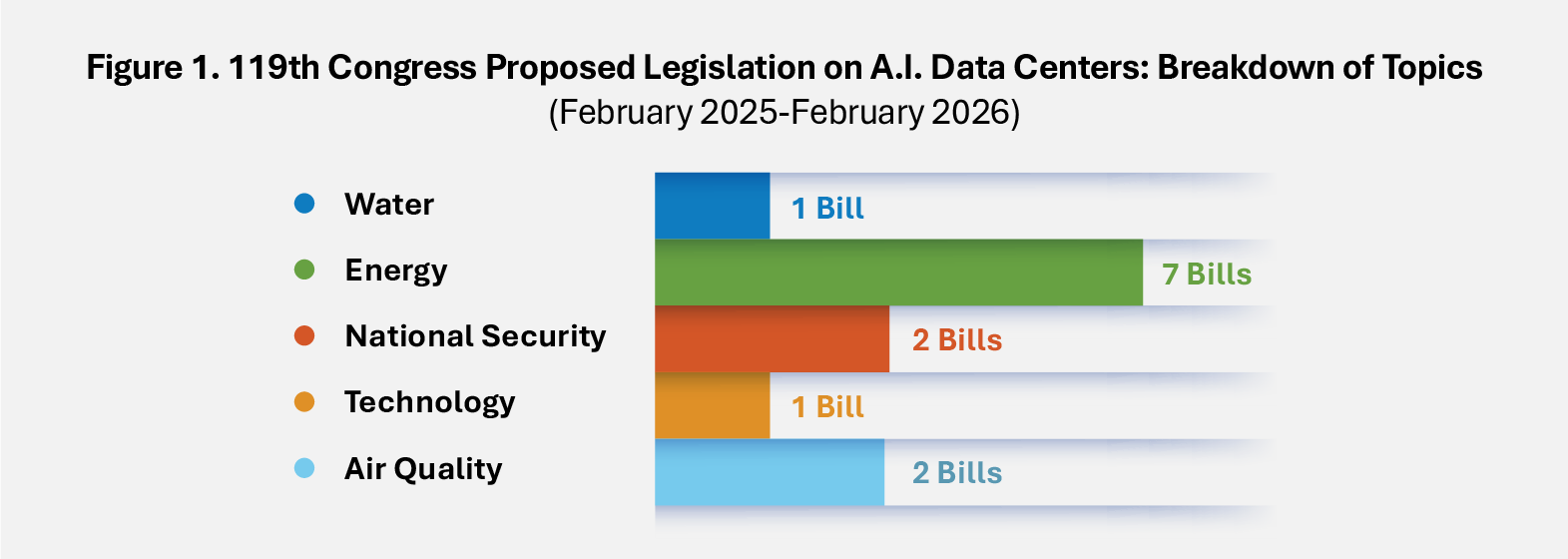
Cite: Created by the Native Nations Center for Tribal Policy Research (NNCTPR).
Notes: Categories reflect NNCTPR classification of bill provisions. Bills may be counted in multiple categories; companion bills are not included.
Bills analyzed in the 119th Congress: H.R.5227, H.R.6984, H.R.6529, H.R.3919, S.3269, S.3852, S.3682, H.R.6983, H.R.6179, H.R.1737.
Within these bills, Congress primarily proposes to exercise its oversight function in addressing data center growth. For instance, some bills require federal agencies to submit reports to Congress on matters such as water usage and greenhouse gas emission tracking and proposed rate structures that protect residential ratepayers. Other proposed bills require federal agencies to assess or conduct studies on specific topics, like the impacts of AI data centers on energy supplies, technology assessments on liquid cooling, and vulnerabilities of AI data centers in cybersecurity or the value of data centers in relation to national security strategies. In some bills, Congress proposes to regulate industry, such as requiring data centers to co-locate with public utilities, derive their energy from a power plant rather than the electrical grid, or to generate their own electricity from a clean energy source.
One bill, H.R. 6179, mentions tribes. Here, Congress proposes to amend the Clean Air Act to address the energy consumption and emissions of data centers and crypto mining facilities. It requires the EPA Administrator to collect and report data on greenhouse gas emissions and electricity consumed from any source. The bill proposes to charge a fee for greenhouse gas emissions above a certain threshold. The collected fees would be used as grants for certain entities, including tribes, to support programs that lower residential consumer energy costs.
State Governing Activities on AI Data Centers
A growing number of states are considering measures to address the growth of data center construction. At least four state governors, to include Washington, Oregon, North Carolina, and Montana, established task forces or working groups to gather information on data center growth and potential impacts for their state. As an example, Washington State’s governor issued Executive Order 25-05 creating a data center working group to address impacts to their economy, tax revenue, energy use, and the environment. On December 1, 2025, the working group submitted its preliminary report, pending tribal consultation, which discusses the economic benefits experienced by communities with data centers, along with the risks to energy, environment, wildlife, cultural resources, and treaty rights.
In 2026, approximately 36 state legislatures have introduced 157 bills addressing data centers (as of April 29, 2026). State legislatures are considering a wide range of oversight, regulatory, and fiscal approaches. For instance, some states are proposing to exercise oversight, like requiring the development of a model zoning ordinance.
While a comprehensive state analysis is beyond the scope of this report, a notable, common consideration across many states is to regulate industry. For example, with respect to ratepayer protections, states have adopted or proposed requirements such as 1) providing notice to property owners when land is purchased to build a data center, 2) encouraging colocation with electric suppliers, and 3) agreeing to reduce electrical use during emergencies, among other various state approaches. Others are considering regulating industry by prohibiting non-disclosure agreements, enacting moratoriums on building data centers, and addressing environmental considerations, such as requiring the submission of reports detailing water usage and greenhouse gas emissions.
Several states have also considered fiscal legislation to influence development. For example, some states are utilizing or considering a range of tax incentives, such as sales or use tax exemptions or tax abatements on property; incentivizing energy efficiency and environmental requirements; or mandating a minimum number of jobs. While some states are actively considering such incentives, others are considering repealing previously enacted data center tax incentives primarily due to cost, such as lost local revenue.
Federal policy approaches may conflict with state approaches, particularly where presidential initiatives seek to establish a federal framework preempting some state actions. In addition to cost concerns, states may be reconsidering prior initiatives to attract investment due to factors such as public concern and emerging research related to energy and water consumption. Taken together, these developments suggest that sovereigns continue to employ a wide variety of governance strategies, often in response to rapidly evolving technology, political, and societal developments.
Across all states, a “one-size-fits-all” policy approach towards data centers does not exist. However, common state actions addressing AI data center growth generally address: • energy usage and protections for ratepayers, • environmental considerations, and • land use development. As tribes explore their options, they may consider that some states balance exploring economic opportunities and potential benefits in the advancements of AI development with risks presented by AI data centers.
Tribal Governance Options for Consideration
As with federal and state governments, tribes may be pressured to act in response to AI data center construction. Tribes considering the potential implications of AI data centers on their communities have a range of available executive and legislative governance options. This section offers internal governance approaches, as well as external engagement strategies related to activities occurring outside their jurisdiction but impacting their rights and interests.
Tribal Executive and Legislative Governing Options
In response to AI data center construction within their jurisdictions, a limited, but growing, number of tribes are considering strategies akin to federal and state approaches. For example, the Cherokee Nation created a data center task force by executive order to review and report on potential economic and natural resource impacts of data centers within their nation. Tribes considering task forces may include a mix of experts from a variety of backgrounds: tribal environmental, economic development, or tax department representatives; legislators; academia; attorneys; industry; or cultural advisors.
Tribes could use their oversight, regulatory, and fiscal functions to prioritize matters of importance to their rights and interests. For example, on March 7, 2026, the Seminole Nation of Oklahoma’s Tribal Council enacted a moratorium on data center development on their lands. The ban includes “any inquiries, discussions and/or developments” during the moratorium period. The moratorium is in response to a start-up company’s request for a non-disclosure agreement. As of May 1, 2026, no other tribes appear to have enacted laws addressing AI data centers. However, in Fall 2025, the Muscogee Creek Nation’s National Council considered a legislative proposal that included the development of a data center on their lands. After citizen engagement, the bill ultimately did not pass.
Like emerging federal and state frameworks, tribes considering legislation about AI data centers could review their existing laws and consider: 1) the adequacy of ratepayer protections for their citizens, 2) solutions for electrical grid stability, or 3) updating environmental standards, like water and air quality. Tribes considering building AI data centers within their jurisdiction could regulate industry through actions like zoning or by requiring transparency, such as in nondisclosure agreements. Fiscal incentives could be used to influence development, like requiring data center companies to “bring, build, or buy” their own energy, or to secure investment into their communities, like permanent jobs. Notably, many communities across the country considering AI data center development are experiencing significant public engagement. In considering legislative options, tribes may consider citizenry impacts and involvement.
Because AI data centers require substantial land and energy resources, tribes may wish to gain a detailed understanding of the potential impacts connected to the land, such as cultural resources and tribal treaty rights. For some tribes with limited land bases or connections to the electrical grid, AI data centers on their land may not be optimal or viable. In addition, because a primary emerging priority across both the federal and state governments involves energy usage and protecting ratepayers, tribes could determine whether these external policy decisions impact energy viability to their communities depending on how the tribe receives energy. Last, tribes considering building data centers may also consider language in contracts or permits addressing data sovereignty.
Tribal External Engagement Strategies with Federal, State, and Tribal Governments
Tribes have several options for external engagement strategies where federal and state actions may impact their tribal rights, interests, and resources. For example, given the Administration’s focus on identifying federal lands for data centers, tribes who have tribal co-management agreements of federal lands could consider if those agreements are implicated. Tribes may also consider cultural resource impacts on federal and state lands and explore existing relevant authorities, such as the National Historic Preservation Act, to assert their rights.
As tribes consider options to address data centers, each tribe’s strategies are rooted in inherent tribal sovereignty and self-determination based on their nation’s priorities. Thus, tribal approaches will vary from tribe to tribe.
Similarly, engagement strategies could consider the formal federal-tribal consultation process when tribal rights or interests are implicated by federal actions. Utilizing the federal consultation process helps both the tribe and the federal government better understand each side’s position and how to uphold the federal trust responsibility. Likewise, tribes could enact or update laws requiring consultation for matters impacting their rights, interests, and resources regarding data centers. Tribes may consider that, just as federal and state regulatory frameworks may implicate tribal rights and interests, tribal regulatory frameworks may implicate federal and state jurisdictions. Engagement may assist with addressing potential policy and legal conflicts, area of overlap, or jurisdictional constraints between sovereigns.
Tribes also can develop targeted engagement strategies, either individually or collectively. Apart from consultation, tribes may advocate for agencies to consider tribal interests. Tribes advocating individually may find it easier to describe the interests specific to their nation but may experience challenges with coordination due to the number of agencies involved. Conversely, tribes may find it easier to coordinate and advocate in their collective voice—such as through a forum like a federal roundtable discussion with the agencies acting under the Administration’s policy priorities—however, it may require tribes to agree on shared priorities to maximize federal responsiveness.
Tribes also may consider advocacy before key members of Congress to discuss their rights and interests involving AI data centers. This may inform Congress as it considers bills addressing AI data centers, including discussion on federal preemption of state approaches and whether that may have tribal implications.
Appendix 1. Summary of U.S. Presidential and White House Actions Regarding Artificial Intelligence Data Centers (July 2025-March 2026) |
||
Date |
Title of Action |
Data Center Provisions |
July 2025 |
The White House America’s A.I. Action Plan—Describes three pillars for addressing artificial intelligence (AI): Pillar I: Innovation, Pillar II: Infrastructure, Pillar III: International Diplomacy and Security |
Pillar II emphasizes the expedited building of data centers. Policy actions include:
|
July 23, 2025 |
Executive Order 14318, Accelerating Federal Permitting of Data Center Infrastructure, implements the A.I. Action Plan by requiring various federal agencies and councils to work together in achieving the A.I. Action Plan goals in building data centers; data centers must meet the definition of “Qualified Projects” |
E.O. 14318 provides the following:
|
December 11, 2025 |
Executive Order 14365, Ensuring a National Policy Framework for Artificial Intelligence, addressing state actions considered inconsistent with national priorities |
E.O. 14365 requires the preparation of a legislative recommendation that establishes a framework to submit to Congress (see the White House action dated March 2026 below). The framework would not pre-empt state law in specific circumstances, including “AI compute and data center infrastructure, other than generally applicable permitting reforms.”
|
March 4, 2026 |
The White House Ratepayer Protection Pledge, lists five pledges where companies agree to ensure consumers do not experience increased energy bills |
The Pledge asks companies building data centers to agree to the following:
|
March 2026 |
The White House A National Policy Framework for Artificial Intelligence: Legislative Recommendations, provides several presidential AI priorities for Congress’s consideration, including data center development |
The Framework identifies the following priorities for the Administration regarding data center infrastructure:
|
Author: Tana Fitzpatrick, J.D., Director, Native Nations Center for Tribal Policy Research
Citation: Fitzpatrick, Tana. 2026. “AI Data Centers and Tribes: Emerging Federal and State Policy Trends and Tribal Governance Options.” Native Nations Center for Tribal Policy Research: The University of Oklahoma, June 16, 2026, https://www.ou.edu/nativenationscenter/research.
Published: June 16, 2026
Externally Peer Reviewed by:
Nikki Borchardt Campbell, J.D., Executive Director National American Indian Court Judges Association
Andrés González, Ph.D., Associate Professor, the University of Oklahoma College of Engineering
Christina Kracher, Esq., 2025 Emergence Circle Fellow
Notice of Use Statement: Copyright © 2025 - This is an open-access article distributed under the terms of the Creative Commons Attribution License (CC BY-NC-NC 4.0). The use, distribution or reproduction in other forums is permitted, provided the original author(s) and the copyright owner(s) are credited and that the original publication is cited, in accordance with accepted academic practice. No use, distribution or reproduction is permitted which does not comply with these terms.
Disclaimer: This work has been created on behalf of the Native Nations Center for Tribal Policy Research (NNCTPR) which seeks to create high quality, non-partisan, neutral research related to Tribal Nations and their citizens. The NNCTPR endeavors to ensure the information presented is authoritative and accurate, but make no claims, promises, or guarantees about the completeness or adequacy of the content contained within this document. All claims expressed in this article do not necessarily represent those of the NNCTPR affiliated organizations, or those of the publisher, the editors and the reviewers.

Copeland Hall Room 225
860 Van Vleet Oval
Norman, OK 73019
nnc@ou.edu | (405) 325-4553