In 1970, the first major retrospective of Bruce Goff’s work opened at the Architectural League of New York—a landmark event that introduced the East Coast architectural community to the full breadth of Goff’s unconventional genius. The exhibition packed 160 boards of photographs, drawings, and prints into the League’s galleries, along with slides and renderings by both Goff and Greene, his former student. Accompanying the exhibition was a portfolio of the Goff’s work, which is now held by more than 170 libraries worldwide.

Ada Louise Huxtable, “Architecture: Peacock Feathers and Pink Plastic.” The New York Times, February 8, 1970.
In her review of the exhibition for The New York Times, architecture critic Ada Louise Huxtable called the show “one of the most provocative manifestations of the American architectural genius,” praising its “mildly mind-blowing” impact. Huxtable noted that the work revealed a “last-stand half-triumph of the romantic individualist” in a profession increasingly shaped by corporate formulas, and urged visitors to look beyond Goff’s unorthodox forms and materials to see the deep artistry and personal vision they embodied. For many in New York, the exhibition was their first real encounter with the radical creativity of the Goff’s and Greene’s American School of Architecture, and the curatorial vision played a pivotal role in shaping that introduction.
University of Oklahoma alumnus William “Bill” Earl Murphy was the brilliant co-curator, with Louis Muller, of that mind-blowing exhibition exalted by Huxtable. Murphy was himself an accomplished architect and designer who helped introduce the visionary spirit of Oklahoma’s American School to New York and whose inventive work was frequently featured in The New York Times.

William Murphy, Abstract Composition, First-Year Studio, Design II (Architecture 18) assignment, 1960. American School Archive, University of Oklahoma Libraries.
Murphy’s passion for architecture began early. A former classmate recalled that Murphy, while still a student at Classen High School in Oklahoma City in the late 1950s, corresponded with Frank Lloyd Wright, who personally invited him to apprentice at Taliesin West—though Wright’s death in 1959 altered that path. Murphy went on to study architecture at the University of Oklahoma, where he experienced the American School curriculum developed by Bruce Goff, Herb Greene, and others. He worked for Goff in his Bartlesville-based architectural practice, and became close friends with fellow architect Herb Greene, assisting on creative projects including Greene’s iconic Norman “Prairie House,” where he helped to shingle the home’s interior.
Goff’s and Greene’s unconventional and visionary approach to design left a lasting mark on Murphy’s design practice. After moving to New York City, Murphy co-founded the firm Louis Muller William Murphy Architects, where he and Muller gained recognition for inventive, space-conscious interiors. Their work was published widely, including highlights in multiple New York Times features, such as “Designers’ Sleight of Hand: Making Small Spaces Larger” (Dec. 22, 1983), “Ingenious Cabinets, Stacked Appliances for Small Kitchens” (Jan. 9, 1986), “Creative Ideas for Tiny Spaces: Redesigning the Small Bathroom” (Sept. 11, 1986), and “Home Beat; Frills and Flowery Patterns” (Oct. 24, 1985).

A collection of New York Times articles featuring work by Louis Muller William Murphy Architects, from left: 1) “Designers’ Sleight of Hand: Making Small Spaces Larger,” December 22, 1983; 2) “Ingenious Cabinets, Stacked Appliances for Small Kitchens,” January 9, 1986; 3) “Home Beat; Frills and Flowery Patterns” October 24, 1985.
The American School Archive, at the University of Oklahoma Libraries’ Special Collections, houses the William Murphy papers and architectural drawings, documenting his career as an architect and curator from 1958–2017. The Murphy collection includes correspondence with important figures such as Lloyd Wright, Bruce Goff, Esther McCoy, and Herb Greene, as well as materials relating to exhibitions, projects, and professional activities. Murphy’s drawings span from his student work at OU to projects completed in New York with firms including Kahn and Jacobs and his partnership with Louis Muller. The archive also includes a selection of architectural drawings by Herb Greene.
More than 50 years after his seminal Goff exhibition, Bill Murphy, who passed away in 2022, leaves a legacy defined by individual expression, material experimentation, and human-centered design. His work as both a designer and curator continues to inform contemporary conversations about architectural innovation and education, including the ongoing study of the American School developed at the University of Oklahoma.
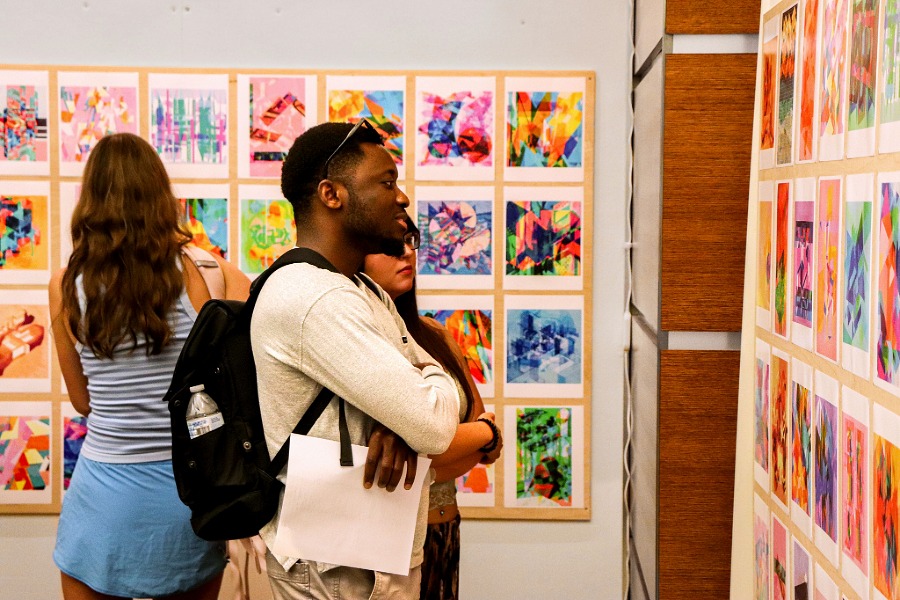
Gibbs College is pleased to present the exhibition 200 Digital Drawings by Professor Tiziana Proietti, currently on display in the Gould Hall Living Room.
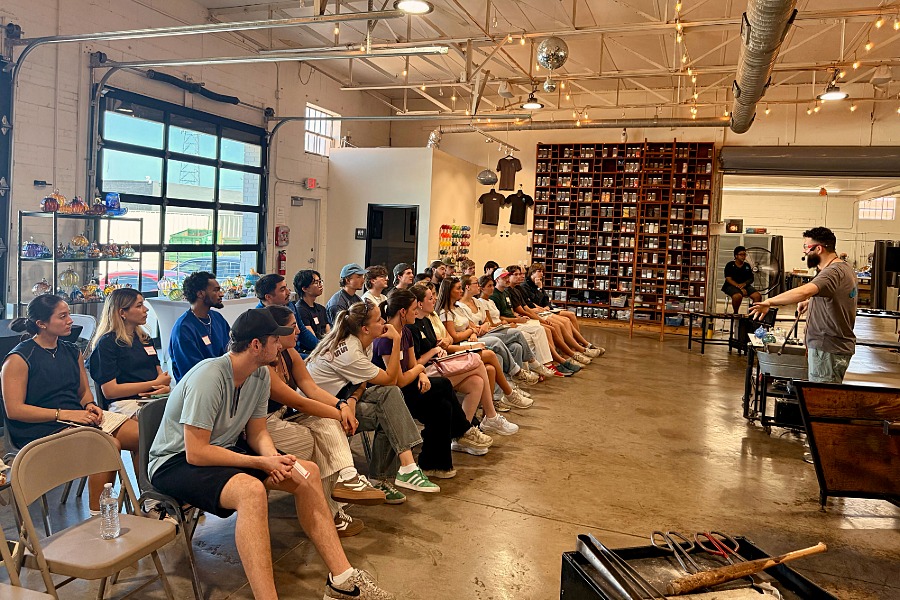
Gibbs College of Architecture Professors Amber Brown and Amy Leveno led 29 students to Dallas, Texas, in September for a learning experience as part of their Design 7 Studio course.
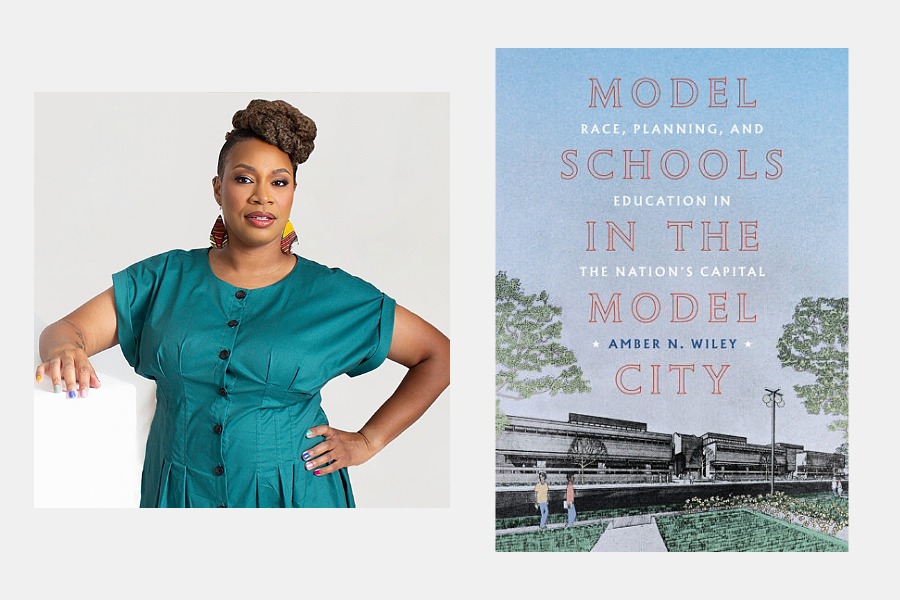
Christopher C. Gibbs College of Architecture professor and Institute for Quality Communities Director Dr. Amber N. Wiley’s book, Model Schools in the Model City: Race, Planning, and Education in the Nation’s Capital, has received two major honors from the Urban History Association.