During the spring 2024 semester, first-year Architecture students began working on a two-part project concerned with extreme weather events and their impact on human lives and architectural spaces.
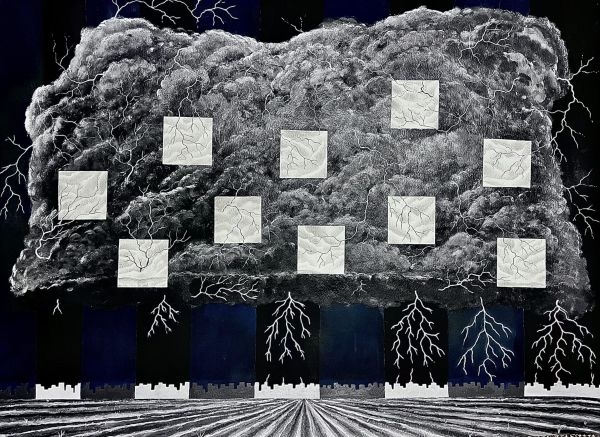
A drawing of a lightning storm by Architecture student Lauren Liguez.
Typically, when studying a site, architects focus on factors such as topography, the slope of the terrain, different views, and access routes while considering nearby bodies of water, vegetation, and orientation to the sun. However, this project encouraged students to explore other important forces: changing atmospheric conditions that surround our living spaces and impact them.
Due to climate change extreme weather events are growing more severe and more frequent. However transient and shifting, those conditions of air, wind, vapor, snow and ice affect human behavior, moods, sight and sense of safety. In extreme situations, the weather also threatens human lives.

Students attending a lecture from Mark Shafer at the National Weather Center.
Mark Shafer, professor in OU’s Department of Geography and Environmental Sustainability, kicked off the project with a lecture at the National Weather Center in Norman and helped students gain an in-depth understanding of natural hazards. At the NWC, the students visited the weather reporting resources of the federal, state and academic entities, including some facilities and tools of the National Severe Storm Laboratory.
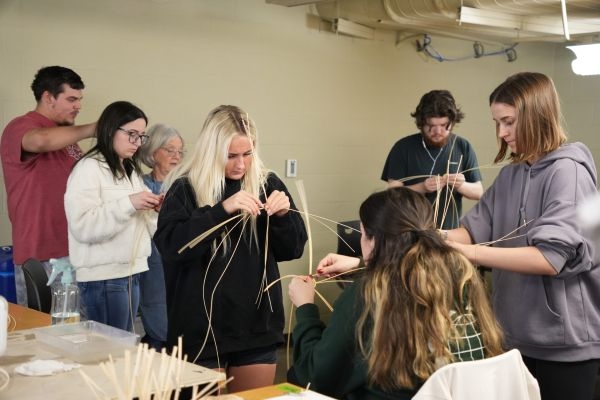
Students attending a weaving workshop.
Each student chose an extreme weather system, such as bomb cyclone, atmospheric river, thunderstorm, blizzard, tornado, hurricane, hailstorm, lightning storm and more. The students then researched and studied their chosen weather system’s evolution and represented it in clear visual form. Using a variety of media, including pencils, watercolor, charcoal and acrylics, the students invented ways to represent other-than-solid states of matter and visualize the formation of these abstract systems over time.
To initiate the second part of the assignment, Sue Fish, Chickasaw Hall of Fame Master Weaver, lectured about indigenous basket making. The students also partook in a week-long workshop to learn Native American basket weaving techniques. The workshop was led by Marcia Balleweg, an accomplished basket maker from Wellston, Oklahoma, with additional aid from Mary Lee, Nancy Rimassa and Maggie Rimassa, basket weavers from the Oklahoma community.
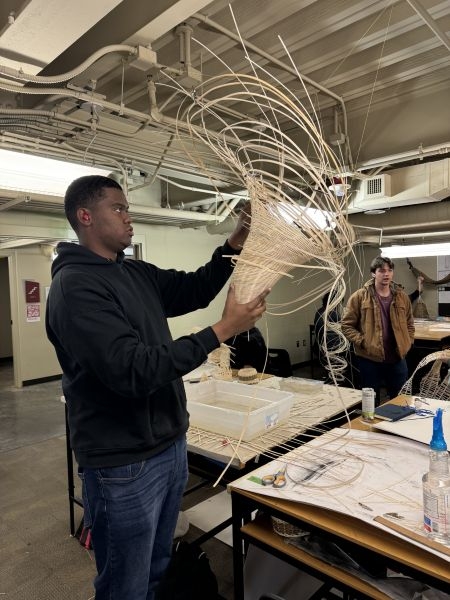
Student Braylyn Russell weaving a storm.
The students then brought their drawings to life by creating three-dimensional woven models of their chosen weather systems. With a variety of reeds, they attempted to express the volume of the storm and its expanse. According to Architecture faculty Tamar Zinguer, who developed the project, the structural yet malleable form of woven objects can provide a new direction for Architecture. Weaving introduced students to a new perspective of design, away from typical principles of firmness and rigidity and towards principles of openness, flexibility, change and formation over time.

Mary Lee showing Denia Salazar a weaving technique.
Alongside Zinguer, Architecture faculty Ted Reeds, Shooka Motamedi, Hunter Read and Chris Loofs led students through this project. The students presented their final projects on Monday, Mar. 11. See more photos of the students’ final projects below.

Sandstorm drawing and weaving by Architecture student Michelle Doan.

Lightning storm drawing and weaving by Architecture student Emma Bock.
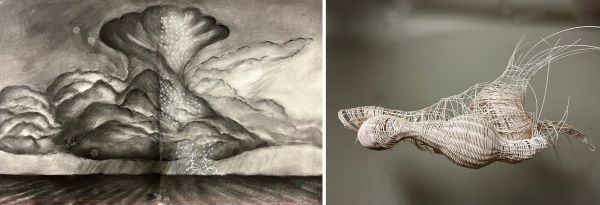
Thunderstorm drawing and weaving by Architecture student Betty-Sue Kihunrwa.
Gibbs College is pleased to present the exhibition 200 Digital Drawings by Professor Tiziana Proietti, currently on display in the Gould Hall Living Room.
Gibbs College of Architecture Professors Amber Brown and Amy Leveno led 29 students to Dallas, Texas, in September for a learning experience as part of their Design 7 Studio course.
Christopher C. Gibbs College of Architecture professor and Institute for Quality Communities Director Dr. Amber N. Wiley’s book, Model Schools in the Model City: Race, Planning, and Education in the Nation’s Capital, has received two major honors from the Urban History Association.