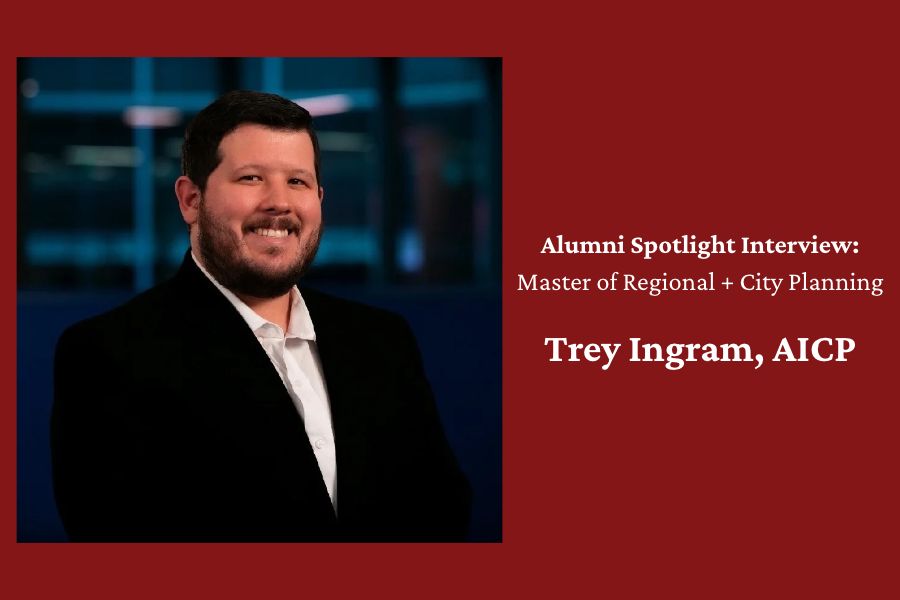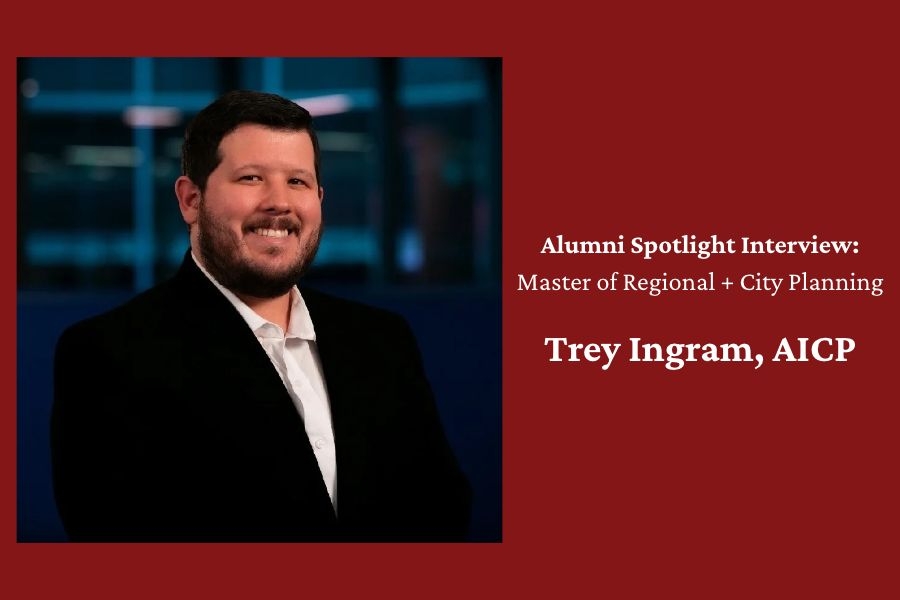
Planning, Landscape Architecture, and Design (PLAD) alumni Trey Ingram, AICP recently spoke with current PLAD student and graduate media assistant Molly Strobel to share his experiences with the Regional and City Planning program and current work with the Toyota Mobility Foundation. Ingram graduated from the University of Oklahoma in 2012 with a B.A. in Geography and a minor in Economics and graduated again in 2014 with a Masters in Regional and City Planning. He currently works as a Program Manager with the Toyota Mobility Foundation.
Molly Strobel: Hello everyone, and welcome to the Gibbs Spotlight. My name is Molly, and I am a media and communications GA for Gibbs College, and I also work on the social media team for the Planning, Landscape Architecture, and Design department. Today, I am speaking with Trey Ingram, a graduate of the Regional and City Planning program.
Welcome, Trey. Real quick, if you could just give us a brief introduction, the year you graduated and the degree you received.
Trey Ingram: Sounds great. First, Molly, thank you so much for having me on here today. Yeah, my name is Trey Ingram. I graduated with my Bachelor of Arts in Geography and a minor in Economics from OU in 2012 and immediately went into the graduate Regional and City Planning program in the College of Architecture and graduated with my master's degree in 2014.
MS: Awesome. And if you could just give us also currently a career trajectory where you started, where you're at now, that would be great.
TI: Yeah, for sure. So, I always knew I wanted to get into urban planning in some way, shape, or form. During my undergraduate studies, I had the opportunity to take one of Charlie Warnken's undergraduate global cities classes, which really kind of solidified my decision to go into urban planning. And so, between my junior and senior year, I actually emailed a bunch of cities in the Oklahoma City metro area to try to create my own internship, which was successful. And I worked for two summers at the city of Piedmont, where I did a lot of GIS work, community development work, and just got a really good foundational understanding of how cities work on a day-to-day basis. And so, that was really good information and experience for me, leading into starting the graduate program in the Regional and City Planning division.
During school, I had an opportunity to be an intern for the city of Oklahoma City in the urban redevelopment division, actually working under a fellow OU alum, Kim Cooper Hart, on her team. And I worked on the commercial district revitalization program and, again, just kind of like getting more experience of how cities work, how they operate, which, again, solidified my career decision.
So, after finishing my graduate degree in 2014, I had an opportunity to immediately, actually right after graduation, start work at the North Central Texas Council of Governments, which is in the Dallas-Fort Worth metro area. It's a regional government agency that has a primary mission of allocating federal transportation dollars to local projects. And so, what that meant for my job was that I was working on a lot of bicycle and pedestrian infrastructure projects. I was doing a lot of sustainable development and corridor redevelopment master planning in the Dallas-Fort Worth region. Our agency kind of acted like a semi-consulting firm for a lot of the smaller cities in the Dallas-Fort Worth area, so I had an opportunity to work on that aspect of regional transportation planning.
And so, I did that from 2014 until 2017, at which point I had an opportunity, actually, to move over to Toyota North America in the social innovation department, which I know is kind of a little bit of a curveball for somebody with an urban planning degree to go work for an auto manufacturer. But they were specifically looking for somebody with an urban planning background because they were looking to conduct community mobility studies in Toyota's plant communities across the U.S. in Indiana, Kentucky, Alabama, Mississippi, and Texas. And so I had an opportunity to do that for a few years, and we would conduct these studies, and then the recommendations from those studies, we would work to implement with local community partners in accessible transportation, public transportation, workforce, and employment-focused transportation, through grants and collaborations with transit agencies, municipal governments, and local nonprofit organizations in those cities and regions where Toyota had a major job presence, like a manufacturing facility or a large office location.
MS: That's so cool.
TI: Yeah, yeah, it's very different. It was not something that I saw in my career path but has absolutely been transformative for my career because in 2019, so I did that position for a couple of years, and then in 2019, I had the opportunity to move over to the Toyota Mobility Foundation, which is Toyota's global nonprofit. And I was able to leverage my expertise in transportation planning and work with communities to manage mobility projects and innovation programs for the foundation. Really, across the globe, I've had an opportunity to work on projects in Asia, Europe, South America, and, of course, in North America as well. And so having the foundation of a multidisciplinary degree like Regional and City Planning has allowed me to work across different contexts and understand different cultures and working styles and really be flexible and adaptable. But it all started with getting that graduate degree from OU.
MS: That's really cool. Very interesting. And I love that OU gave you this foundation to work on in your professional career. Are there any projects that you want to highlight that have really exemplified your multidisciplinary background?
TI: For sure. So, my main program over the last about three years now was called the Sustainable Cities Challenge. And it was a global innovation competition where we solicited entries from cities across the globe that were experiencing a mobility problem in advancing low-carbon mobility or strengthening their local mobility systems. Or overcoming a mobility barrier in the accessibility space. And so, we ended up getting about 200 entries from 170 cities globally. At which point we went through a selection process very similar to like a standard call for projects. We ended up selecting three cities that move forward in the program: Detroit, Michigan, Venice, Italy, and Varanasi, India. And we ran – once we selected those cities, we worked with them to create an open innovation competition where we worked with them to help them define their problem, create the call for innovations around that, and kind of manage the whole program. And so, we opened three call for innovations in each of those cities and selected a cohort of innovators, and they received funding from TMF. And then we went through kind of a downselection process. We had 10 semifinalist innovators in each city and then we downselected to up to five. And then in each of the three cities we just announced throughout this year the winners of the competition in each of those cities, and they received some additional funding from TMF to continue and scale up their solutions in each of the three cities.
But with all of that came the need to be able to work in three completely different places, the U.S., Italy, and India, three completely different working styles. The governments work completely differently. So, you know, there was a lot of work in, you know, data collection, data gathering, helping define a problem, working with the local community. And so, you know, having a background in urban planning where you're needing to work with diverse communities and needing to understand how to navigate many different stakeholders was an absolute necessity in managing and executing that project.
MS: That's awesome. Are there any other projects that you want to highlight that you've done throughout the years?
TI: Maybe my favorite project that is still going on right now is actually in Medellín, Colombia. We are working to improve or address accessible transportation in two neighborhoods of Medellín that have a high concentration of persons with disabilities and people using mobility devices like wheelchairs and other types of devices. But these two neighborhoods are on the hillsides of the Medellín metro area. And so, the streets have very steep grades. And so, it's not easy to go up or down if you're using a mobility device. And so, we're working with the community on an open innovation competition to try to address some of those issues regarding, you know, safety to and from someone's house to the bus stop, information around when the bus is going to arrive, if the bus has a wheelchair lift that's actually working that day. And so, that project is still ongoing; we're not complete with that yet. But that's been a really good experience working in a place I never worked in before in Colombia.
MS: Nice. That's really cool to hear about. So, really quick, I want to transition to learning about why you chose Gibbs College, why you chose PLAD and regional and city planning. If you could speak a little bit to why this stood out to you. I know you talked a little bit about Charlie's class, Global Cities but if there's any other factors...
TI: So, I actually started out at OU as a meteorology major. That was what I wanted to do. But after the first semester, I quickly realized maybe it was more of a hobby for me than something I wanted to actually do as a career. And so, I had an opportunity to meet with one of the professors and undergraduate advisors in the geography department. And he was just kind of talking to me about what I was interested in, what I like to do. He was like, do you like to play SimCity? Do you like simulation games like that? And I was like, yeah, I've been playing SimCity my entire life. And he was like, well, with a degree in geography, it's a common career path to then go into city planning. I was like, oh, I never actually thought about that. I never thought about that as an actual career. And so, he helped me throughout my undergraduate studies. He helped me craft a course path through my electives that would be beneficial if I wanted to eventually go to graduate school and focus on regional and city planning. And so, obviously, I had a lot of mapping classes and getting familiar with GIS and analytic methods and taking courses in economics and things like that. And, of course, when I had the opportunity my senior year to take Charlie's Global Cities class, that really solidified my decision. And because of that undergraduate class, I became familiar with the RCPL department, and I really wanted to have Charlie for more classes. And so, to be honest, I didn't really look at any other graduate programs because I grew up in Oklahoma. I was already comfortable at OU. I was familiar with the professors in the program already, so it just made it an easy, nice transition for me going from undergrad into grad school in the College of Architecture.
MS: Are there any opportunities that you had during your graduate program in Gibbs College that you would say stood out or made you want to continue doing what you do?
TI: Having the internship experience at the City of Oklahoma City in the Urban Redevelopment Division working with Kim Cooper-Hart on the Commercial Development Revitalization Program helped me understand the broader picture of what a career in urban planning could be. Current planning, which is plan review and dealing with zoning codes and things like that, just not something that I was really interested in. And so, having an internship experience where I got to do a little different type of urban planning than what was known to me at the time was very appealing. And, you know, because the planning division had some good relationships with alumni at the time, they were able to create these internship opportunities for students.
MS: Awesome. Do you have any advice for current students, not only in the Regional and City Planning program, but in PLAD as a whole?
TI: Be open. Keep your mind open. Look for opportunities that might seem nontraditional or tangentially related to what the official description of your degree might be because you might find some unique opportunities that need your skill set and your mindset of being an urban planner. I never saw myself working at Toyota or the Toyota Mobility Foundation, but my skills that were foundationally constructed in the urban planning program have absolutely been applicable and have been valued and heard and understood. And so, yeah, my advice is to just be open and look for those opportunities that might be a little off the beaten path because you never know where you might find yourself.
MS: That's awesome advice. Thank you. All right. Well, this concludes our interview. Thank you, Trey, for meeting with me.
TI: Well, thank you so much for the time. Very much appreciated.
Planning, Landscape Architecture, and Design (PLAD) alumni Trey Ingram, AICP recently spoke with current PLAD student and graduate media assistant Molly Strobel to share his experiences with the Regional and City Planning program and current work with the Toyota Mobility Foundation.
Christopher C. Gibbs College of Architecture assistant professor Amy Leveno and Mark Leveno, co-founders of OFFICIAL Design, have received a 2026 AIA Central States Region Design Award for the firm’s Granger Annex Community Center project in Garland, Texas.
Construction Industry Speaker Series welcomed Stephen Evans from the Oklahoma City National Memorial & Museum to give a lecture on better conversations and relationship building.