
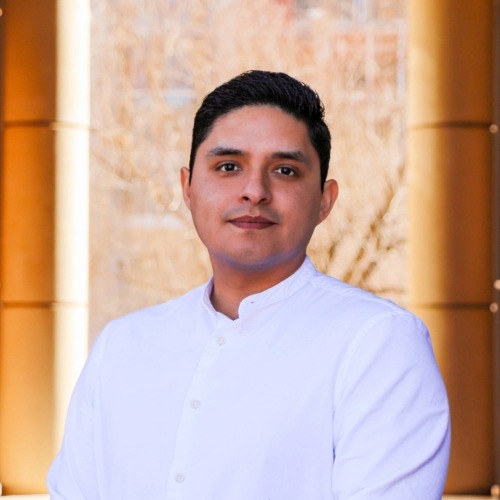
Felipe Flores (Quito, 1991) is a PhD candidate in Planning, Design and Construction at the University of Oklahoma (OU), under the supervision of Dr. Angela Person. His research explores the perception of time, space, and body in the spatial practices of Indigenous Achuar communities in the Ecuadorian Amazon. Through ethnographic fieldwork, architectural documentation, and interdisciplinary analysis, he examines how Indigenous knowledge systems shape the built environment in ways that challenge and resist state-led development and Western design paradigms. He also serves as Editor-in-Chief of Telesis, the nationally awarded architecture journal led by students at the Gibbs College of Architecture.
During his doctoral studies, Felipe has been recognized with numerous national and institutional honors for both his research and teaching. He was awarded the Endangered Material Knowledge Programme (EMKP) grant from the British Museum to support his fieldwork on Indigenous architecture. He received the Midwestern Association of Graduate Schools (MAGS) Excellence in Teaching National Award, the Provost’s Graduate Teaching Assistant Award at OU, and the Architecture Research Center Consortium (ARCC) King Medal for Excellence in Architectural and Environmental Research. He has also secured competitive funding from the Charles M. Russell Center, the OU College of Architecture, and the Security in Context Research Fellowship to support his interdisciplinary work across architecture, anthropology, and Indigenous studies.
Prior to his doctoral studies, Felipe worked as an Associate Architect at DLZ Corporation, where he contributed to the design of Public Safety and Justice Architecture projects with a focus on green building systems and integrated project delivery. He earned a Master of Architecture at the University of Illinois Urbana-Champaign (UIUC) as a Fulbright Scholar. At UIUC, he served as a research assistant and contributed to projects including Visceral Geographies—a study of bodily-environmental interaction on the outskirts of Bogotá, Colombia—as well as NICU upgrades in rural Illinois and experimental material development using agricultural waste fibers.
He founded FG Architects, an environmentally conscious design studio based in Quito. The practice emphasizes sustainable construction systems, from water harvesting and clean energy to hybrid material technologies and the use of local resources. The studio emerged after he earned his Bachelor of Architecture from Pontificia Universidad Católica del Ecuador (PUCE), where his commitment to ecological design first took root.
At the core of Felipe’s work is a commitment to bringing non-Western perspectives of space and place into both academic discourse and professional practice. Through his teaching and research, he aims to foster a more holistic architectural education that recognizes multiple ways of knowing and inhabiting the world, while equipping future practitioners to approach design as a culturally responsive practice—one that aligns with community worldviews, ways of living, and context-specific needs.
