NEWS

OKLAHOMA CITY – A University of Oklahoma researcher has received a $1.9 million National Institutes of Health award to uncover new ways to predict when multiple medications taken together could cause dangerous side effects.
Wei Yue, Ph.D., a professor of pharmaceutical sciences in the OU College of Pharmacy, will use the five-year award to study how the body moves drugs into the liver and how other medications can disrupt that process. These drug-drug interactions are a significant source of preventable harm, particularly as more patients manage multiple prescriptions at once.
“When people are sick, they often aren’t taking just one medication. They have to take several at a time,” Yue said. “My research focuses on finding new ways to minimize the unwanted side effects that can happen when patients take multiple medications together.”
Statins, the widely prescribed cholesterol-lowering medications that help prevent heart attacks and strokes, offer a familiar example. Labels of certain statins warn against drinking large amounts of grapefruit juice, which slows the body's ability to break the drug down. That kind of interaction, involving drug metabolism, has been studied for decades.
Yue’s research focuses on a less understood factor: drug transporters. Statins, and many other medications, enter liver cells through proteins on the cell surface called organic anion transporting polypeptides, or OATPs. When a second drug blocks those transporters, the first drug can’t reach the liver, where it is processed.
“If a second drug inhibits these transporters, less of the statin can enter the liver cells,” Yue said. “Then more statins build up in the blood, go to the muscles and cause muscle toxicity. That’s a well-known clinical problem with statin treatment. Transporter-mediated drug interactions are a clinical concern for many drugs, not only statins, although the organs affected, types of toxicity, and changes in efficacy vary depending on the drug.”
With the new award, Yue’s team will identify novel mechanisms to help identify drugs that may cause previously unrecognized interactions, combining cell and molecular biology with computational modeling and simulation. The long-term goal is to develop a strategy that better predicts transporter-related drug interactions before patients are harmed.
Yue’s work has already helped shape how researchers develop safe new medicines worldwide. Publications from her laboratory, authored by her PhD students and postdoctoral trainees, have been cited in drug interaction guidance for industry from the U.S. Food and Drug Administration and in the current ICH M12 drug interaction guideline, which regulatory agencies in the United States, Europe, Japan and elsewhere use to advise pharmaceutical companies. In addition, “For many drugs already on the market, their potential for drug interactions is not fully understood,” Yue said. “Our research can help identify which drugs may be unsafe to use together, giving doctors and pharmacists that knowledge in advance.”
She also serves on the steering committee of the International Transporter Consortium (ITC), a global group of scientists from academia, industry and regulatory agencies working to advance transporter science and improve drug development and human health. Yue was elected to the ITC in 2021 and to its 12-member steering committee in 2024. She served as a group leader on an ITC white paper published in 2022 and is leading the writing of another.
“The OU College of Pharmacy is fortunate to have Dr. Wei Yue as a member of its faculty. Her expertise is recognized and valued nationally and internationally, as well as locally, where she makes a meaningful impact on pharmacy students, graduate students, post-doctoral fellows, research staff, and her faculty and administrative colleagues,” said Dr. Melissa Medina, dean of the OU College of Pharmacy. “Her research is a wonderful example of how faculty can conduct fundamental bench research that translates directly to improving patient outcomes. I look forward to seeing her continued accomplishments and the impact of her work in the years ahead.”
About the project
“Regulation of Hepatic Drug Transport Proteins: Identifying Novel Drug Interaction Signals” is funded by a $1,911,695 Maximizing Investigators’ Research Award (MIRA) from the NIH’s National Institute of General Medical Sciences, project 1R35GM164073-01. The project began on July 1, 2026, and is expected to conclude on March 31, 2031.
About the University of Oklahoma
Founded in 1890, the University of Oklahoma is a public research university with campuses in Norman, Oklahoma City and Tulsa. As the state’s flagship university, OU serves the educational, cultural, economic and healthcare needs of the state, region and nation. In Oklahoma City, the Harold Hamm Health Campus is one of the nation’s few academic health centers with seven health profession colleges located on the same campus. The Harold Hamm Health Campus serves approximately 4,000 students in more than 70 undergraduate and graduate degree programs spanning Oklahoma City and Tulsa and is the leading research institution in Oklahoma. For more information about the Harold Hamm Health Campus, visit www.ouhsc.edu.
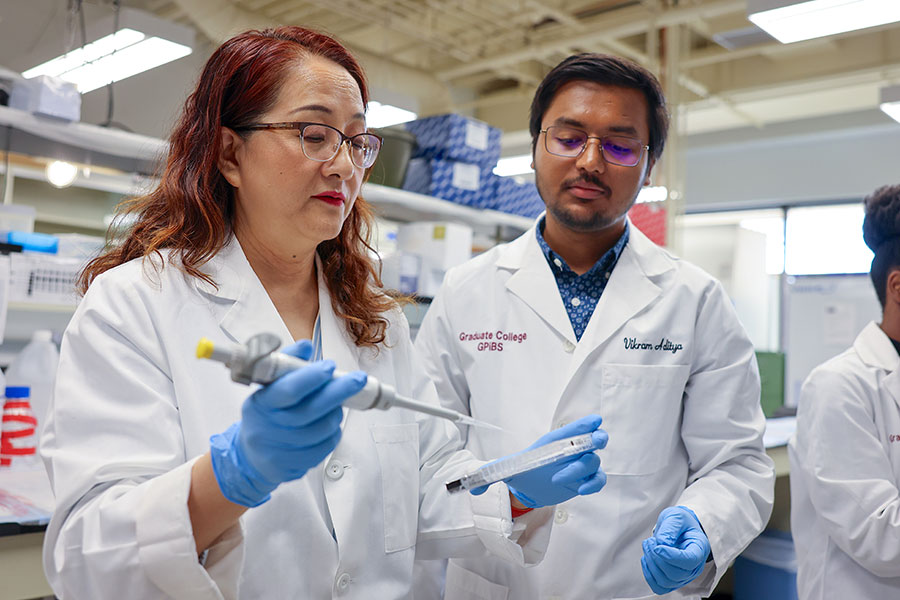
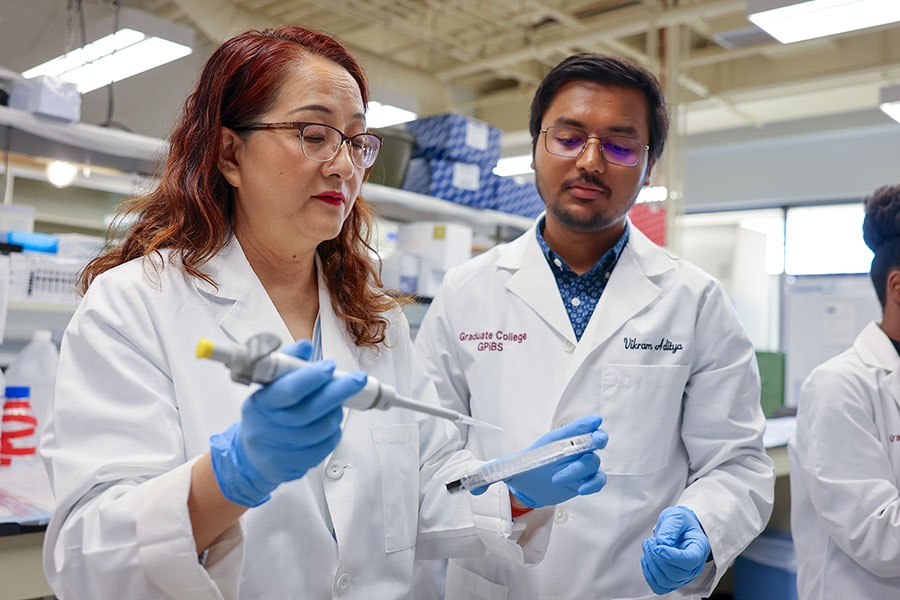
Wei Yue, Ph.D., a professor of pharmaceutical sciences in the OU College of Pharmacy, has received a $1.9 million National Institutes of Health award to uncover new ways to predict when multiple medications taken together could cause dangerous side effects.
People with type 2 diabetes were much more likely to achieve remission after weight-loss surgery than after intensive medical and lifestyle management, according to a long-term study. Researchers also identified patient characteristics linked to remission and to the likelihood of diabetes returning.
The University of Oklahoma College of Law has named Oklahoma Supreme Court Justice James R. Winchester as the 2026 recipient of the Eugene Kuntz Award. The annual award recognizes professionals who have made significant contributions to oil, gas and natural resources law.