NEWS

OKLAHOMA CITY – People experiencing homelessness often live with chronic illness, mental health conditions and substance use disorders, while facing significant barriers to accessing and managing health care. With a new five-year, $1 million federal grant, the University of Oklahoma is addressing this challenge by launching a Street Medicine and Advocacy Pathway at the OU College of Medicine to train medical residents in delivering compassionate, comprehensive care to this vulnerable population.
Residents in internal medicine and family medicine can choose the pathway, which immerses them not only in the clinical care of people who are homeless but also in community services. OU is one of only 24 primary care residency programs in the country to receive the grant from the Health Resources and Services Administration.
“Unhoused populations are less likely to receive the care they need for their physical, mental and social health needs, and that only worsens their situations,” said Brian Lich, M.D., an associate professor of internal medicine at the OU College of Medicine, who is leading the work of the grant. “We want to help break that cycle and help them live healthier lives.”
Residents in the pathway will take part in eight-week rotations. About half of their time will be spent at Healing Hands Health Care Services, a federally qualified health center in Oklahoma City, where they will work alongside a licensed physician treating patients experiencing homelessness. The rest of the time will be spent at community organizations, including food banks, homeless shelters and social service agencies.
While connecting a patient to a resource is important, firsthand experience within community organizations will allow residents to better serve their patients.
“We’re training residents to be physician advocates,” said associate professor and grant co-leader Mary Gowin, Ph.D., MPH, director of the Primary Care Health Policy Division in the Department of Family and Preventive Medicine, OU College of Medicine. “People experiencing homelessness are facing big problems, and physicians can sometimes feel powerless about how to help them. This pathway is designed to empower physicians to help their patients connect to the needed resources in the community beyond simply giving them the name of an organization.”
In 2024, 1,838 people were homeless in the Oklahoma City metro, according to the City of Oklahoma City’s Point-in-Time Survey Report. Of those, 376 were living with severe mental illness, 212 reported substance use disorders, 137 had experienced domestic violence, and 15 were living with HIV/AIDS. Certain subgroups face even greater risk, including veterans, minors, unaccompanied youth, and individuals with one or more disabling conditions.
Caring for patients in a health care setting is important, but if they don’t have the resources to continue care on their own, their health likely will not improve, Lich said.
“We have to look beyond a patient’s diagnosis and care about them as a whole person, considering the social drivers of their situation,” Lich said. “For example, someone with a diabetic foot ulcer may need six to eight weeks of IV antibiotics. What do we do next as physicians when they don’t have the resources to access that care? There isn’t always an easy answer, but acknowledging the challenge, educating our residents and strengthening partnerships with community organizations is a step in the right direction.”
Each year, three to four residents from both the internal medicine and family medicine residency programs will take part in the Street Medicine and Advocacy Pathway. Family medicine resident Shanna Rolfs, M.D., who recently finished her rotation, said the experience affirmed her commitment to serving patients who often fall through the cracks of the traditional health care system.
“Navigating a complex health care system can be difficult for patients without adequate resources, and it is important for physicians to help those experiencing addiction and housing instability navigate the system,” Rolfs said. “I value the emphasis the Street Medicine Pathway places on building relationships within the community in nontraditional settings, as I strive to become a physician who is prepared to serve all members of the community regardless of barriers to health care.”
Mackenzie Gonzalez, D.O., assistant professor of family and preventive medicine and a co-leader of the grant, said the pathway is part of the residency program’s effort to foster a deep sense of responsibility and advocacy among residents.
“Health care doesn’t begin and end within clinic walls,” she said. “For many unhoused individuals, traditional systems are simply out of reach. Through this pathway, our residents can build trust, provide essential medical care, and learn firsthand about the realities our patients face.”
For nearly a decade, residents in primary care programs have provided care at free clinics across the Oklahoma City metro and learned about community resources through an advocacy rotation. The new grant formalizes and expands those efforts, creating dedicated time and structure for the Street Medicine and Advocacy Pathway. The grant’s leaders are also creating the Oklahoma Street Medicine Network, a twice-yearly meeting with community partners.
“This is an opportunity to convene all of our different partners so we can have bigger conversations about how we can better help people,” Gowin said. “We want to align our resources in a way that truly moves the needle for people experiencing homelessness.”
About the University of Oklahoma
Founded in 1890, the University of Oklahoma is a public research university located in Norman, Oklahoma. As the state’s flagship university, OU serves the educational, cultural, economic and health care needs of the state, region and nation. For more information about the university, visit www.ou.edu.
The University of Oklahoma has received a transformative gift from Jon and Shannon McCartney, which will name the McCartney Family Tunnel of Champions, the McCartney Family Gate of the Gaylord Family - Oklahoma Memorial Stadium and the McCartney Family Grand Lecture Hall in the Michael F. Price College of Business. The gift will also support the Inspiring Champions and the Athletic Director’s Discretionary Fund, in addition to establishing the McCartney DFW Career Trek program at Price College.
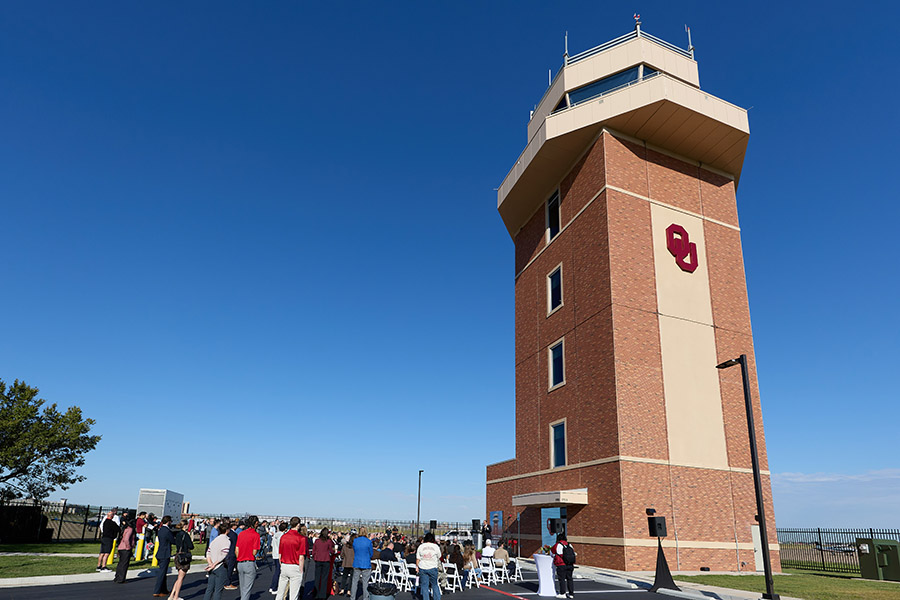
The University of Oklahoma today celebrated the opening of a new air traffic control tower at the OU Max Westheimer Airport. Standing 106 feet tall, more than double the current 52-foot facility, the new tower will modernize air traffic control operations and improve safety for pilots and students operating in the airspace.
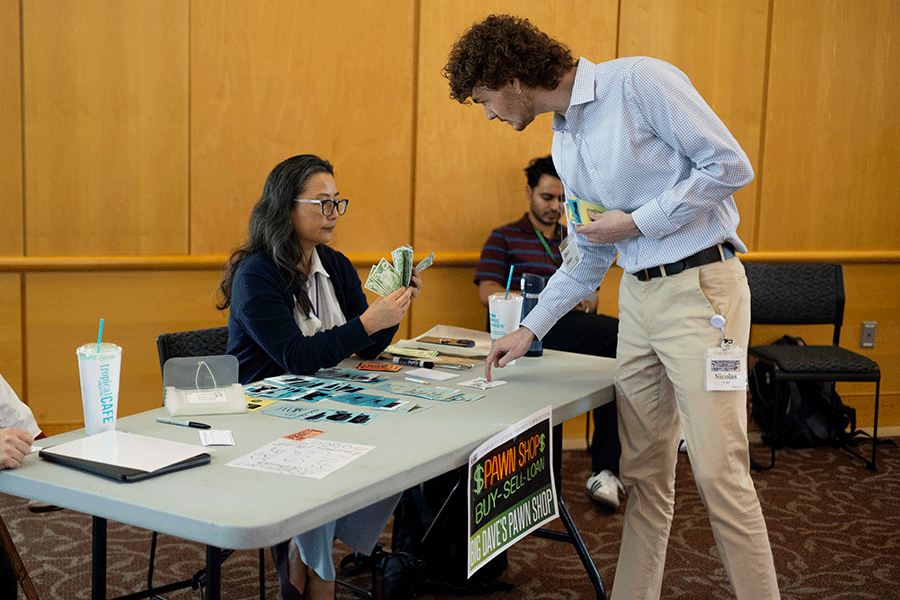
Do I buy groceries or pay the electric bill? Should I pawn some of my belongings to afford my prescription? My child is sick, so I will have to miss work to take care of him. Those are just a few of the difficult choices that OU-Tulsa health professional students confronted during the Community Access to Resources Experience. The role-playing activity challenged students to navigate the financial, family and other pressures that can affect a person’s health and ability to follow medical advice. Held annually during the SCM Institute orientation week, the experience is designed to generate understanding and build empathy.