NEWS

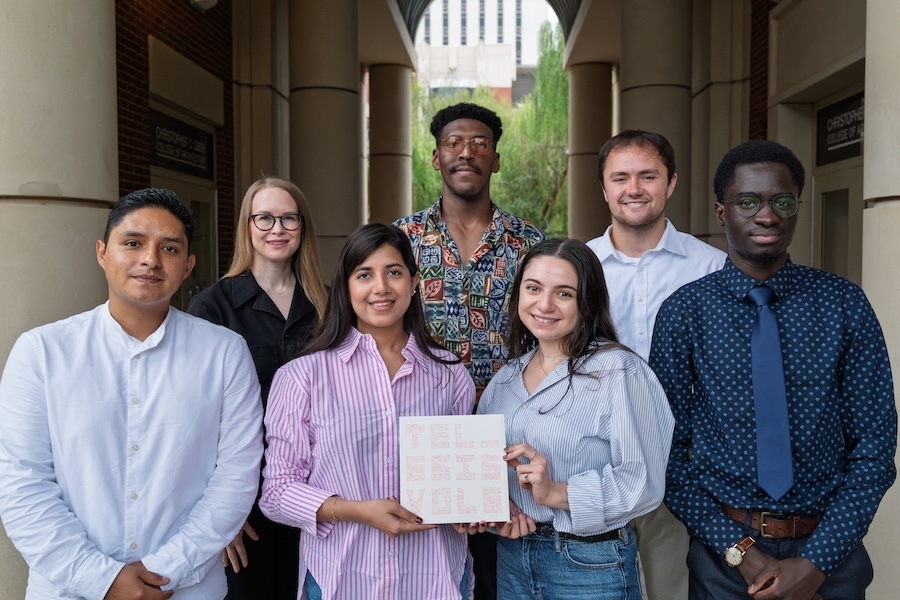
NORMAN– The University of Oklahoma Christopher C. Gibbs College of Architecture has earned national recognition with its student-produced journal Telesis, which has been awarded the 2025 Douglas Haskell Award for Student Journals by the Center for Architecture in New York City.
This marks the third time OU has received the honor, previously winning in 2019 and 2022. The honor is one of the most prestigious awards for student journals, recognizing excellence in architecture, planning and design writing. Previous winners include top programs such as Harvard University, Yale University, Columbia University and the Massachusetts Institute of Technology.
“Winning the Haskell Award is incredibly validating for our students,” said Angela Person, Ph.D., associate dean for research and external engagement at the Gibbs College of Architecture and faculty adviser for Telesis. “Our student editors and contributors work tirelessly to create a publication that elevates their voices and ideas. This recognition demonstrates that the perspectives of OU students matter on the national stage.”
The 2025 award was given for the sixth volume of Telesis, titled The Essence. The issue examines what remains essential in architecture amid climate change, digital saturation and AI-generated imagery, emphasizing material honesty, presence and human connection as key to design. In addition to the Haskell Awards, Telesis has received support from the Graham Foundation in Chicago, which funded the publication of two recent issues.
Telesis was first published at OU in the 1970s before being revived in 2019. Since its relaunch, the journal has published seven volumes exploring critical questions in architecture and design.
“What makes this award so meaningful is that it acknowledges the hard work and intellectual courage of our students,” Person said. “They are tackling questions that are urgent, creative and deeply human. Telesis demonstrates that design education at OU is both rigorous and imaginative.”
Access the digital issue of Telesis Volume VI at architecture.ou.edu/telesis-orders. To learn more about the Christopher C. Gibbs College of Architecture at the University of Oklahoma, visit https://architecture.ou.edu/.
About the Student Editorial Team:
The student editor for the Telesis issue, The Essence, was Ph.D. candidate Felipe Flores. Additional editorial support was provided by Gibbs College students including:
Undergraduate Students:
Jenna-Claire Asibelua, Interior Design
Abbey Fradette, Interior Design
Savannah Joslin, Interior Design
Trey London, Architecture
Cole Newport, Architecture
Darren Riley, Environmental Design
Chandler J. Thompson, Architecture
Isac Valenciano, Architecture
Graduate Students:
Rupa Chakraborty, Regional and City Planning
Madeline Henry, Interior Design
Frank Hicks, Landscape Architecture
About the University of Oklahoma
Founded in 1890, the University of Oklahoma is a public research university located in Norman, Oklahoma. As the state’s flagship university, OU serves the educational, cultural, economic and health care needs of the state, region and nation. For more information about the university, visit www.ou.edu.
The University of Oklahoma College of Medicine has honored two residents with the Lloyd Rader Award, which recognizes outstanding clinical and research achievements in residency.
The University of Oklahoma will receive up to $220 million over five years from the U.S. Department of Commerce and the National Oceanic and Atmospheric Administration to continue the life-saving weather research led by the OU-NOAA Cooperative Institute for Severe and High-Impact Weather Research and Operations, extending a nearly 50-year partnership that has helped give Americans earlier, more accurate weather warnings
The OU Food Pantry won the annual Red River Food Fight, collecting 31,815.9 pounds of shelf-stable food and drinks to top UT Outpost’s 22,567 pounds. OU has won the competition four years in a row.