NEWS


OKLAHOMA CITY, OKLA – Electronic cigarettes, or vapes, are widely used and available in hundreds of different types and flavors, yet researchers lack information about the everyday e-cigarette habits of young adults. The National Institutes of Health, in partnership with the U.S. Food and Drug Administration, has funded a University of Oklahoma study that will investigate how, when and why young adults use e-cigarettes and how that use may relate to health risks. The results will help the FDA make decisions about regulating the makers of e-cigarette products.
Emily Hébert, a member of the TSET Health Promotion Research Center at OU Health Stephenson Cancer Center and an assistant professor of family and preventive medicine in the OU College of Medicine, earned the $3.1 million, five-year NIH grant to conduct the study, which will begin enrolling young adults this fall. The study is a novel departure from the surveys that have been used to conduct such research in the past. Rather than relying on a person to remember their vaping habits over the past month, Hébert and her team will check in with study participants daily via a smartphone platform. Called ecological momentary assessment, the technique is designed to capture young adults’ routines and motivations in the moment.
“Surveys typically ask about average behavior, and they are subject to recall bias. We needed a different methodology to understand exactly which product characteristics are associated with which use patterns. What we want to know is, are there certain characteristics – like candy flavors or nicotine concentrations – that may carry higher public health risks or appeal disproportionately to youth, which is important for the FDA to know,” Hébert said.
Study participants will be prompted for input multiple times daily for a month, then again in six months, in five different waves, helping researchers gather both short-term and long-term data. Hébert said researchers will ask about the types of products being used, what participants’ moods are like, whether they’re alone or with friends, whether they’re also using other products like cannabis or traditional cigarettes, and if they have symptoms like respiratory problems.
In pilot studies, Hébert said she found that many young adults use multiple vaping products over the course of a month, not necessarily showing loyalty to a particular brand – and there are hundreds of different products to choose from, which can be purchased in person and online.
“Because we are collecting data so often, we can quickly monitor any market changes,” she said. “Study participants can also upload pictures so we can see exactly what type of product they’re using.”
Understanding young adults’ frequency of e-cigarette use is also important, Hébert said. Existing research shows that many young adults use e-cigarettes all day long.
“If people are using e-cigarettes to quit traditional cigarettes or are vaping just once or twice a day, we want to know that, but that’s not necessarily what we’re seeing,” Hébert said. “We’re seeing many young adults who have never smoked initiating e-cigarette use and, in some cases, reporting frequent use that may indicate early signs of dependence. Like other common substances, such as caffeine, frequency and intensity of use matter. Heavy use may indicate risk that warrants further investigation.”
The FDA has approved approximately 30 e-cigarettes to be marketed in the United States, all either tobacco- or menthol-flavored. These authorizations are based on evidence that the products are suitable for protecting public health, taking into account factors such as youth appeal, addiction potential, and the likelihood of helping smokers transition away from combustible cigarettes, Hébert said. However, hundreds of other e-cigarette products remain on the market without FDA authorization. While enforcement is challenging, Hébert’s study may shed light on the extent to which these unauthorized products are being used by young adults.
Hébert said she is excited to get started on her study because it offers the potential to gather information previously unavailable to the FDA.
“Young adults are comfortable using smartphones to communicate, and we anticipate getting rich, real-time data,” she said. “This is a fulfilling type of research because your findings can lead to changes in policy. It is a unique area of tobacco regulatory science.”
About the project
The research reported in this news release is supported by the National Institute on Drug Abuse, a component of the National Institutes of Health, under award number R01DA060878. The project’s title is “Using Real Time Data to Examine the Impact of Product Characteristics on Young Adult ENDS Use.”
About the University of Oklahoma
Founded in 1890, the University of Oklahoma is a public research university with campuses in Norman, Oklahoma City and Tulsa. As the state’s flagship university, OU serves the educational, cultural, economic and health care needs of the state, region and nation. In Oklahoma City, OU Health Sciences is one of the nation’s few academic health centers with seven health profession colleges located on the same campus. OU Health Sciences serves approximately 4,000 students in more than 70 undergraduate and graduate degree programs spanning Oklahoma City and Tulsa and is the leading research institution in Oklahoma. For more information about OU Health Sciences, visit www.ouhsc.edu.
The University of Oklahoma has received a transformative gift from Jon and Shannon McCartney, which will name the McCartney Family Tunnel of Champions, the McCartney Family Gate of the Gaylord Family - Oklahoma Memorial Stadium and the McCartney Family Grand Lecture Hall in the Michael F. Price College of Business. The gift will also support the Inspiring Champions and the Athletic Director’s Discretionary Fund, in addition to establishing the McCartney DFW Career Trek program at Price College.
The University of Oklahoma today celebrated the opening of a new air traffic control tower at the OU Max Westheimer Airport. Standing 106 feet tall, more than double the current 52-foot facility, the new tower will modernize air traffic control operations and improve safety for pilots and students operating in the airspace.
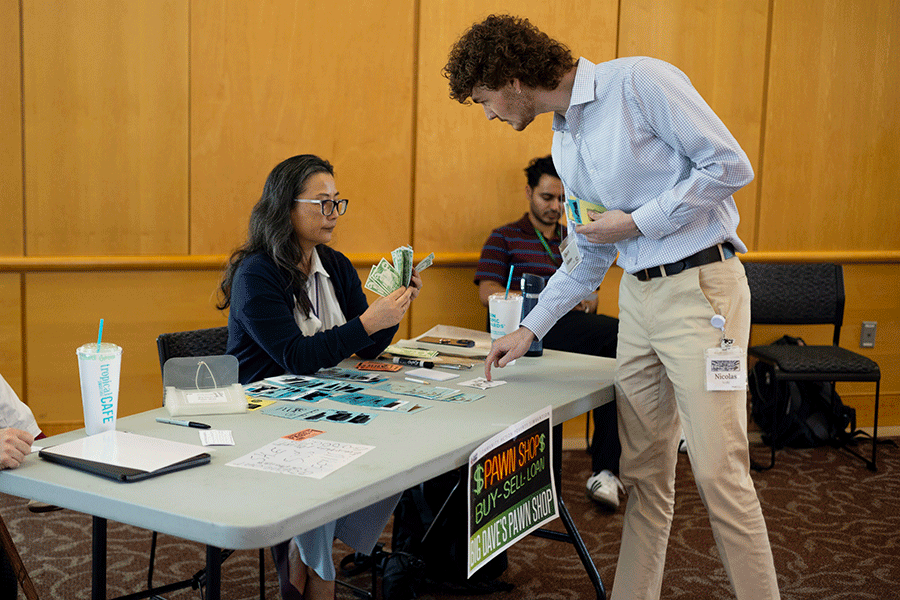
Do I buy groceries or pay the electric bill? Should I pawn some of my belongings to afford my prescription? My child is sick, so I will have to miss work to take care of him. Those are just a few of the difficult choices that OU-Tulsa health professional students confronted during the Community Access to Resources Experience. The role-playing activity challenged students to navigate the financial, family and other pressures that can affect a person’s health and ability to follow medical advice. Held annually during the SCM Institute orientation week, the experience is designed to generate understanding and build empathy.