NEWS


OKLAHOMA CITY – Large cell neuroendocrine carcinoma (LCNEC), a rare and aggressive type of lung cancer, has a high chance of metastasis, no standard treatment and a poor survival rate. A study published in Nature Communications provides a new understanding of the disease and uncovers a potential target for treatment.
Abdul Rafeh Naqash, M.D., is a researcher at the University of Oklahoma and a co-senior author of the paper, which is considered the most comprehensive characterization of LCNEC to date. The research team analyzed data from 590 patients across numerous health systems in the United States and Europe.
“Given the rarity of this cancer, we have not understood a lot about it,” said Naqash, a medical oncologist and associate professor of medicine at the University of Oklahoma College of Medicine. “In this study, we have examined two types of information: molecular data, which helps us understand this tumor and its subtyping, and clinical outcomes.”
To better understand the molecular makeup of LCNEC, the research team partnered with Caris Life Sciences, which provided comprehensive molecular profiling datasets. They found that LCNEC shares features with the better-known small cell lung cancer and non-small cell lung cancer, yet there were aspects of LCNEC that didn’t resemble either. Machine learning helped to differentiate those unclassified tumors.
Researchers also found promising news regarding a protein involved in LCNEC. The protein, called FGL1, plays a role in helping cancer evade the body’s immune system by deactivating immune cells. However, current drugs are available to inhibit FGL1, potentially resulting in the reactivation of immune cells and killing the tumor.
“This highly collaborative study provides insights into the biology of LCNEC and suggests new avenues for treatments. This is exactly the type of high-impact science that Caris strives to nurture and support via the Caris Precision Oncology Alliance, our shared clinico-genomic data, and our expertise in pathology,” said James Hamrick, M.D., MPH, chairman of the Caris Precision Oncology Alliance at Caris Life Sciences. “We look forward to improvements in patient outcomes in LCNEC as this line of scientific inquiry continues.”
In addition, researchers found that LCNEC tends to have less infiltration of a type of immune cell called T cells, which means the T cells are not as likely to recognize and attack tumor cells.
The T cell finding also indicates that LCNEC will not respond as well to immunotherapy, which is indeed what the researchers found in their examination of clinical data. Patients with LCNEC did not fare better when receiving immunotherapy, either alone or in addition to chemotherapy.
Because there is no Food and Drug Administration-approved treatment for LCNEC, clinicians are often of two schools of thought regarding how to treat the cancer – either as small cell lung cancer or non-small cell lung cancer. Naqash said he hopes the study sets the stage for clinical trials so that a more precise treatment ultimately can be found.
“This is one of the first attempts at unraveling the molecular heterogeneity within large cell neuroendocrine carcinoma, as well as understanding clinical outcomes to the current treatment approaches,” he said. “What we are trying to show in this paper is that one size does not fit all. There is a lot of complexity in LCNEC.
“This study is also an example of the importance of academic research in finding solutions to these types of rare diseases,” Naqash added. “These conditions often lack the attention and resources devoted to more common illnesses, leaving patients and families with limited options. By pursuing fundamental discoveries and translating them into potential therapies, university researchers bring hope to those living with rare diseases like LCNEC.”
About the project
The study, “Integrated molecular and clinical characterization of pulmonary large cell neuroendocrine carcinoma,” can be found at https://www.nature.com/articles/s41467-025-63091-0. Co-senior author is Anne C. Chiang, M.D., Ph.D., and first author is Amin H. Nassar, M.D., both of Yale School of Medicine and Yale Cancer Center.
About the University of Oklahoma
Founded in 1890, the University of Oklahoma is a public research university with campuses in Norman, Oklahoma City and Tulsa. As the state’s flagship university, OU serves the educational, cultural, economic and health care needs of the state, region and nation. In Oklahoma City, OU Health Sciences is one of the nation’s few academic health centers with seven health profession colleges located on the same campus. OU Health Sciences serves approximately 4,000 students in more than 70 undergraduate and graduate degree programs spanning Oklahoma City and Tulsa and is the leading research institution in Oklahoma. For more information about OU Health Sciences, visit www.ouhsc.edu.
The University of Oklahoma has received a transformative gift from Jon and Shannon McCartney, which will name the McCartney Family Tunnel of Champions, the McCartney Family Gate of the Gaylord Family - Oklahoma Memorial Stadium and the McCartney Family Grand Lecture Hall in the Michael F. Price College of Business. The gift will also support the Inspiring Champions and the Athletic Director’s Discretionary Fund, in addition to establishing the McCartney DFW Career Trek program at Price College.
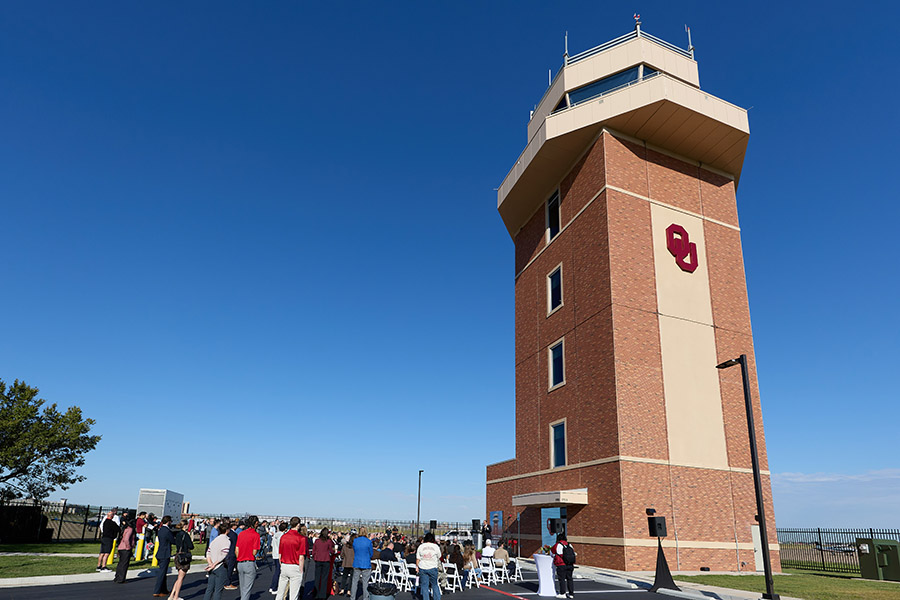
The University of Oklahoma today celebrated the opening of a new air traffic control tower at the OU Max Westheimer Airport. Standing 106 feet tall, more than double the current 52-foot facility, the new tower will modernize air traffic control operations and improve safety for pilots and students operating in the airspace.
Do I buy groceries or pay the electric bill? Should I pawn some of my belongings to afford my prescription? My child is sick, so I will have to miss work to take care of him. Those are just a few of the difficult choices that OU-Tulsa health professional students confronted during the Community Access to Resources Experience. The role-playing activity challenged students to navigate the financial, family and other pressures that can affect a person’s health and ability to follow medical advice. Held annually during the SCM Institute orientation week, the experience is designed to generate understanding and build empathy.