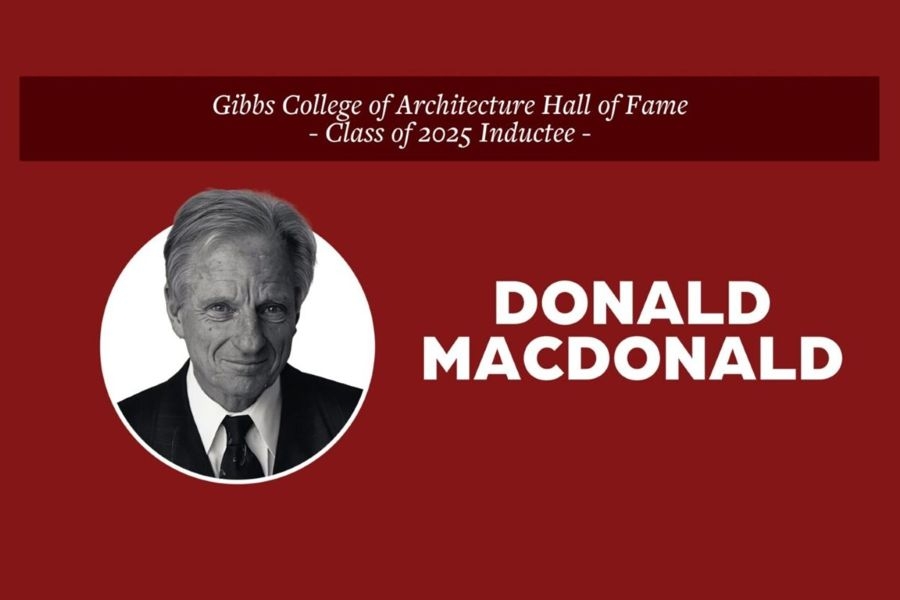
The University of Oklahoma Christopher C. Gibbs College of Architecture Hall of Fame (GCA HOF) recognizes a select number of high-character individuals who have made a significant and lasting positive impact over time to Gibbs College (GCA), its students, staff, faculty, alumni, and/or to communities across the globe. The impact may have been, or continues to be, in the form of service and mentorship, sustained professional excellence, and/or advancement and financial support. Donald MacDonald is part of the 2025 Hall of Fame class.

Make a donation in honor of Donald MacDonald
The Architecture Program Development Fund #32009 supports the Division of Architecture.

Donald MacDonald was born in Calgary, Alberta, Canada. While working as a draftsman at a firm steeped in Bauhaus design principles in Edmonton, he decided in 1958 to study architecture at the University of Oklahoma after reading a magazine article featuring Bruce Goff’s design work. He later said the freedom he was given in Herb Greene’s studio fundamentally shaped his vision of the creative architectural process. In 1962, he earned a Bachelor of Architecture from OU, followed by a master’s degree from Columbia University in 1963. His strong structural foundation came from studying under renowned structural engineers Mendell Glickman (Frank Lloyd Wright’s engineer) and Mario Salvadori (founding partner of Weidlinger Associates and longtime Columbia professor). After graduation, MacDonald traveled through Europe on a scholarship before opening his own private practice in San Francisco.
It was MacDonald who gave the name “The American School” to the pedagogy and practice of the uniquely American architectural movement that emerged mid-century from the University of Oklahoma School of Architecture under Bruce Goff and Herb Greene. The first mention of the American School appeared in the preface to a November 1981 article in Architecture and Urbanism authored by MacDonald. In 1985, he played a major role in curating a London exhibition featuring this uniquely American movement, including works by Goff and several graduates. Titled the “American School,” the exhibition introduced the movement to an international audience. MacDonald has continued to be a strong advocate for the promotion of the American School.

Catalogue cover for the 1985 American School exhibition in London.
He was named one of the inaugural Goff Professors in the early 1980s when the OU Bruce Goff Professorship for Creative Architecture was established. During that time, he delivered a series of lectures and worked closely with students as a Designer in Residence.
MacDonald’s work has been wide-ranging, even extending to the domestic scale, where he designed one hundred pieces of do-it-yourself furniture. In the 1970s, his work focused on master planning and ski chalet design in California’s major ski areas. In the 1980s, he pioneered the design of individual shelters for San Francisco’s homeless population. Known as the City Sleeper, this shelter was built from prefabricated parts and six sheets of plywood. He was one of three architects invited to attend the 1987 World Peace Forum in Moscow and has also worked internationally with Greenpeace.

City Sleeper shelters designed by MacDonald.
In 1980, MacDonald won the design competition for the Golden Gate Bridge toll plaza, which launched his career in bridge design. Since then, his practice has gained international recognition for its many bridge projects, including the Eastern Span of the San Francisco-Oakland Bay Bridge. Current projects include the new Baltimore bridge to replace the collapsed structure, the Mobile Bay Bridge in Alabama, and the I-395 bridge in Miami, Florida. MacDonald emphasizes the role of bridges as iconic imagery for city branding.
Throughout his career, MacDonald has authored five books, received more than 200 design awards, and continues to advocate for efficient home design as a path to accessible home ownership.
Gibbs College is pleased to present the exhibition 200 Digital Drawings by Professor Tiziana Proietti, currently on display in the Gould Hall Living Room.
Gibbs College of Architecture Professors Amber Brown and Amy Leveno led 29 students to Dallas, Texas, in September for a learning experience as part of their Design 7 Studio course.
Christopher C. Gibbs College of Architecture professor and Institute for Quality Communities Director Dr. Amber N. Wiley’s book, Model Schools in the Model City: Race, Planning, and Education in the Nation’s Capital, has received two major honors from the Urban History Association.