The University of Oklahoma Christopher C. Gibbs College of Architecture Hall of Fame recognizes a select number of high-character individuals who have made a significant and lasting positive impact on Gibbs College, its students, staff, faculty, alumni and/or to communities across the globe. The impact may have been, or continues to be, in the form of service and mentorship, sustained professional excellence, and/or advancement and financial support.
Hall of Fame inductees can represent any of the Gibbs College programs. A five-member Nomination Committee is appointed by the dean from a group of recommendations from each advisory board. This committee then chooses the inductees from the list of submitted nominees
Attendance to the event is by special invitation only.
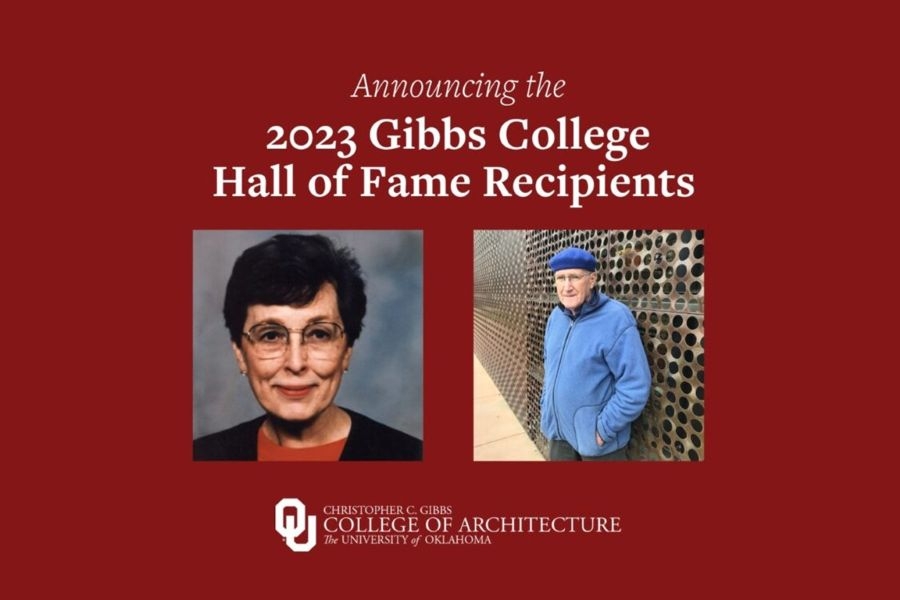
Learn about the two remarkable individuals named to the 2023 Christopher C. Gibbs College of Architecture Hall of Fame Inductees below.
Herb Greene was born in Oneonta, New York, in 1929. He began his architectural studies at Syracuse but transferred to the University of Oklahoma after learning of Bruce Goff’s work in 1948. Known for his skill as an artist and delineator, Greene produced many colored renderings for Goff over several years, including the drawings of the Bavinger House in Norman. After graduating in 1953, Greene worked in Houston and then in Los Angeles for John Lautner. He returned to OU to teach for six years (1956-62) as an associate professor, at which time he and his colleagues, including Bruce Goff and Mendel Glickman, developed the American School of Architecture. In 1962, Greene accepted a teaching position at the University of Kentucky, where he taught for 18 years. Among his most important works are the Lyne Residence (1956; Houston); the Joyce Residence and the Roosevelt Granite Quarry Office (1960; Snyder, Oklahoma); the Prairie House, labeled the “Prairie Chicken House” by Life magazine (1961; Norman, Oklahoma); the Cunningham Residence (1963; Oklahoma City); Unitarian Church (1965; Lexington, Kentucky); and the French Res (1966; Versailles, Kentucky).

Herb Greene.
Throughout his life, in addition to being a practicing architect, Greene was also a prolific visual artist. Using mixed media, including photographs, he explores memory, experience and time. Known throughout the United States for his influence on American architecture, he has been recognized with exhibitions of his work.
Greene’s influence on the curriculum and pedagogy at Gibbs College can still be seen today, as students are encouraged to respect, connect, be experimental, resourceful and look beyond the accepted canon of Western architecture.
Pat Eidson earned her bachelor’s degree in architecture from Kansas State University in 1966, making her one of Kansas’s first licensed female architects. Beginning as a draftsman in 1957, she rose to principal at The Eidsons, Architects, a firm revered for its comprehensive services, spanning architecture and standout interior design projects like those seen in Manhattan’s Public Library.
By the mid-1970s, Eidson’s passion for interior design and architecture converged in academia. She shaped the future of interior architecture at Kansas State University, advocating for elevated teaching standards and curriculum integration. Her academic pursuits led her from the University of Hawaii at Manoa to the University of Cincinnati’s DAAP[CJL1] , where she further specialized in the synergy of architecture and interior design.

Pat Eidson.
Joining the University of Massachusetts faculty, Eidson became a beacon in design methodology research, particularly in interior design pedagogy. In 1988, her journey brought her to the University of Oklahoma. As she ascended from tenure to associate dean, she revolutionized the approach to interior design education, blending architectural principles and forging stronger alignments with professional practice.
After her death in 1994, Eidson’s influence has continued to resonate. Beyond her professional milestones, she championed women in architecture and interior design, actively enriched her community and left a profound legacy, including scholarships for future generations of designers.
Gibbs College is pleased to present the exhibition 200 Digital Drawings by Professor Tiziana Proietti, currently on display in the Gould Hall Living Room.
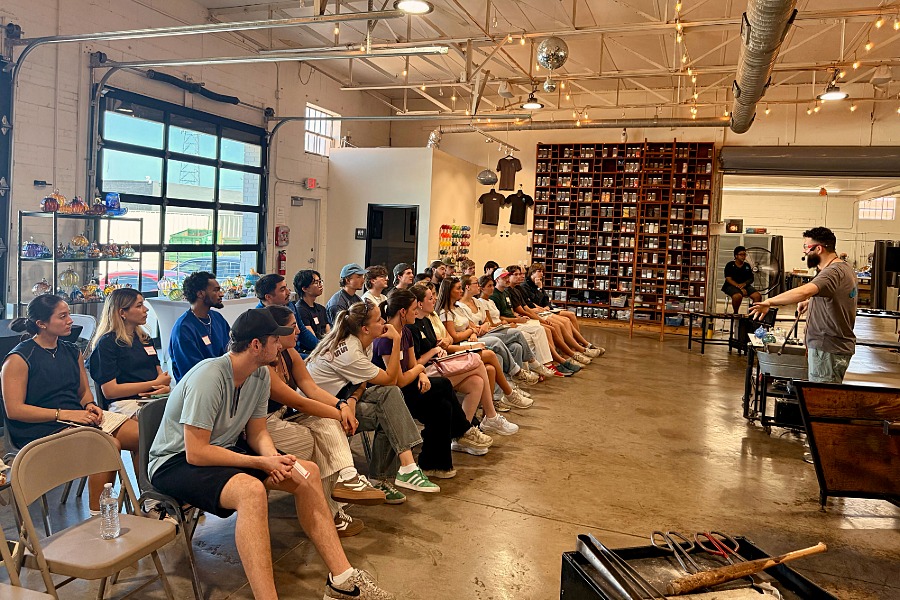
Gibbs College of Architecture Professors Amber Brown and Amy Leveno led 29 students to Dallas, Texas, in September for a learning experience as part of their Design 7 Studio course.
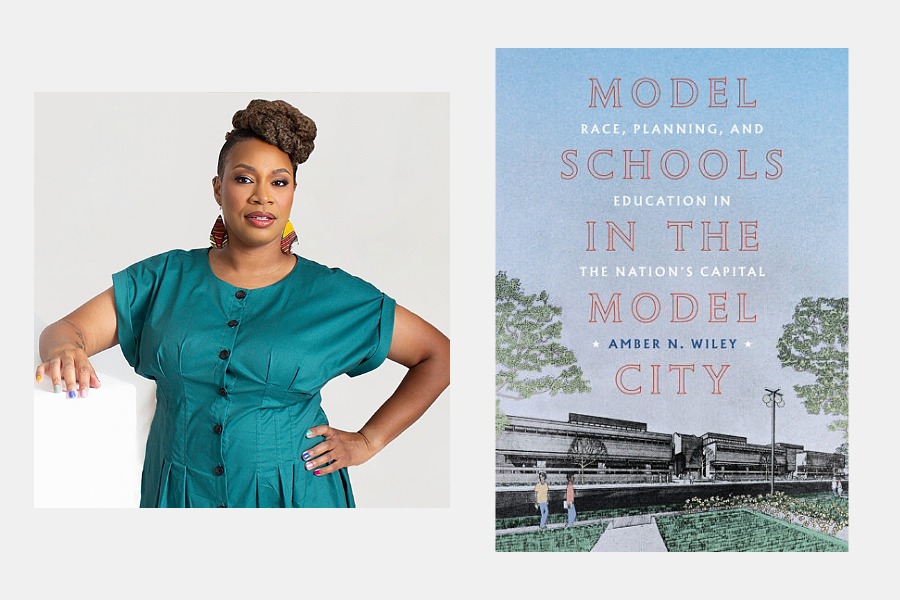
Christopher C. Gibbs College of Architecture professor and Institute for Quality Communities Director Dr. Amber N. Wiley’s book, Model Schools in the Model City: Race, Planning, and Education in the Nation’s Capital, has received two major honors from the Urban History Association.