University of Oklahoma assistant professor of architecture Angela M. Person recently released a co-edited book entitled Affective Architecture: More-than-Representational Geographies of Heritage (Routledge, 2020), with colleague Jacque Micieli-Voutsinas, of Skidmore College. The book is part of the Routledge series “Critical Studies in Heritage, Emotion and Affect.”
Affective Architectures explores questions related to how affect and emotion function in architectural heritage environments, such as “How do places manipulate our emotions?” and “How are spaces affectious in their articulation and design?”
In answer to these questions, Affective Architectures provides theoretical frameworks for exploring affective dimensions of architectural sites based on the notion that heritage, as an embodied experience, is embedded in places and spaces.
Drawing together an interdisciplinary collection of essays spanning geographically diverse architectural sites — including Ford’s Theater, the site of President Lincoln’s assassination; the Estadio Nacional of Santiago, Chile, where 12,000 detainees were held following the ouster of President Salvador Allende; and Unit 731, the site of a biological and chemical warfare research unit of the Imperial Japanese army in Harbin, China, amongst others — this edited collection assembles critical dialogue amongst scholars and practitioners engaging in affective and other more-than-representational approaches to cultural memory, heritage, and identity-making.
Broken into three main sections: Affective Politics; Embedded Geographies; and Affective Methodologies, this book draws together multidisciplinary perspectives from the arts, social sciences and humanities to understand the role of architecture in generating embodied experiences at places of memory.
This book offers interdisciplinary perspectives on fundamental questions of memory, identity and space. It will be of interest to students and scholars in the fields of geography, architecture, cultural studies, and museum and heritage studies.
Two other Gibbs College faculty made contributions to Affective Architectures. The foreword is by Hans E. Butzer, recipient of the American Institute of Architects’ Thomas Jefferson Award for Public Architecture and dean of the Gibbs College of Architecture, while professor Keith Gaddie co-authored a chapter entitled “The affect of memorializing the loss, the affect of losing the memorial: Confederate war monuments in New Orleans.”
Gibbs College is pleased to present the exhibition 200 Digital Drawings by Professor Tiziana Proietti, currently on display in the Gould Hall Living Room.
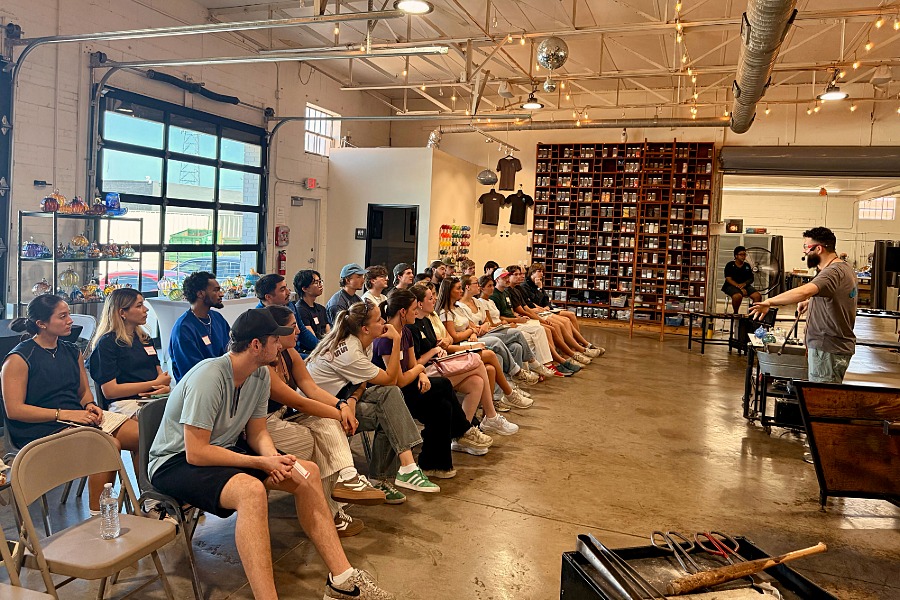
Gibbs College of Architecture Professors Amber Brown and Amy Leveno led 29 students to Dallas, Texas, in September for a learning experience as part of their Design 7 Studio course.
Christopher C. Gibbs College of Architecture professor and Institute for Quality Communities Director Dr. Amber N. Wiley’s book, Model Schools in the Model City: Race, Planning, and Education in the Nation’s Capital, has received two major honors from the Urban History Association.