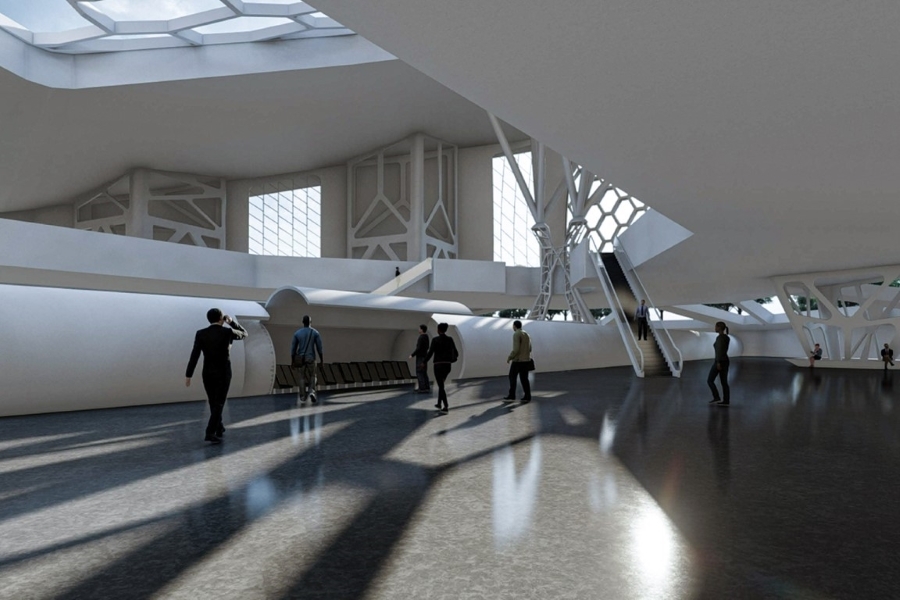
On April 27th, students in the 3rd year design studio class led by René Peralta, Sara Fast and Zach Maggia presented their proposal for an Oklahoma City-based Hyperloop station and housing project to members of Hyperloop Transportation Technologies, the Los Angeles firm that served as consultant and jury for the project.

Image credit: Michael Neal, 3rd year architecture student
The studio focused on the design of a Hyperloop transportation system station in downtown Oklahoma City for a supposed Dallas to Oklahoma City route, a journey that would take only 18 minutes with this technology. The semester combined urban planning with a modest amount of futurism to plan for a project that would exist 30 years into the future. The brief also included urban mix-use/housing on the same site as the station.
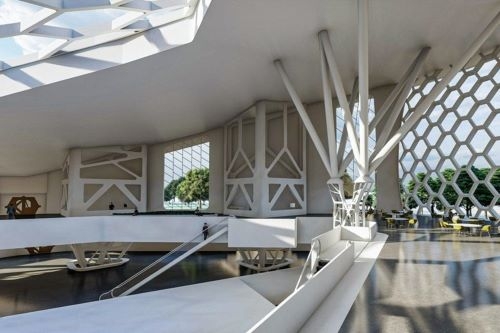
Image credit: Soloman Harris, 3rd year architecture student
“The most valuable thing I learned working on this project was why architects work in teams,” said 3rd year architecture student Katharine Young. “When you have a project this huge there is just not enough time in a semester to make it fully how you want it to look. Especially with the second half of the semester being online, the normal collaboration that happens in studio was a bit stunted. Though I liked my design, I could have easily continued developing it for another month.”
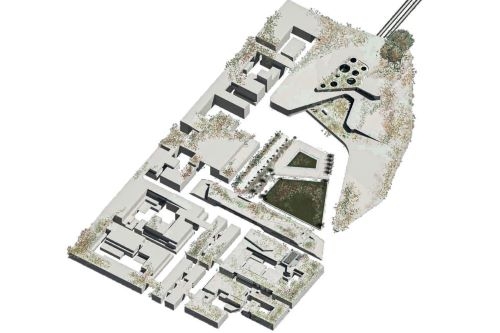
Image credit: Phoo Thant Sin Aung, graduate student
Just before the midterm students had the opportunity to speak via Zoom with designers from Hyperloop Transportation Technologies (HTT), one of the companies leading the technical and scientific development of this innovative transportation system that began as a white paper by Elon Musk in 2013.
To conclude the semester, students presented a series of possible scenarios that included the Hyperloop station, a variety of housing types, commercial and office space, public amenities as well as public parks on the same site.
Header image credit: Soloman Harris, 3rd year architecture student
Christopher C. Gibbs College of Architecture assistant professor Amy Leveno and Mark Leveno, co-founders of OFFICIAL Design, have received a 2026 AIA Central States Region Design Award for the firm’s Granger Annex Community Center project in Garland, Texas.
Construction Industry Speaker Series welcomed Stephen Evans from the Oklahoma City National Memorial & Museum to give a lecture on better conversations and relationship building.
The University of Oklahoma Christopher C. Gibbs College of Architecture Hall of Fame recognizes a select number of high-character individuals who have made a significant and lasting positive impact on Gibbs College, its students, staff, faculty, alumni and/or to communities across the globe. The impact may have been, or continues to be, in the form of service and mentorship, sustained professional excellence, and/or advancement and financial support. Joseph Edgar Smay is part of the 2025 Hall of Fame class.