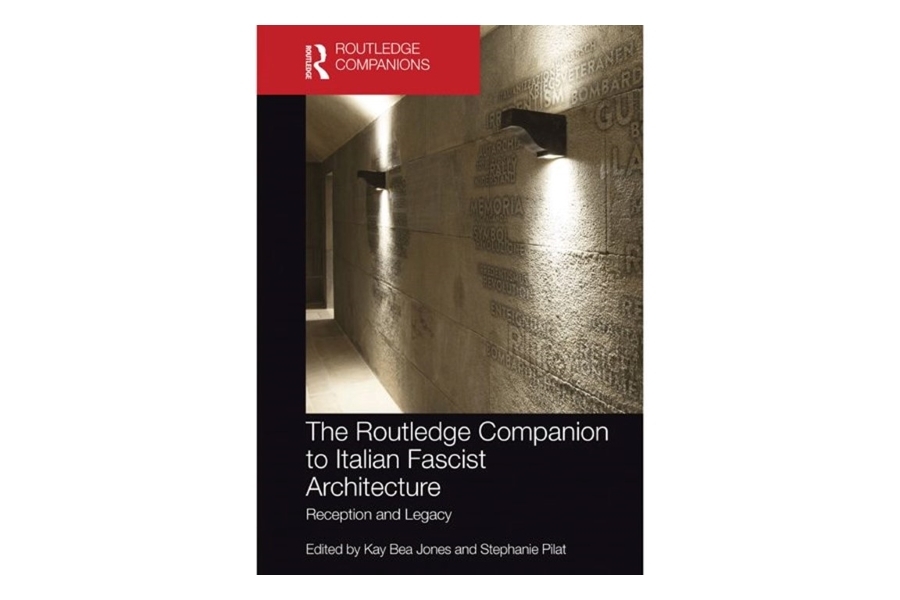
A new book co-edited by Architecture director Stephanie Pilat and professor Kay Bea Jones of Ohio State University examines what has become of the architectural and urban legacy of fascism in Italy.
Mussolini’s government constructed thousands of new buildings across the Italian Peninsula and islands and in colonial territories. From hospitals, post offices and stadia to housing, summer camps, Fascist Party Headquarters, ceremonial spaces, roads, railways and bridges, the physical traces of the regime have a presence in nearly every Italian town.
The Routledge Companion to Italian Fascist Architecture: Reception and Legacy brings together the voices of dozens of scholars from around the world to reflect on the many ways in which the physical legacy of the fascist regime has been transformed. The essays include a rich array of new arguments by both senior and early career scholars from Italy and beyond.
They examine the reception of fascist architecture through studies of destruction and adaptation, debates over reuse, artistic interventions and even routine daily practices, which may slowly alter collective understandings of such places.
Paolo Portoghesi sheds light on the subject from his internal perspective, while Harald Bodenschatz situates Italy among period totalitarian authorities and their symbols across Europe. Section editors including Gibbs College’s own Dr. Francesco Cianfarani, frame, synthesize and moderate essays that explore fascism’s afterlife; how the physical legacy of the regime has been altered and preserved and what it means now.This critical history of interpretations of fascist-era architecture and urban projects broadens our understanding of the relationships among politics, identity, memory and place.
This companion will be of interest to students and scholars in a range of fields, including Italian history, architectural history, cultural studies, visual sociology, political science and art history.
Purchase this volume at the Routledge website.
Gibbs College is pleased to present the exhibition 200 Digital Drawings by Professor Tiziana Proietti, currently on display in the Gould Hall Living Room.
Gibbs College of Architecture Professors Amber Brown and Amy Leveno led 29 students to Dallas, Texas, in September for a learning experience as part of their Design 7 Studio course.
Christopher C. Gibbs College of Architecture professor and Institute for Quality Communities Director Dr. Amber N. Wiley’s book, Model Schools in the Model City: Race, Planning, and Education in the Nation’s Capital, has received two major honors from the Urban History Association.