NEWS


NORMAN, OKLA. – As Oklahoma communities weigh new data center development, research co-authored by a University of Oklahoma architecture professor offers insight into what draws major technology companies to locations – and why those choices matter locally.
Kijin Seong, Ph.D., an assistant professor in the Division of Planning, Landscape Architecture and Design at OU’s Christopher C. Gibbs College of Architecture, was one of three researchers to examine 212 U.S. data centers operated by 11 major technology companies, including Amazon, Microsoft, Google and Meta, finding that land use, infrastructure and workforce characteristics help explain where companies build.
“The buildings that hold data centers need land, a lot of electricity, water for cooling and fiber connections,” Seong said. “Artificial intelligence has a very real physical footprint and that footprint lands in real communities.”
Data center locations have received relatively little attention in planning research, said Seong, a certified planner who examines how infrastructure and climate risks affect communities. Companies often make those decisions privately, leaving planners to draw on industry reports and studies of individual locations.
The study, published in Cities, an international journal of urban policy and planning, compared each data center with four census tracts with similar population density and urban or rural setting that did not host a data center. The researchers focused on data centers run by major technology companies, whose site choices are getting more attention from communities, Seong said.
Land-use diversity emerged as the strongest factor in the analysis. Proximity to electrical substations, major roads and concentrations of information technology workers also helped explain where facilities were located. Places with dense fiber networks had nearly three times the odds of hosting a data center.
One finding surprised the researchers: Climate explained relatively little of the difference between data center sites and comparable locations. “We expected climate to matter a lot because cooling is one of the biggest costs of running a data center,” Seong said.
Climate may influence an earlier decision about which state or region to consider, Seong said. Once companies narrow their search to individual sites, access to developed land and infrastructure matters more. Access to electrical substations became an even stronger factor after researchers accounted for other characteristics.
The researchers also identified six distinct types of data center locations, ranging from dense urban centers to growing suburban corridors and agricultural areas along metropolitan edges. Amazon and Microsoft appeared in all six types and Google in five, while other companies concentrated in one or two. “There is no single typical data center location,” Seong said.
Although the study did not specifically model Oklahoma, Seong said the patterns are relevant as the state attracts more development. Established industrial parks with access to power and major roads offer characteristics consistent with the study’s findings.
For Oklahoma communities, those location decisions raise questions about electricity, water and surrounding neighborhoods. State policy helps shape development, but many decisions remain local, including zoning, site plans, design guidelines and water supplied through municipal utilities.
Seong said pauses on new approvals give communities time to consider whether their development rules adequately address these facilities and their infrastructure needs.
The findings also offer context for discussions about tax incentives. About 85% of the data centers studied were in states offering incentives. But comparisons with similar locations were inconclusive about whether incentives influenced individual site choices.
The research provides a broader view of the conditions that attract data centers. “Our study serves as a starting point for communities preparing for the physical demands of the AI boom,” she said.
About the Project:
“Investigating data center site planning of major ICT companies in the U.S.: A spatial and methodological framework” was published in Cities. Authors are Seung Jun Choi, of Incheon National University; Kijin Seong, University of Oklahoma; and Junfeng Jiao, Singapore Management University. Research supported by National Science Foundation grants 2125858 and 2236305 and by The MITRE Corporation. Article at https://doi.org/10.1016/j.cities.2026.107509.
About the University of Oklahoma
Founded in 1890, the University of Oklahoma is a public research university located in Norman, Oklahoma. As the state’s flagship university, OU serves the educational, cultural, economic and healthcare needs of the state, region and nation. For more information about the university, visit www.ou.edu.
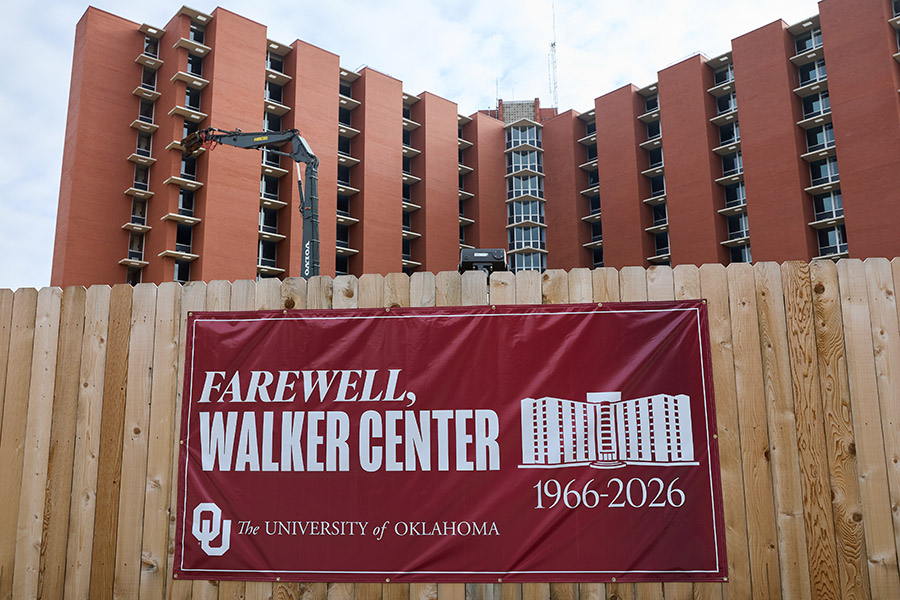
The University of Oklahoma has begun the demolition of Walker Center, marking a new step in the university’s refresh of student housing. The 12-story building has served as a home for thousands of students on the Norman campus.
The University of Oklahoma College of Medicine and its clinical partner, OU Health, are expanding access to specialized medical care for rural Oklahomans through three initiatives supported by the Oklahoma Rural Health Transformation Program.
Connecting hundreds of OU students with high-impact entrepreneurial projects throughout its history, the Ronnie K. Irani Center for the Creation of Economic Wealth marks its 20th anniversary at the University of Oklahoma.