NEWS


By
Lexie Cuttler
alexis.n.cuttler-1@ou.edu
Date
TULSA, Okla. – The Department of Medical Informatics at the University of Oklahoma-Tulsa is teaching students how to approach patient care in an increasingly digital age.
When people think of medical advancements, they often think of new medicines or the advanced devices doctors use to complete imaging and other diagnostic procedures. But smaller aspects of medical care are also moving online, giving rise to the ever-expanding field of telehealth.
“Telehealth covers a very broad spectrum of services,” explained Blake Lesselroth, M.D., M.B.I., vice chair of the Department of Medical Informatics. “The unifying characteristic of it is you’re connecting two places that are geographically not co-located, and it involves delivery of care.”
The field spans everything from a person accessing their own lab results through an online medical portal to a physician conducting a clinical visit through a video call.
According to Lesselroth, more aspects of a physical exam can be conducted virtually than people might initially expect.
“You can do an oropharyngeal exam. You can have people use a penlight to look in their mouth. You can do a basic assessment of skin. You can have a patient do photographs of their skin and upload those photographs. Dermatology clinics do it. You can do musculoskeletal exams. I’ve taught how to do shoulder exams, knee exams, hip exams.”
Lesselroth said the more important question is what types of health situations shouldn’t be addressed through a virtual exam.
Issues he identified as limited for virtual diagnosis or assessment included anything requiring a genitourinary exam, which evaluates the urinary and reproductive systems, along with heart and lung exams.
Even those gaps continue to shrink as more patient-accessible technology is invented.
Lesselroth recently led several of his students through a demonstration of how to use a digital stethoscope, a device that converts data being gathered by the stethoscope into a digital signal that can be transmitted virtually, allowing a doctor to hear the sound of a patient’s heartbeat and lungs.
Though digital stethoscopes aren’t commonly used in virtual exam settings, Lesselroth said he wants to ensure his students are prepared to encounter potential future advancements in the field.
“Is my job to teach professionals exactly what’s happening right now or to predict where we would be in 10 years? These are kids that are going to go out and practice. The future state’s going to look a lot different.”
Still, virtual visits and other aspects of telehealth aren’t the correct solution for every patient.
“It isn’t one size fits all, but it never really was with medicine anyway. Is it okay to do telemedicine with a 20-something-year-old person who’s comfortable with technology? Yes. Is it a great idea to do with an 80-something-year-old who may have hearing and eye impairment? No.”
In Lesselroth’s opinion, older individuals can absolutely learn the skills needed to make telehealth successful, but clinicians need to consider an individual patient’s limitations — physical, mental or technological — when deciding if telemedicine is an appropriate route for them.
Beyond those limitations, not every aspect of telehealth is equally accessible everywhere.
“Every paper you ever read in the medical literature on telehealth, it always starts off with the same sort of stock phrase like ‘telemedicine affords the promise of increased access to care for vulnerable populations.’ That’s a promise, not a reality.”
Some of the factors Lesselroth listed as having an impact on the accessibility of telehealth services included internet connectivity, computer access, insurance, language and location.
According to Lesselroth, it’s important to acknowledge these limitations and teach students how they impact patients.
“The landscape is changing and I have an obligation as an educator, and OU has an obligation as a teaching institution, to prepare students for that environment because whether we like it or not, our future employers are going to be providing these services in different ways and our patients are going to be expecting access in different ways. We’re helping to shape what that future environment looks like, stepping up and speaking when we think it’s unsafe and being good advocates for our patients.”
About the University of Oklahoma
Founded in 1890, the University of Oklahoma is a public research university located in Norman, Oklahoma. As the state’s flagship university, OU serves the educational, cultural, economic and healthcare needs of the state, region and nation. For more information about the university, visit www.ou.edu.
The University of Oklahoma College of Medicine and its clinical partner, OU Health, are expanding access to specialized medical care for rural Oklahomans through three initiatives supported by the Oklahoma Rural Health Transformation Program.
Connecting hundreds of OU students with high-impact entrepreneurial projects throughout its history, the Ronnie K. Irani Center for the Creation of Economic Wealth marks its 20th anniversary at the University of Oklahoma.
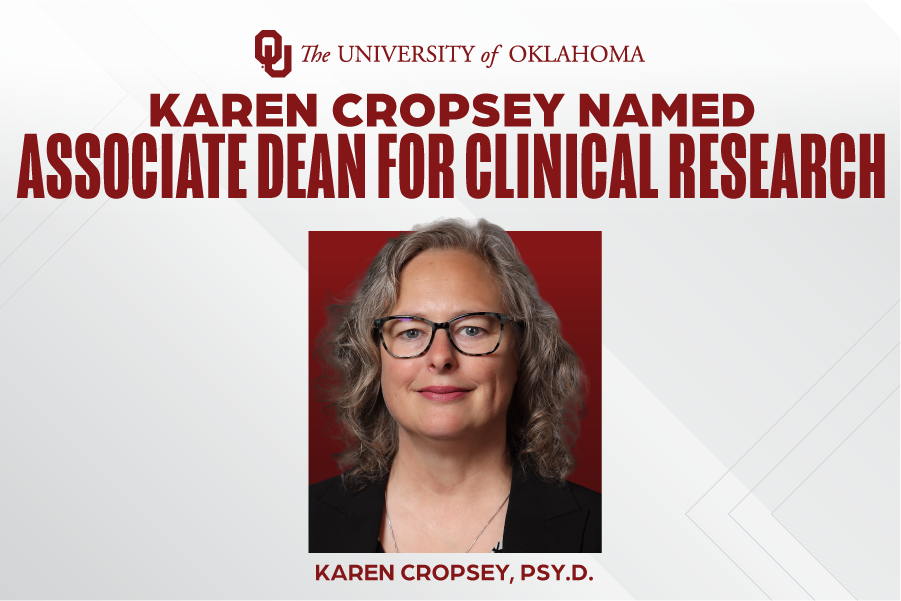
Karen Cropsey, Psy.D., has been named Associate Dean for Clinical Research at the University of Oklahoma College of Medicine on the OU Harold Hamm Health Campus. She will also serve as a professor in the college’s Department of Psychiatry and Behavioral Sciences.