NEWS

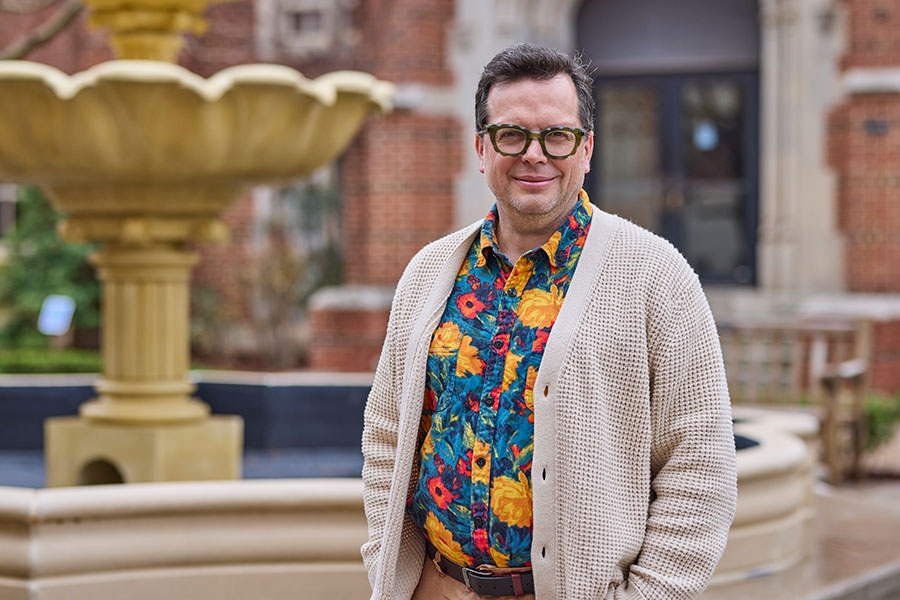
NORMAN, Okla. – Clathrate hydrates are crystalline structures formed at the bottom of seafloors, created by water molecules trapping methane, carbon dioxide or other molecules. While these materials are underutilized in technology, a University of Oklahoma researcher is helping scientists better understand them through a trailblazing study.
Alberto Striolo, a professor in OU’s Gallogly College of Engineering, co-authored an article published in the Proceedings of the National Academy of Sciences that addresses a key challenge toward utilizing hydrates: their slow growth rates. He and his fellow researchers have discovered an unusual interfacial layer on the hydrate that impacts its growth rate.
Striolo is the college’s Asahi Glass Chair in Chemical Engineering and Lloyd and Jane Austin Presidential Professor. He is also the director of the college’s Online Master of Science in Sustainability and the Materials Science and Engineering doctoral program.
Clathrate hydrates have qualities similar to ice, but they can be more stable than ice, making them appealing to understand for technological uses such as energy storage and desalination. However, these hydrates have not yet been widely used in technology, partly because their growth rate is too slow.
According to Striolo, little has been known about how to make hydrate materials grow more quickly. That has not only made it difficult to utilize their properties, but stunted progress toward addressing their properties in nature. These structures can be both an extensive energy resource as well as a nuisance for the energy industry, in particular for their effects on oil and gas pipelines.
“When they form, they can block the oil fields’ production,” Striolo said. “But also, these are rocks, effectively, that may end up breaking the pipeline. And when that happens, you have leaks of hydrocarbons and environmental problems.”
To study clathrate hydrates, the researchers used computer models to simulate their behavior in the presence of chemical additives near the hydrate’s surface. On that surface is the quasi-liquid layer, a structure that exists between ice and water and is neither fully solid nor fully liquid.
The researchers discovered that by adsorbing additives, the quasi-liquid layer increased in thickness. The results suggest that the layer promotes higher growth rates by adsorbing carbon dioxide molecules.
“The implication is that CO2 molecules move faster in this quasi-liquid layer compared to in liquid water,” Striolo said. ‘That's exactly key to the discovery.”
With this new knowledge, Striolo said that he and his fellow researchers aim to explore larger hydrate structures that possess “cages” large enough to trap more molecules within the crystalline structure. Those larger structures could then be used to develop technology that stores gases at lower pressures, making gas transport cheaper and more environmentally benign.
With further research, Striolo said that hydrates could help solve real-world problems. For example, hydrates expel salt before forming, so they could help with water desalination if they are created using saltwater. They could also help separate different gases using their cage-like structures and develop new methods for carbon dioxide containment.
“If we were able to learn how to trap CO2 with these structures, we would be able to perhaps prevent CO2 from going to the atmosphere without large chemical plants to trap it,” Striolo said. “Clathrate hydrates have niche applications that may be quite attractive.”
He emphasized the contribution of his fellow co-authors: Prof. Matteo Salvalaglio and Dr. Xinrui Cai, who previously worked with Striolo as a doctoral student. Both are with the Thomas Young Centre and University College London’s Department of Chemical Engineering.
Striolo also noted that the growing knowledge base surrounding hydrates is coming from across the world. “This is an international collaboration,” he said. “We have collaborated with so many people, including industry and academia experts, and we hope to continue along this path.”
About the research
The study, “The quasi-liquid layer thickness controls clathrate hydrates growth rate,” can be found in Proceedings of the National Academy of Sciences at www.pnas.org.
About the University of Oklahoma
Founded in 1890, the University of Oklahoma is a public research university located in Norman, Oklahoma. As the state’s flagship university, OU serves the educational, cultural, economic and health care needs of the state, region and nation. For more information about the university, visit www.ou.edu.
The University of Oklahoma has received a transformative gift from Jon and Shannon McCartney, which will name the McCartney Family Tunnel of Champions, the McCartney Family Gate of the Gaylord Family - Oklahoma Memorial Stadium and the McCartney Family Grand Lecture Hall in the Michael F. Price College of Business. The gift will also support the Inspiring Champions and the Athletic Director’s Discretionary Fund, in addition to establishing the McCartney DFW Career Trek program at Price College.
The University of Oklahoma today celebrated the opening of a new air traffic control tower at the OU Max Westheimer Airport. Standing 106 feet tall, more than double the current 52-foot facility, the new tower will modernize air traffic control operations and improve safety for pilots and students operating in the airspace.
Do I buy groceries or pay the electric bill? Should I pawn some of my belongings to afford my prescription? My child is sick, so I will have to miss work to take care of him. Those are just a few of the difficult choices that OU-Tulsa health professional students confronted during the Community Access to Resources Experience. The role-playing activity challenged students to navigate the financial, family and other pressures that can affect a person’s health and ability to follow medical advice. Held annually during the SCM Institute orientation week, the experience is designed to generate understanding and build empathy.