NEWS

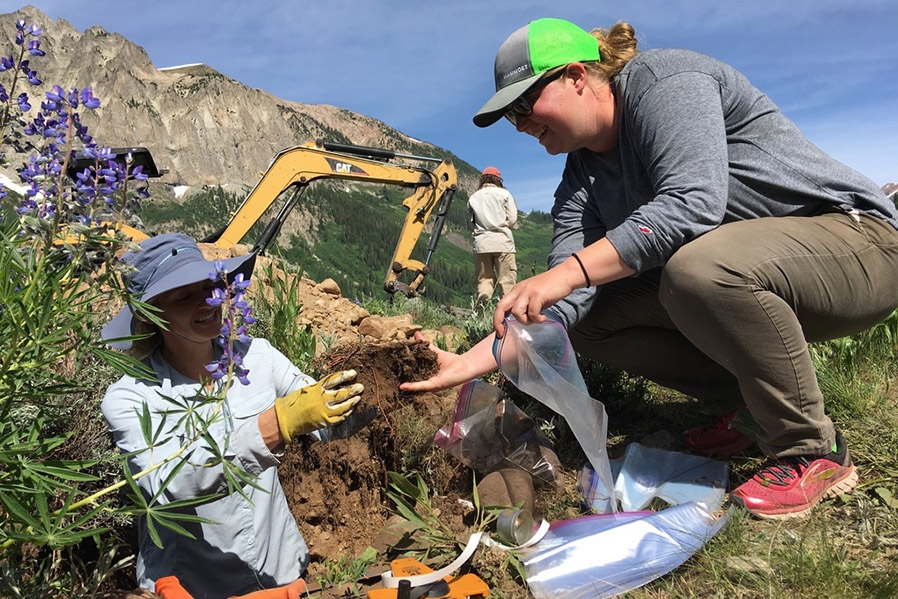
NORMAN, Okla. – In the longest-running field warming experiment of its kind, researchers have documented dramatic shifts in high-elevation mountain meadows, revealing that changes in climate alter not only the plants we can see above ground, but the invisible world of fungi and microbes in the soil below. The results, published in an article in Proceedings of the National Academy of Sciences and led by University of Oklahoma researcher Lara Souza, show that sustained warming is causing meadows to undergo “shrubification,” a transition from diverse grasslands and flowering plants to shrub-dominated landscapes, and that the ecosystem belowground is responding in kind.
“What is really exciting about these findings is that they demonstrate that not only do plant communities shift, which has been documented before, but the soils that are associated with these communities can also change,” said Souza, associate professor in OU’s School of Biological Sciences. “A lot of global change experiments haven’t been able to test or address whether soils are changing, partially because they haven’t taken place for long enough for the microbial communities or the soils to respond. The changes we’re seeing below ground are driven by the changes in the plants, and that’s why it takes time to see that happening below ground, because what is above ground has to change.”
For nearly three decades, heaters warmed experimental plots of ground year-round at the Rocky Mountain Biological Laboratory in Colorado. For most of that time, researchers documented how the meadow plant life transitioned from productive grasslands dominated by species like fescue and sunflowers to conservative shrub communities dominated by sagebrush.
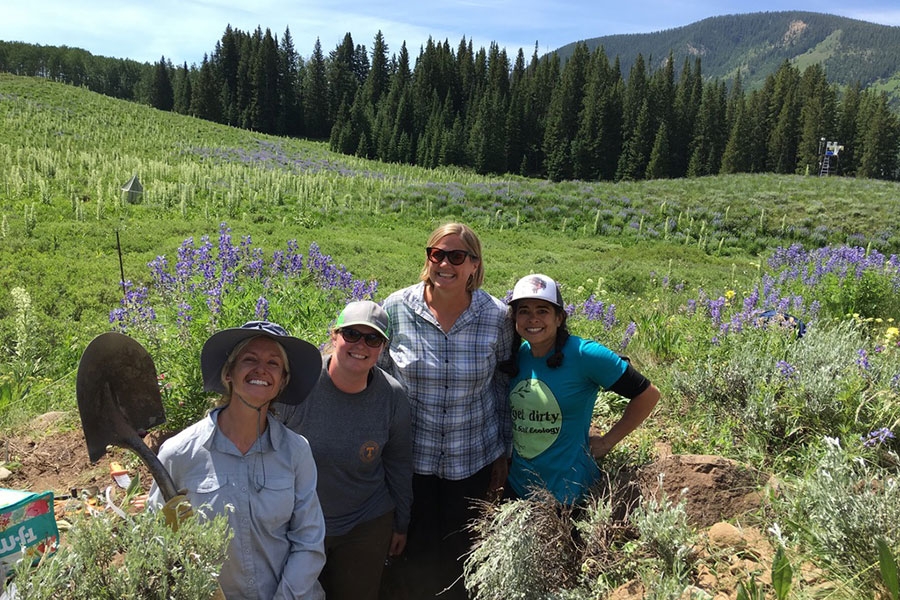
The novelty of this newly published study lies in the revelations from underground. In 2019, Souza, her co-principal investigators — Stephanie Kivlin, University of Tennessee, Knoxville; Aimée Classen, University of Michigan; and Jennifer Rudgers, University of New Mexico — and other researchers undertook a field campaign to harvest the entire site, gathering data from deeper into the ground than had been done in such a study.
At greater depths, the team discovered that the soil ecosystem is changing alongside the plants, fundamentally altering how these systems function. As the plant community shifted, so did the types of fungi associated with plant roots. In the original grassland ecosystem, plants relied heavily on mycorrhizal fungi — beneficial partners that help plants absorb water and nutrients from the soil in exchange for carbon. Under warming conditions, however, these mutualistic relationships declined dramatically, and soil saprotrophic fungi, which are involved in the decomposition of organic matter, increased.
“We’re watching mountain meadows transform in real time. As shrubs expand and plants alter their resource strategies, the balance between plants and the fungi that support them is changing, signaling a move toward slower, more conservative ecosystem functioning,” said Classen.
“We show that mycorrhizal fungi and decomposers are not reacting to environmental change the same way as plants, which can result in an unexpected loss of microorganisms under future climates,” said Kivlin. “We expected that after 29 years of warming, that mycorrhizal fungi could adjust or acclimate to the higher temperatures, but the fact is that they can’t, and that has consequences for ecosystem carbon and nutrient cycles.”
These changes alter key services that ecosystems provide, such as foraging land for wildlife. The original herbaceous meadow provided rapid nutrient cycling, meaning that plants quickly absorbed nutrients from the soil, incorporated them into their tissue and returned them to the soil when they died. By contrast, the new shrub-dominated environment operates much more slowly and conservatively. Under these new conditions, the grassland areas become drier and more arid.
“More work is necessary to determine the timeframe of when decoupling will occur and if mitigation can restore communities back to their coupled state following disturbance,” Kivlin said.
About the University of Oklahoma
Founded in 1890, the University of Oklahoma is a public research university located in Norman, Oklahoma. As the state’s flagship university, OU serves the educational, cultural, economic and health care needs of the state, region and nation. For more information about the university, visit www.ou.edu.
The University of Oklahoma has received a transformative gift from Jon and Shannon McCartney, which will name the McCartney Family Tunnel of Champions, the McCartney Family Gate of the Gaylord Family - Oklahoma Memorial Stadium and the McCartney Family Grand Lecture Hall in the Michael F. Price College of Business. The gift will also support the Inspiring Champions and the Athletic Director’s Discretionary Fund, in addition to establishing the McCartney DFW Career Trek program at Price College.
The University of Oklahoma today celebrated the opening of a new air traffic control tower at the OU Max Westheimer Airport. Standing 106 feet tall, more than double the current 52-foot facility, the new tower will modernize air traffic control operations and improve safety for pilots and students operating in the airspace.
Do I buy groceries or pay the electric bill? Should I pawn some of my belongings to afford my prescription? My child is sick, so I will have to miss work to take care of him. Those are just a few of the difficult choices that OU-Tulsa health professional students confronted during the Community Access to Resources Experience. The role-playing activity challenged students to navigate the financial, family and other pressures that can affect a person’s health and ability to follow medical advice. Held annually during the SCM Institute orientation week, the experience is designed to generate understanding and build empathy.