NEWS

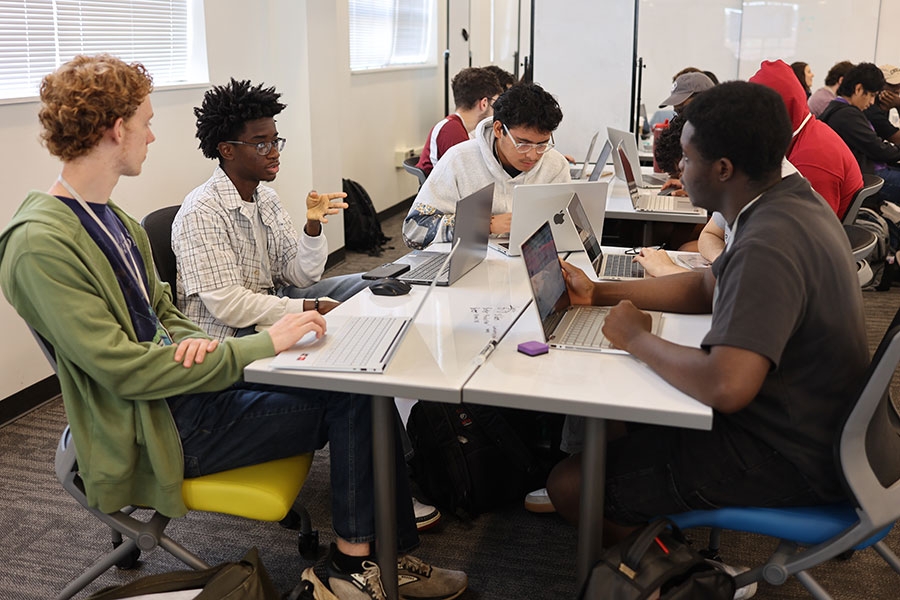
NORMAN, OKLA. – Nearly 50 high school students from three states spent four days at the University of Oklahoma exploring one of the fastest-growing fields in technology during the inaugural Artificial Intelligence Summer Camp hosted by the Gallogly College of Engineering.
The new camp, developed in partnership with the OU School of Computer Science, challenged students to move beyond learning about artificial intelligence by applying it to real-world problems. Working in small teams, participants identified challenges in healthcare, environmental sustainability, entertainment and society, then designed, built and presented AI-based solutions. Throughout the week, students also examined ethical considerations, including bias, accessibility, and responsible AI development.
“While understanding of the fundamentals of AI tools and technologies is essential, so is the innovation that can be enabled at the intersection of AI technology and societal needs,” explained Shishir Shah, Ph.D., academic director of the School of Computer Science and OU’s Chief Artificial Intelligence Officer. “Our goal was to provide a place where high-school curiosity meets real-world complexity. We created this camp with the objective of engaging participants in learning about AI through active design, to train them as interdisciplinary thinkers by tackling problems they feel passionate about, and most importantly, to establish a commitment to ethical and responsible thinking around AI and AI-based solutions.”
The four-day program welcomed 49 students representing Oklahoma, Texas and Kansas. 73% of participants were Oklahoma residents, while 24% traveled from Texas. The camp also reached students who are traditionally underrepresented in higher education, with 14% of participants identifying as prospective first-generation college students.
While the camp introduced students to engineering and computing, it also attracted participants with a wide range of career interests. 30% of students indicated they are currently considering majors outside the Gallogly College of Engineering, highlighting the program's ability to introduce artificial intelligence concepts to students from diverse academic backgrounds.
"Artificial intelligence is changing every industry, but technology alone is never the answer," said Randa Shehab, Ph.D., senior associate dean of the Gallogly College of Engineering. "Students need to understand how to ask good questions, evaluate information critically and design solutions that serve people. This camp gives them those skills while showing them what is possible through engineering and computer science."
Unlike traditional lecture-based camps, students spent the week practicing teamwork and collaboration. Teams defined a problem, researched existing technologies, developed an AI solution, and presented their work to judges and peers during the final day of the program.
“Students came into the camp with a range of experiences and skill sets and worked together to achieve awesome outcomes,” shared Sean Mackay, Ph.D., assistant professor in the School of Computer Science and faculty camp director. “Our teams built creative projects spanning environmental, healthcare, and societal good applications, with more than half delivering fully working products, including a functioning Chrome extension, web apps, and more."
Sanjana Mudduluru, Ph.D., assistant professor in the School of Computer Science and faculty camp director, said, “Beyond building AI applications, we wanted students to think critically about the impact of the technologies they create. Ethics was embedded throughout the camp, with every team expected to design AI solutions for social good that prioritized fairness, responsible data use, transparency and human well-being. We hope students leave not only with technical skills, but also with the mindset to build AI that serves people responsibly.”
The AI Summer Camp is part of the Gallogly College of Engineering's expanding K-12 outreach efforts, which provide students with opportunities to explore engineering, science and technology through hands-on experiences before they begin college. Through programs such as Engineering Days, Engineering Open House and the new AI Summer Camp, OU Engineering continues to strengthen the pathway of future innovators while helping students better understand careers in engineering and computing.
Photos can be found here: https://flic.kr/s/aHBqjD1zs7
About the University of Oklahoma
Founded in 1890, the University of Oklahoma is a public research university located in Norman, Oklahoma. As the state’s flagship university, OU serves the educational, cultural, economic and healthcare needs of the state, region and nation. For more information about the university, visit www.ou.edu.
The University of Oklahoma has received a transformative gift from Jon and Shannon McCartney, which will name the McCartney Family Tunnel of Champions, the McCartney Family Gate of the Gaylord Family - Oklahoma Memorial Stadium and the McCartney Family Grand Lecture Hall in the Michael F. Price College of Business. The gift will also support the Inspiring Champions and the Athletic Director’s Discretionary Fund, in addition to establishing the McCartney DFW Career Trek program at Price College.
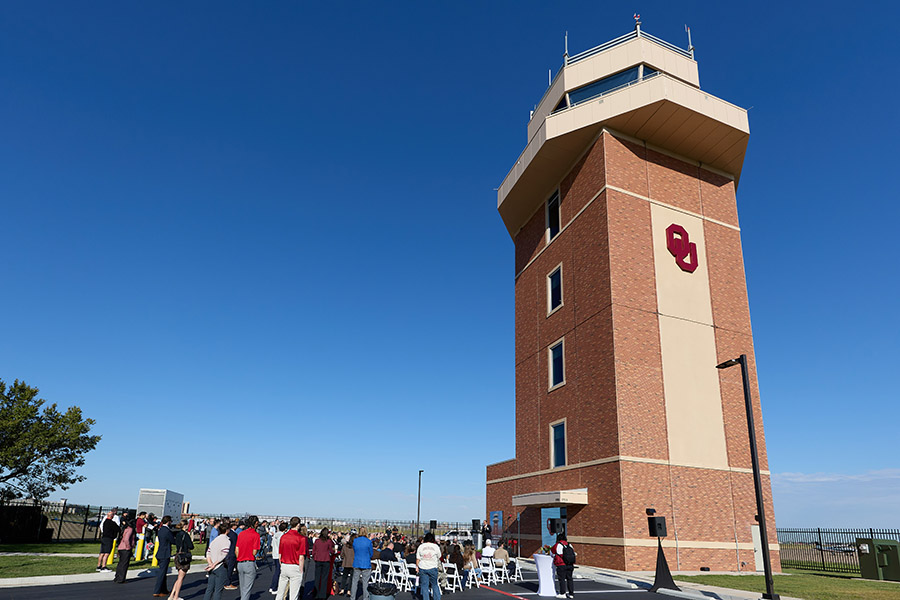
The University of Oklahoma today celebrated the opening of a new air traffic control tower at the OU Max Westheimer Airport. Standing 106 feet tall, more than double the current 52-foot facility, the new tower will modernize air traffic control operations and improve safety for pilots and students operating in the airspace.
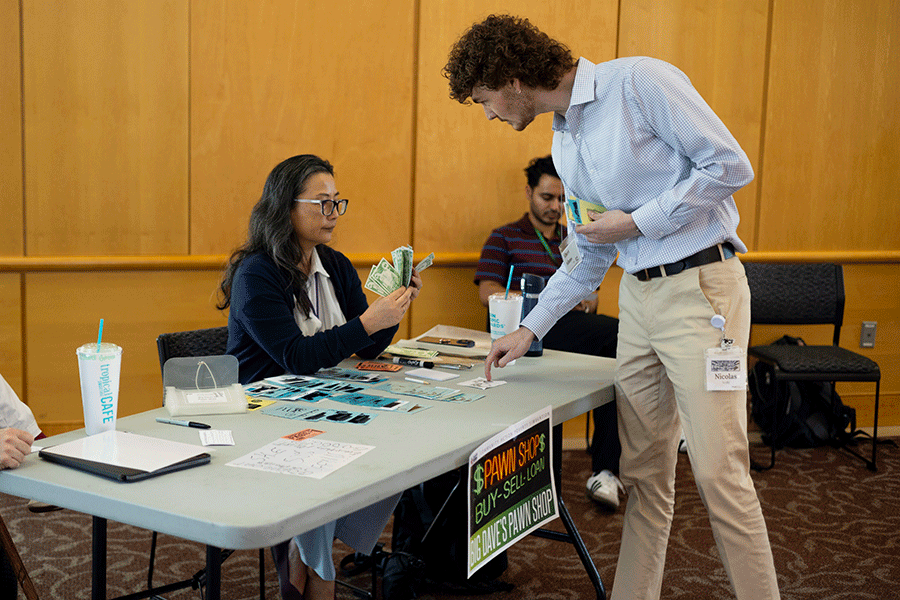
Do I buy groceries or pay the electric bill? Should I pawn some of my belongings to afford my prescription? My child is sick, so I will have to miss work to take care of him. Those are just a few of the difficult choices that OU-Tulsa health professional students confronted during the Community Access to Resources Experience. The role-playing activity challenged students to navigate the financial, family and other pressures that can affect a person’s health and ability to follow medical advice. Held annually during the SCM Institute orientation week, the experience is designed to generate understanding and build empathy.