NEWS


NORMAN, Okla. – Fresh water is essential to human life, but growing populations, economic development and changing climates have made it more difficult to maintain. A University of Oklahoma researcher is helping address this problem by creating groundbreaking models and datasets of agricultural irrigation as part of an international team simulating Earth’s water system to gather insights into how to better use and preserve it.
Yanhua Xie, an assistant professor in OU’s College of Atmospheric and Geographic Sciences, is one of four principal investigators for the Re-Analysis of Water for Society (RAWS) project. He is collaborating with experts from other academic institutions, NGOs and stakeholders to create an in-depth analysis of how terrestrial water has changed worldwide over the past 60 years.
The project is backed by a five-year, $9.5 million grant from the Schmidt Sciences’ Virtual Institute for Earth’s Water (VIEW). The funding includes support for an OU team of two postdoctoral researchers, one Ph.D. student and two undergraduates to assist Xie in the project.
To help address global water challenges, the international team aims to develop advanced tools and publicly available datasets necessary for modeling how terrestrial water flows across ecosystems, an area where current models lack sufficient spatial detail and temporal frequency. By doing so, the researchers will shed light on how humans can best manage fresh water for long-term sustainability.
“We use too much water as humans,” Xie said. “At the same time, we pollute water through different anthropogenic activities like food production and economic activities.”
The team’s outputs will include AI-assisted models of the terrestrial water system at unprecedented resolution, down to one square kilometer and updated daily. These high-resolution datasets will cover both data-rich countries like the U.S. and regions that lack significant detail.
As a geospatial data scientist, Xie is leading the project’s efforts to develop scalable geospatial AI models to produce high-resolution maps of agricultural water use and infrastructure – the largest consumer of global fresh water – over the past six decades. The datasets are expected to significantly improve the representation of human water use, especially agricultural irrigation, in global water models.
“With different irrigation technologies, water use efficiency varies significantly,” Xie explained. “Rice fields in Arkansas are usually flooded with low water use efficiency, while citrus orchards in California commonly use drip irrigation systems, which can exceed 90% efficiency.”
Xie’s research will also include talking with water managers connected to the Ogallala Aquifer, one of the world’s largest groundwater sources, which is currently being depleted. The aquifer spans eight U.S. states, including western Oklahoma.
Insights from this region, together with many other water-stressed areas such as the Central Valley in California and the Indo-Gangetic Plain in South Asia, will help refine global water models and translate their outputs into actionable tools and data products.
The team’s work will be made public to support policymakers and resource managers worldwide.
“We have very limited fresh water, and demand is increasing” Xie said. “We are forming an interdisciplinary team to inform better, more sustainable water management and policy for the future.”
About the project
“RAWS: Re-Analysis of Water for Society” is funded by a $9.5 million grant from the Schmidt Sciences’ Virtual Institute for Earth’s Water and is being led by principal investigators from Utrecht University, the University of Oklahoma, Virginia Tech and the Euro Mediterranean Center for Climate Change.
About the University of Oklahoma
Founded in 1890, the University of Oklahoma is a public research university located in Norman, Oklahoma. As the state’s flagship university, OU serves the educational, cultural, economic and health care needs of the state, region and nation. For more information about the university, visit www.ou.edu.
The University of Oklahoma has received a transformative gift from Jon and Shannon McCartney, which will name the McCartney Family Tunnel of Champions, the McCartney Family Gate of the Gaylord Family - Oklahoma Memorial Stadium and the McCartney Family Grand Lecture Hall in the Michael F. Price College of Business. The gift will also support the Inspiring Champions and the Athletic Director’s Discretionary Fund, in addition to establishing the McCartney DFW Career Trek program at Price College.
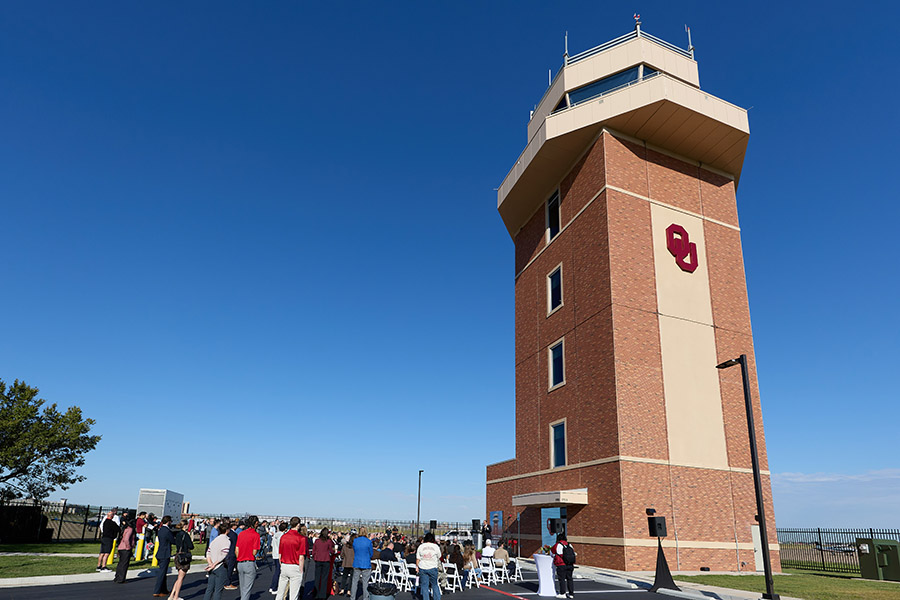
The University of Oklahoma today celebrated the opening of a new air traffic control tower at the OU Max Westheimer Airport. Standing 106 feet tall, more than double the current 52-foot facility, the new tower will modernize air traffic control operations and improve safety for pilots and students operating in the airspace.
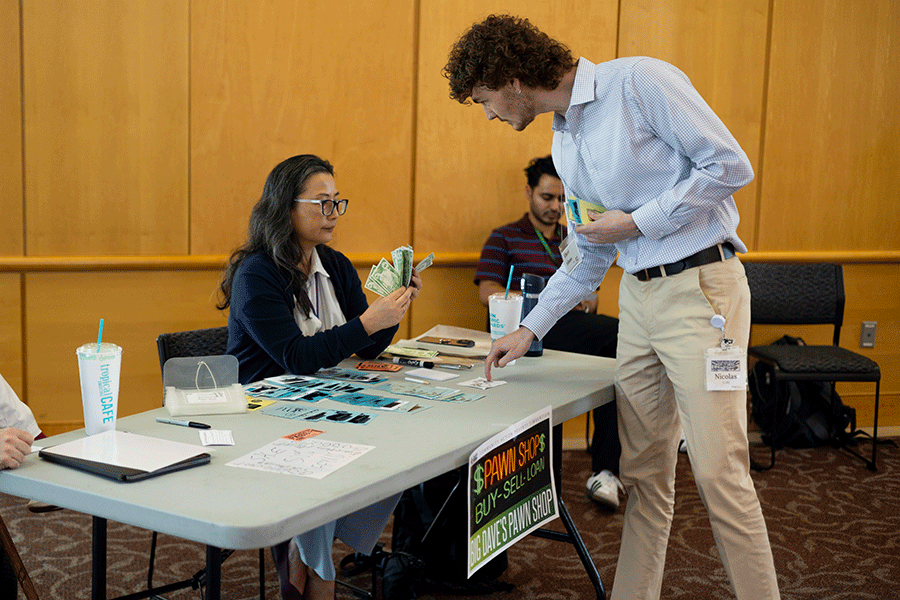
Do I buy groceries or pay the electric bill? Should I pawn some of my belongings to afford my prescription? My child is sick, so I will have to miss work to take care of him. Those are just a few of the difficult choices that OU-Tulsa health professional students confronted during the Community Access to Resources Experience. The role-playing activity challenged students to navigate the financial, family and other pressures that can affect a person’s health and ability to follow medical advice. Held annually during the SCM Institute orientation week, the experience is designed to generate understanding and build empathy.