NEWS

NORMAN, Okla. – As sports athletes and coaches work to outperform their competition, physical training becomes a key resource toward gaining tangible advantages. However, new research led by a University of Oklahoma faculty member shows that heavier training loads can hurt next-day performance, suggesting it’s critical for coaches to consider each athlete’s individual needs to maximize success.
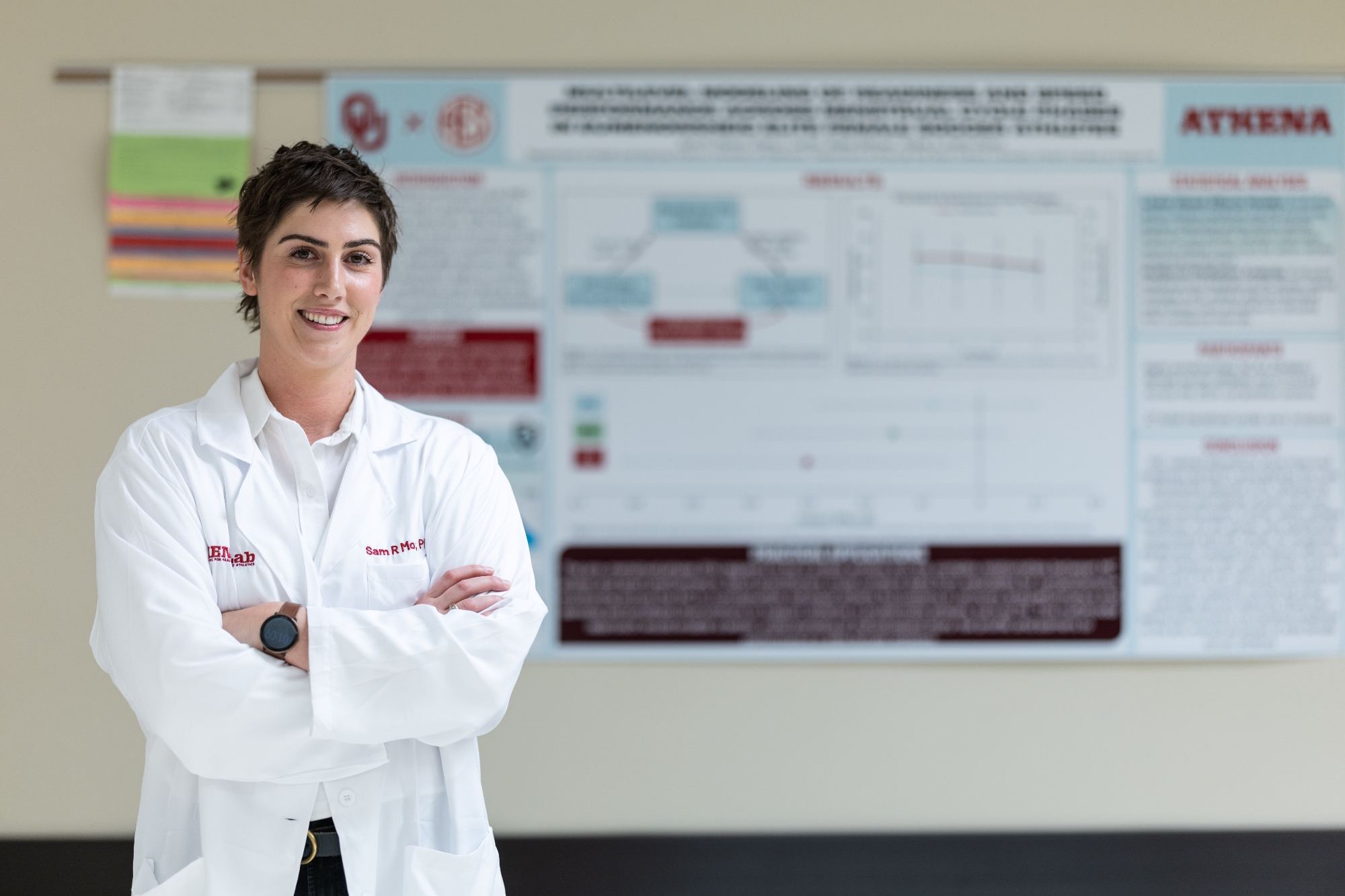
Sam Moore, Ph.D., is the lead author of the study published in the International Journal of Sports Physiology and Performance. She is an assistant professor of sports data analytics in the Department of Health and Exercise Science at OU’s Dodge Family College of Arts and Sciences, and is the director of the ATHENA Lab, which emphasizes female physiology in sport science.
A former collegiate athlete, Moore suffered a serious knee injury at the end of her freshman year that kept her sidelined for several months. During her rehabilitation, she became deeply interested in how to help others through physical recovery.
“I had just turned 18 years old, and the surgeon told me, ‘If you want to keep playing, you can, but most athletes don’t,’” Moore said. “It was my strength and conditioning coaches who gave me the opportunity to keep playing and finish out my college career.”
Her recently published study, co-authored by the University of North Carolina at Chapel Hill’s Elena Cantu, M.A., and Abbie Smith-Ryan, Ph.D., centers on an elite collegiate women’s soccer team. The researchers monitored players on the team over the course of their season to determine what effect their daily training load – the total distance they traveled and their high-speed running distance during practices and competitions – had on their recovery, maximum running speed performance and well-being the next day.
To gather data, the researchers gave the athletes wearable GPS units during training sessions and matches, and smart rings to wear while sleeping. They also sent daily wellness surveys asking about perceived fatigue, stress, mood, soreness and sleep quality.
Their findings show that, on average, the athletes had negative outcomes when their training load from the previous day was much higher than usual. That includes worse sleep recovery, lower wellness scores and slower speed performance. While the results may suggest that the higher training loads are harmful for next-day competitions, Moore noted that they can be beneficial during parts of the season when building up fitness is more important than, for example, running at a higher maximum speed.
“It's about understanding how much above an athlete’s norm does their speed begin to be impacted,” Moore said. “Then you can reverse engineer how you practice and plan training loads going into really important games.”
The study not only provides concrete data – such as that for every 100 meters of extra high-speed running, the athletes’ next-day max speed decreased by 1 kilometer per hour – but also highlights the importance of studying women within sport science. Moore said that past research shows that male and female athletes have different subjective responses to training load, and that further studies could help coaches for women’s teams improve their decision-making independent of male-focused data.
“A recent article estimated that in sports medicine research, it will take 800 years for females to be equally represented with males as subjects,” Moore said. “One of my big passions is obviously to speed that up, but also to the female athletes that we’re working with, it’s so impactful.”
Moore said that she plans to focus on the effects of creatine, including with how it affects the female body, for her upcoming research. Through that work, she aims to determine if it could be an effective intervention for women suffering from fatigue during their menstrual cycles.
“Female athletes are in college for four years, but they're going to be active women hopefully for the rest of their lives,” Moore said. “So while they're here and we have all these resources in one place, how can we educate them, inform them and empower them to understand more about their physiology and what they can do?”
About the research
The study, “Influence of Training Load on Recovery, Wellness, and Performance in Elite Soccer Athletes,” can be found in the International Journal of Sports Physiology and Performance at doi.org/10.1123/ijspp.2026-0076.
This research is available online through the support of OU Libraries’ Open-Access Research Publication Fund, which helps ensure that all open-access, peer-reviewed scholarly work produced at OU is formally published.
About the University of Oklahoma
Founded in 1890, the University of Oklahoma is a public research university located in Norman, Oklahoma. As the state’s flagship university, OU serves the educational, cultural, economic and healthcare needs of the state, region and nation. For more information about the university, visit www.ou.edu.
A team of researchers headquartered at the University of Oklahoma is taking an innovative approach toward advancing grassland conservation and management, with grant support from the the U.S. National Science Foundation. The project brings together experts and observatory sites from across the state.
Dorothy A. Rhoades, M.D., M.P.H., has been recognized for her impact on improving Native American health outcomes. She was honored by the Association of American Indian Physicians at its 54th Annual Meeting & Health Conference.
New research from the University of Oklahoma shows how unusual atmospheric conditions linked to tropical cyclones can contribute to compound extreme heat and ground-level ozone pollution, even far from the storm, increasing risks to human health.