NEWS


By
Greg Bruno
Date
Media Contact
Kat Gebauer
kathryngebauer@ou.edu
In science fiction, self-driving cars are everywhere, from futuristic highways to urban utopias.
Reality is different. Today, a privately owned self-driving Tesla starts at around $40,000 before monthly fees, while one of Waymo’s Jaguar-based robotaxis cost well into six figures.
Bringing prices down is the goal for University of Oklahoma mechanical engineering professor Bin Xu, Ph.D. After several years of trials, he’s moving fast toward his destination.
Xu’s team is developing a prototype autonomous driving system that can retrofit any consumer vehicle with about $1,000 worth of hardware. One day soon, he hopes, his low-cost technology will make self-driving a reality for anyone who wants it.
“Self-driving for all is coming, but it's slow,” said Xu, director of the OU Mobility Intelligence Lab, an innovator in self-driving affordability. “We're trying to optimize AI algorithms so they can fit into low-cost hardware and still maintain high daily driving performance without compromising safety.”
Price remains one of the biggest obstacles to widespread adoption of autonomous transit. A Waymo taxi, which operates in 11 major U.S. cities, typically costs more than a human-driven ride, like Uber or Lyft. Private car ownership is also cost prohibitive for many.
Nonetheless, experts predict large-scale adoption of privately owned self-driving cars is on the horizon. In January 2026, McKinsey reported that industry insiders expect robotaxis and fully autonomous trucking to be the first commercially viable implementations, with private vehicles coming later in the 2030s.
From his Mobility Intelligence Lab (MiLa) in Norman, Xu and a dozen young researchers are working to accelerate the timeline.
That effort starts by fitting new consumer vehicles with off-the-shelf cameras, GPS, computers and devices to perceive the surrounding environment, plan paths, follow paths and navigate to a destination. The lab’s current fleet includes four electric Nissan LEAFs, one electric Hyundai Ioniq 5, a gas-powered Lincoln MKZ, and a gas-powered Dodge Ram cargo van.
Once the vehicles are retrofitted, the team uses them to train its own self-driving algorithms, which are built on open-source software. Using a 3D replica of a small loop around their lab on the Norman campus, the researchers put the cars in drive – and sit back. A lab-based simulator connected to a Starlink satellite uplink helps monitor and supervise the vehicle operation remotely. Data from the test drives is then uploaded each evening, and the system trains on the new inputs overnight, generating an updated version of the self-driving software for the next day's test.
No bigger than a three-car garage, Xu’s lab is packed with computing hardware featuring the latest Nvidia GPUs such as RTX 5090 and Jetson AGX Thor, monitors and oversized computer screens. On a recent afternoon, the white Hyundai Ioniq was parked in the first bay, its roof loaded with sensors.
While only about five years old, the Xu’s lab is already contributing to real-world applications through federally funded OU collaborations, including three US Department of Transportation and Department of Energy federal autonomous driving-related projects, valued at more than $16 million.
For instance, they are developing a self-driving car for logistics transportation on rural and tribal roads; two self-driving cars for the city of Atoka’s public transit system; a self-driving cargo van that can carry methane leak detection equipment for use in oil and gas operations; and connected cones and phones for work zone safety.
When he’s not researching autonomous vehicles, Xu is working to expand opportunities for the next generation of engineers.
Each fall semester, he teaches a graduate-level course, Dynamics and Control for Autonomous Driving, which uses his lab’s fleet to help students gain an understanding of real-world data acquisition, code, AI and vehicle testing.
Another course is designed to teach early engineers basic automotive concepts, such as powertrains, speed, torque and emissions.
“When I arrived at OU five years ago, much of the equipment was outdated and left a huge gap between the university and industry,” Xu said. “It posed a challenge for students to adapt to the industry after graduation.”
Since then, Xu has helped equip OU’s internal combustion engine lab with gear more fitting of the era – including a chassis dynamometer, which measures a vehicle’s horsepower and torque, and a Toyota Scion IQ compact car for powertrain system testing. Xu even procured a 2025 Kawasaki Ninja 7 Hybrid, with a combination internal combustion and electric motor, that his students use to assess the latest hybrid system.
Xu acknowledges that a fully driverless future – the type depicted by science fiction – remains a distant goal, while some experiences (driving a motorcycle or a sports car, for instance) might always be better left to humans.
But his work at OU, from teaching basic automotive concepts to building self-driving cars, is contributing to a safer, more affordable future on the road.
“These are all tiny contributions to the self-driving revolution,” Xu said. “Eventually, the winner in all of this is the consumer.”
About the University of Oklahoma
Founded in 1890, the University of Oklahoma is a public research university located in Norman, Oklahoma. As the state’s flagship university, OU serves the educational, cultural, economic and healthcare needs of the state, region and nation. For more information about the university, visit www.ou.edu.
One in eight Oklahomans has type 2 diabetes, and an estimated one-third of the state’s adult population has undiagnosed prediabetes. University of Oklahoma researchers are developing a digital outreach program to help people understand their risk and connect with resources to help prevent the disease.
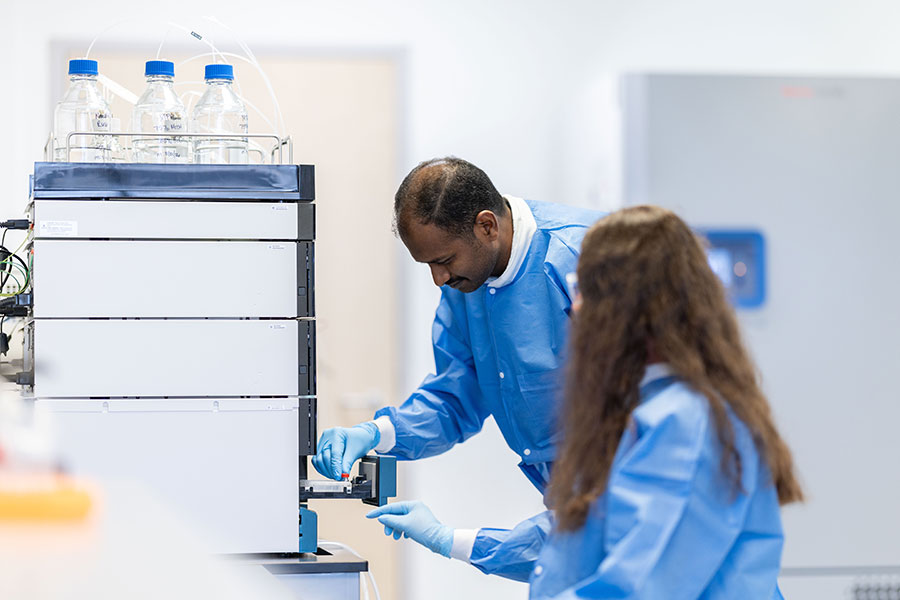
The Presbyterian Health Foundation has provided a grant for the University of Oklahoma College of Pharmacy to obtain its first liquid chromatography mass spectrometry equipment system. This acquisition expands the health campus’s ability to turn research into real-world impact.
Armed with a new five-year, $3.4 million grant from the National Institutes of Health, OU healthcare leaders are building the first chronic pain mHealth intervention app made with and for Native Americans.