NEWS

NORMAN, OKLA. – An interdisciplinary team of researchers from across the University of Oklahoma has received a $1.2 million grant from the National Science Foundation to transform how communities anticipate and mitigate risks from treefall during extreme weather events. Led by Aikaterini Kyprioti, an assistant professor from the School of Civil Engineering and Environmental Science, the project will integrate advanced technologies with local knowledge to develop solutions that directly benefit people and their communities.
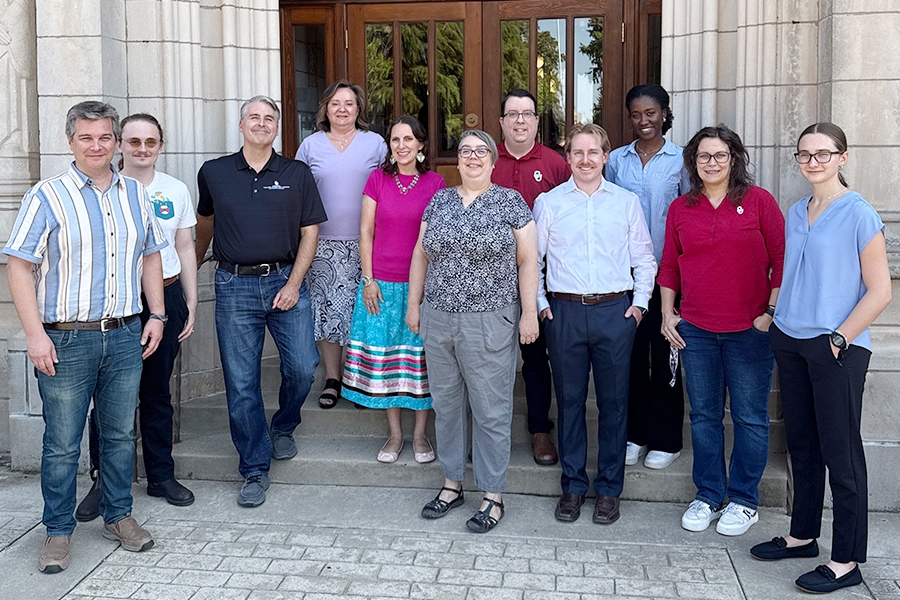
Experts in artificial intelligence, environmental science, engineering, social science and economics will be united into a convergent research enterprise led explicitly by OU researchers, including co-principal investigators Heather McCarthy (Associate Professor at the School of Biological Sciences), Andrew Fox (Research Scientist at IPPRA), Dimitrios Diochnos (Assistant Professor at the School of Computer Science) and Christopher Malloy (Assistant Professor at the Department of Economics). Along with the above, senior personnel Georgia Kosmopoulou (Professor at the Department of Economics), Gregory S. Burge (Professor at the Department of Economics) and Farina King (Associate Professor at the Department of Native American Studies) will contribute in various roles to the project.
The project’s innovation lies in its AI-driven, scalable risk assessment framework. By combining image recognition from street-view satellite imagery, fragility models that simulate how different tree species respond to stressors, and social and economic impact analyses of treefall disruptions, TREE-CARE will deliver holistic insights into treefall risks.
Kyprioti describes trees as a sort of double-edged sword: They provide essential benefits to communities, such as shade and improved air quality, but they are not without risk. “We want trees around, but in severe weather, they can cause damage and problems when it comes to emergency response. We want to create guidance that says which trees might be dangerous in a neighborhood so they can be looked at closely.”
The goal of healthy, safe trees will be supported by five coordinated research thrusts: automated hazard detection, structural and fragility modeling of tree failure, risk and impact analysis on infrastructure through economic analysis, behavioral science on public risk perception and decision-making, and policy and management guidance for local implementation.
At the heart of TREE-CARE are Oklahoma communities, some of which — including Norman, Yukon and Ponca City — will serve as testbeds for the project’s framework. By engaging emergency managers, first responders, local Indigenous tribes, local and county officials, nonprofit organizations and homeowners, TREE-CARE will build a participatory environment where solutions are designed with, not just for, communities. Annual workshops, focus groups and collaborative mapping sessions will ensure that local knowledge and traditional ecological knowledge is integrated into the technical framework. Educating the broader community, the project is set to engage children (K-12) and adults through a variety of activities involving, among others, the Science Museum of Oklahoma and the Sierra Club Oklahoma.
Kyprioti said the NSF-funded project was made possible by OU-supported work. A Junior Faculty Fellowship and seed funding from the OU Institute for Community and Society Transformation (ICAST) allowed the team to demonstrate proof-of-concept, engage with initial stakeholders and establish a research agenda.
Long-term, the framework is designed to be adaptable to other regions and hazards, ensuring that the benefits extend far beyond Oklahoma. By weaving together advanced AI, community partnerships and environmental stewardship, TREE-CARE will enable municipalities to evaluate tree conditions, prioritize management strategies, and prepare emergency responses — ultimately reducing downtime, protecting critical services, and delivering lasting scientific and technical benefits.
About the Project
“TREE-CARE: Treefall Risk Evaluation and Empowerment for Community Assessment and Resilience Enhancement” is funded by a $1,199,990.00 grant from the U.S. National Science Foundation, 2531450. It began in September 2025 and is estimated to end in August 2029.
Foundational work for the project was supported by a Junior Faculty Fellowship from the OU Vice President of Research and Partnerships and by seed funding from the OU Institute for Community and Society Transformation.
About the University of Oklahoma
Founded in 1890, the University of Oklahoma is a public research university located in Norman, Oklahoma. As the state’s flagship university, OU serves the educational, cultural, economic and health care needs of the state, region and nation. For more information about the university, visit www.ou.edu.
The University of Oklahoma College of Medicine has honored two residents with the Lloyd Rader Award, which recognizes outstanding clinical and research achievements in residency.
The University of Oklahoma will receive up to $220 million over five years from the U.S. Department of Commerce and the National Oceanic and Atmospheric Administration to continue the life-saving weather research led by the OU-NOAA Cooperative Institute for Severe and High-Impact Weather Research and Operations, extending a nearly 50-year partnership that has helped give Americans earlier, more accurate weather warnings
The OU Food Pantry won the annual Red River Food Fight, collecting 31,815.9 pounds of shelf-stable food and drinks to top UT Outpost’s 22,567 pounds. OU has won the competition four years in a row.