NEWS


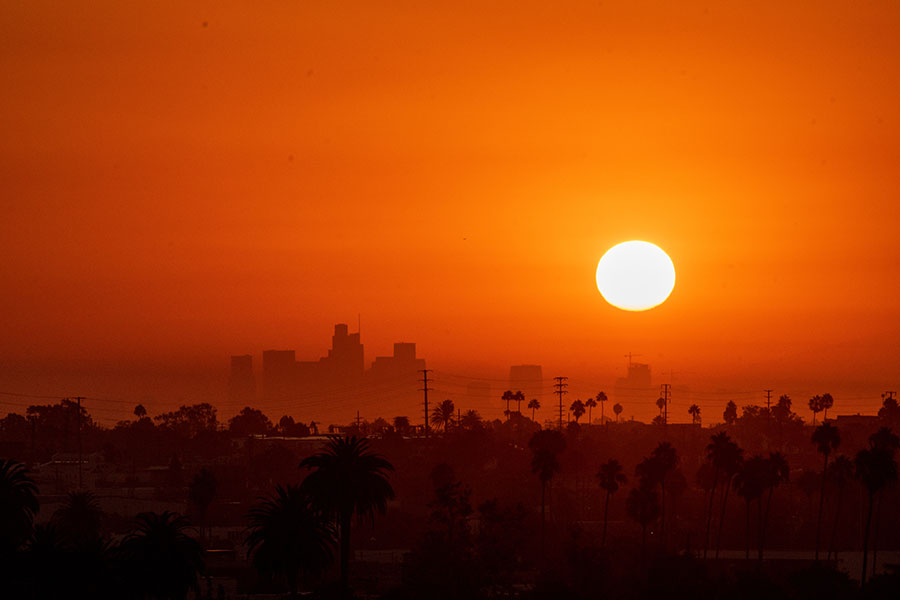
NORMAN, OKLA. – U.S. cities are facing a growing threat that goes beyond hot weather or hazy air. New research from the University of Oklahoma reveals that “compound events” — periods when heat wave conditions coincide with high air pollution levels — are becoming more frequent and intense in urban areas across the United States.
According to the National Weather Service, extreme heat is the deadliest weather phenomenon facing the country, causing more deaths each year than any other weather hazard. Chenghao Wang, Ph.D., a professor in the School of Meteorology and the Department of Geography and Environmental Sustainability at OU, received a NASA Early Career Investigator award last year to study the combination of extreme heat and air pollution in urban environments. Findings for Wang and his Sustainable Urban Futures (SURF) Lab, published in sister studies focusing on separate pollution sources, reveal a country dealing with increasing heat stress and pollution, posing a significant threat to public health and urban sustainability.
“Compound heat and air pollution episodes occur when extreme heat and high levels of pollution happen at the same time. They are an increasing threat to public health, especially for urban populations,” said Wang.
Overall, Wang and his team have found that U.S. cities are facing more frequent and intense overlaps of extreme heat with harmful air pollutants than surrounding rural areas. Results published in Urban Climate focused specifically on compound heat and ozone pollution. The study showed that while urban heat waves were more frequent, intense and longer-lasting than their rural counterparts, ozone levels were higher in rural environments. When heat and ozone events did occur together, 88.8% of cities saw higher cumulative heat and ozone intensities than rural areas.
In the other study, published in Environmental Research, Wang and his team examined 23 years of heat and fine particulate matter pollution data, a span that gives them a broad look at trends that shorter-term studies could miss.
“Fine particulate matter, or PM2.5, is small enough in size that it can penetrate deep into the respiratory system and enter the bloodstream, and exposure is associated with adverse health outcomes such as respiratory infections and cardiovascular diseases,” said Jessica Leffel, an MS student in the School of Meteorology and SURF Lab, and the lead author of this work.
When heat waves and PM2.5 episodes occurred together, nearly 98% of cities experienced more frequent and intense compound events, and more than half faced longer durations.
The spatial patterns closely matched those of PM2.5 episodes, suggesting that air pollution plays a dominant role in driving these overlaps. PM2.5 pollution and compound event days have increased in recent years in the western U.S., driven in part by wildfire smoke.
“Wildfire-related PM2.5 is often excluded from air quality assessments under the EPA’s Exceptional Events Rule, which can hide the true health burden of these episodes,” said Leffel. “Integrating wildfire-related PM2.5 into air quality evaluations could better align policy with public health risks.”
A key driver of these dangerous compound events is the urban heat island effect, a phenomenon where cities are warmer than the surrounding rural areas due to factors such as impervious surfaces, fewer trees and dense building structures that trap heat. While rural regions cool down at night, cities stay hot long after sunset as pavement and buildings continue radiating stored heat.
Equally important, elevated pollution emissions from transportation, industry and energy use in cities exacerbate air quality challenges, creating conditions where heat and pollutants interact to intensify health risks.
Because of such differences in environment, fighting this problem will require specific, regionalized strategies that take into account the local factors surrounding compound events. City-specific changes could include urban trees, green roofs or reflective materials. Still, in rural areas where high amounts of pavement are not a contributing factor in compound events, different types of mitigation strategies and policy protections are necessary.
Earlier work that contributed to this PM2.5 paper was conducted with support from the National Weather Center's Research Experiences for Undergraduates (REU) program, which pairs undergraduate students with research mentors to tackle pressing questions in meteorology, climate, and environmental sustainability. The NSF-funded program helps train the next generation of scientists to address complex challenges like urban heat and air quality.
About the research
“Compound heat and ozone pollution in the urban environment” is published in Urban Climate at doi.org/10.1016/j.uclim.2025.102511. “Cities as hotspots of compound heat and fine particulate matter pollution: A 23-year urban–rural comparison across the United States” is published in Environmental Research at doi.org/10.1016/j.envres.2025.122508.
About the University of Oklahoma
Founded in 1890, the University of Oklahoma is a public research university located in Norman, Oklahoma. As the state’s flagship university, OU serves the educational, cultural, economic and health care needs of the state, region and nation. For more information about the university, visit www.ou.edu.
A team of researchers headquartered at the University of Oklahoma is taking an innovative approach toward advancing grassland conservation and management, with grant support from the the U.S. National Science Foundation. The project brings together experts and observatory sites from across the state.
Dorothy A. Rhoades, M.D., M.P.H., has been recognized for her impact on improving Native American health outcomes. She was honored by the Association of American Indian Physicians at its 54th Annual Meeting & Health Conference.
New research from the University of Oklahoma shows how unusual atmospheric conditions linked to tropical cyclones can contribute to compound extreme heat and ground-level ozone pollution, even far from the storm, increasing risks to human health.